


Completed


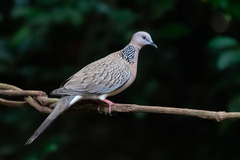

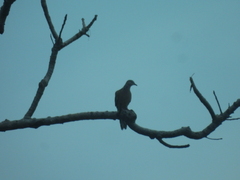
Pearl-necked Dove
Spilopelia chinensis
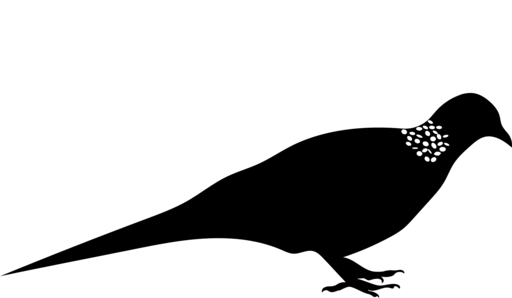
Silhouette: Jun Mencius · PhyloPic
- KingdomAnimalia (Animals)
- PhylumChordata (Chordates)
- ClassAves (Birds)
- OrderColumbiformes (Pigeons and Doves)
- FamilyColumbidae (Pigeons and Doves)
- GenusSpilopelia (Laughing and Spotted Doves)
- SpeciesSpilopelia chinensis (Pearl-necked Dove)
394 Verified sightings at Hajipur
39,753 In all 56 parks From 2019 to 2026
July Best month
☀️ Diurnal When it's spotted
About the Pearl-necked Dove
The spotted dove or eastern spotted dove (Spilopelia chinensis) is a small and somewhat long-tailed pigeon that is a common resident breeding bird across its native range on the Indian subcontinent and in East and Southeast Asia. The species has been introduced to many parts of the world and feral populations have become established.
This species was formerly included in the genus Streptopelia with other turtle-doves, but studies suggest that they differ from typical members of that genus. This dove is long tailed buff brown with a white-spotted black collar patch on the back and sides of the neck. The tail tips are white and the wing coverts have light buff spots.
There are considerable plumage variations across populations within its wide range. The species is found in light forests and gardens as well as in urban areas. They fly from the ground with an explosive flutter and will sometimes glide down to a perch. It is also called the mountain dove, pearl-necked dove, lace-necked dove, and spotted turtle-dove.
The spotted dove was formally described in 1786 by the Austrian naturalist Giovanni Antonio Scopoli and given the binomial name Columba chinensis. Scopoli based... Wikipedia →
Recent sightings of Pearl-necked Dove in Hajipur
LIVEiNaturalistGlobal Distribution
Parks Where Found
Zoos & Centres Where Found
| # | Zoo / Centre | Country | |
|---|---|---|---|
| 1 | Prague Zoo | 🇨🇿 Czechia | |
| 2 | Ostrava Zoo | 🇨🇿 Czechia | |
| 3 | Zoo Pilsen | 🇨🇿 Czechia | |
| 4 | Zoo Miami | 🇺🇸 United States | |
| 5 | Beijing Wildlife Park | 🇨🇳 China | |
| 6 | Shanghai Wild Animal Park | 🇨🇳 China | |
| 7 | Kadoorie Farm and Botanic Garden | 🇭🇰 Hong Kong SAR China | |
| 8 | Kunming Zoo | 🇨🇳 China | |
| 9 | Melbourne Zoo | 🇦🇺 Australia | |
| 10 | Philadelphia Zoo | 🇺🇸 United States | |
| 11 | Kuala Lumpur Bird Park | 🇲🇾 Malaysia | |
| 12 | Tamworth Marsupial Park & Adventure Playground | 🇦🇺 Australia | |
| 13 | The Living Planet Aquarium | 🇺🇸 United States | |
| 14 | Hong Kong Zoological and Botanical Gardens | 🇨🇳 China | |
| 15 | Birds of Eden | 🇿🇦 South Africa | |
| 16 | Ipswich Nature Centre | 🇦🇺 Australia | |
| 17 | Hertenkamp De Roedel | 🇳🇱 Netherlands | |
| 18 | Peacock Garden | 🇨🇳 China | |
| 19 | Edward Youde Aviary | 🇭🇰 Hong Kong SAR China | |
| 20 | Rákosův pavilon | 🇨🇿 Czechia | |
| 21 | Velemlokárium | 🇨🇿 Czechia | |
| 22 | Ocean Park Hong Kong | 🇨🇳 China |
Closest Relatives at Hajipur





Before you go
What are the chances of seeing a Pearl-necked Dove in Hajipur?
Very likely
Over 90% of wildlife watchers report a Pearl-necked Dove sighting in Hajipur on a given day, based on 394 verified sightings from GBIF citizen-science data. It is the most-seen of the 43 birds we can rate there.
When is the best time to see a Pearl-necked Dove in Hajipur?
March–May and July–November
In those months over 90% of wildlife watchers report a Pearl-necked Dove in Hajipur on a given day, against about 50% in February, the lowest month. January has too few records to rate.
What time of day is best to see a Pearl-necked Dove?
Between 3 and 6 pm
Across all the parks we cover, that three-hour window holds the most Pearl-necked Dove sightings with a recorded time, and about 9 in 10 of them come between 6 am and 6 pm: it is a daytime animal.
Is Hajipur the best place to see a Pearl-necked Dove?
Yes
Of the 139 cities where we can rate Pearl-necked Dove sightings, Hajipur has the highest daily chance: over 90%. Next come Suzhou (China, about 90%) and Visakhapatnam (India, about 90%).
Where does the Pearl-necked Dove sighting chance come from?
GBIF citizen-science records
It is estimated from how often the Pearl-necked Dove is recorded against all the birds logged in Hajipur (394 verified sightings), calibrated against known sighting rates. Figures are rounded to the nearest 10% because citizen-science data supports honest approximations, not decimals, and months with records from fewer than five people show "—". How it works.
