Brown Shrike

Brown Shrike

Lanius cristatus

Silhouette: Andy Wilson · PhyloPic

LCLeast ConcernNTVUENCR
Daily sighting probability ~10% · With luck
at Bandhavgarh National Park

In 3 days ~30% in a week ~60%

156 Verified sightings at Bandhavgarh National Park From 2019 to 2026
6,640 In all 37 parks
February Best month
☀️ Diurnal When it's spotted

About the Brown Shrike

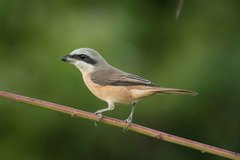
The brown shrike (Lanius cristatus) is a bird in the shrike family that is found mainly in Asia. It is closely related to the red-backed shrike (L. collurio) and isabelline shrike (L. isabellinus). The genus name, Lanius, is derived from the Latin word for "butcher", and some shrikes are also known as "butcher birds" because of their feeding habits. The specific cristatus is Latin for "crested", used in a broader sense than in English. The common English name "shrike" is from Old English scríc, "shriek", referring to the shrill call.

Like most other shrikes, it has a distinctive black "bandit-mask" through the eye and is found mainly in open scrub habitats, where it perches on the tops of thorny bushes in search of prey. Several populations of this widespread species form distinctive subspecies which breed in temperate Asia and migrate to their winter quarters in tropical Asia. They are sometimes found as vagrants in Europe and North America.

In 1747 the English naturalist George Edwards included an illustration and a description of the brown shrike in the second volume of his A Natural History of Uncommon Birds. He used the English name "The Crested Red, or Russit Butcher... Wikipedia →

Sounds

Call0:18

China · 2026

© Bo Shunqi 薄顺奇 · XC1175009 · CC BY-NC-SA 4.0

Begging call0:25

Mongolia · 2025

© Ding Li Yong · XC1027249 · CC BY-NC-ND 4.0

Alarm call0:26

China · 2023

© Dave GUO · XC890806 · CC BY-NC-SA 4.0

Global Distribution

Parks Where Found

# Park Country Daily sighting probability
1 Udawalawe National Park 🇱🇰 Sri Lanka
~50%
2 Yala National Park 🇱🇰 Sri Lanka
~50%
3 Wilpattu National Park 🇱🇰 Sri Lanka
~30%
4 Eravikulam National Park 🇮🇳 India
~30%
5 Sinharaja Forest Reserve 🇱🇰 Sri Lanka
~30%
6 Periyar National Park 🇮🇳 India
~30%
7 Minneriya National Park 🇱🇰 Sri Lanka
~20%
8 Horton Plains National Park 🇱🇰 Sri Lanka
~20%
9 Khao Yai National Park 🇹🇭 Thailand
~20%
10 Mudumalai National Park 🇮🇳 India
~20%
11 Kanha National Park 🇮🇳 India
~20%
12 Gobi Gurvansaikhan National Park 🇲🇳 Mongolia
~10%
13 Manas National Park 🇮🇳 India
~10%
14 Nagarhole National Park 🇮🇳 India
~10%
15 Kaziranga National Park 🇮🇳 India
~10%
16 Cat Tien National Park 🇻🇳 Vietnam
~10%
17 Bandhavgarh National Park 🇮🇳 India
~10%
18 Kaeng Krachan National Park 🇹🇭 Thailand
~10%
19 Khao Sok National Park 🇹🇭 Thailand
~10%
20 Bandipur National Park 🇮🇳 India
~10%
21 Sundarbans National Park 🇮🇳 India
~10%
22 Doi Inthanon National Park 🇹🇭 Thailand
~10%
23 Cuc Phuong National Park 🇻🇳 Vietnam
~10%
24 Chitwan National Park 🇳🇵 Nepal
~10%
25 Keoladeo National Park 🇮🇳 India
~10%
26 Royal Bardia National Park 🇳🇵 Nepal
~10%
27 Way Kambas National Park 🇮🇩 Indonesia
<5%
28 Royal Manas National Park 🇧🇹 Bhutan
<5%
29 Khao Luang National Park 🇹🇭 Thailand
<5%
30 Satpura National Park 🇮🇳 India
<5%
31 Taroko National Park 🇹🇼 Taiwan
<5%
32 Gunung Leuser National Park 🇮🇩 Indonesia
<5%
33 Taman Negara National Park 🇲🇾 Malaysia
<5%
34 Namdapha National Park 🇮🇳 India
<5%
35 Jim Corbett National Park 🇮🇳 India
<5%
36 Danum Valley Conservation Area 🇲🇾 Malaysia
<5%
37 Sepilok 🇲🇾 Malaysia
<5%

Cities Where Found

# City Country Daily sighting probability
1 Manila 🇵🇭 Philippines
~60%
2 Kaohsiung 🇹🇼 Taiwan
~50%
3 Davao City 🇵🇭 Philippines
~50%
4 Cebu City 🇵🇭 Philippines
~50%
5 Taichung 🇹🇼 Taiwan
~40%
6 Tainan 🇹🇼 Taiwan
~30%
7 Asansol 🇮🇳 India
~30%
8 Angeles 🇵🇭 Philippines
~30%
9 Tamluk 🇮🇳 India
~30%
10 Phnom Penh 🇰🇭 Cambodia
~20%

Before you go

What are the chances of seeing a Brown Shrike in Bandhavgarh National Park?

With luck

About 10% of wildlife watchers report a Brown Shrike sighting in Bandhavgarh National Park on a given day, based on 156 verified sightings from GBIF citizen-science data from 2019 to 2026. It is the 98th most-seen of the 241 birds we can rate there. Over three days the chance rises to about 30%, and over a week to about 60%, if each day is a fresh chance.

When is the best time to see a Brown Shrike in Bandhavgarh National Park?

February

In that month about 30% of wildlife watchers report a Brown Shrike in Bandhavgarh National Park on a given day, against under 5% in April–June and September–October, the lowest months. That is one of Bandhavgarh National Park's driest months, with about 15 mm of rain against 400 mm in August.

What time of day is best to see a Brown Shrike?

Between 7 and 10 am

Across all the parks we cover, that three-hour window holds the most Brown Shrike sightings with a recorded time, and about 9 in 10 of them come between 6 am and 6 pm: it is a daytime animal.

Where does the Brown Shrike sighting chance come from?

GBIF citizen-science records

It is estimated from how often the Brown Shrike is recorded against all the birds logged in Bandhavgarh National Park (156 verified sightings from 2019 to 2026), calibrated against known sighting rates. Figures are rounded to the nearest 10% because citizen-science data supports honest approximations, not decimals, and months with records from fewer than five people show "—". How it works.

← Back to Bandhavgarh National Park