Stork-billed Kingfisher

Stork-billed Kingfisher

Pelargopsis capensis

Silhouette: Steven Traver · PhyloPic

LCLeast ConcernNTVUENCR
Daily sighting probability ~10% · With luck
at Cat Tien National Park

In 3 days ~20% in a week ~50%

127 Verified sightings at Cat Tien National Park From 2019 to 2026
8,230 In all 33 parks
June Best month
🌅 Crepuscular When it's spotted

About the Stork-billed Kingfisher

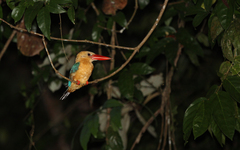
The stork-billed kingfisher (Pelargopsis capensis), is a tree kingfisher which is widely but sparsely distributed in the tropical Indian subcontinent and Southeast Asia, from India to Indonesia. These kingfishers are large and have a heavy bill. The head is brown and the chin is paler coloured. The sexes are similar in coloration. This is found mostly in streams and ponds in lowland areas with tree cover. This kingfisher is sendentary throughout its range.

The first formal description of the stork-billed kingfisher was by the Swedish naturalist Carl Linnaeus in 1766 in the 12th edition of his Systema Naturae. He coined the binomial name Alcedo capensis. Linnaeus based his description on Mathurin Jacques Brisson's "Le martin-pescheur du Cap de Bonne Espérance". Brisson believed his specimen had come from the Cape of Good Hope region of South Africa. The species does not occur in Africa and it was suggested that the specimen had been obtained on the Indonesian island of Java. The specimen is now known to have come from near Chandannagar in West Bengal, India. Linnaeus's specific epithet capensis denotes the Cape of Good Hope. The current genus Pelargopsis was introduced... Wikipedia →

Sounds

Song0:17

Vietnam · 2026

© Ding Li Yong · XC1107123 · CC BY-NC-ND 4.0

Call0:12

Malaysia · 2023

© Lim Ying Hien · XC815132 · CC BY-NC-ND 4.0

Flight call0:15

India · 2021

© Akash M J · XC671715 · CC BY-NC-SA 4.0

Global Distribution

Parks Where Found

# Park Country Daily sighting probability
1 Tanjung Puting National Park 🇮🇩 Indonesia
~80%
2 Kinabatangan Wildlife Sanctuary 🇲🇾 Malaysia
~70%
3 Royal Bardia National Park 🇳🇵 Nepal
~40%
4 Kaziranga National Park 🇮🇳 India
~40%
5 Wilpattu National Park 🇱🇰 Sri Lanka
~30%
6 Chitwan National Park 🇳🇵 Nepal
~30%
7 Way Kambas National Park 🇮🇩 Indonesia
~30%
8 Jim Corbett National Park 🇮🇳 India
~20%
9 Minneriya National Park 🇱🇰 Sri Lanka
~20%
10 Sepilok 🇲🇾 Malaysia
~20%
11 Manas National Park 🇮🇳 India
~20%
12 Taman Negara National Park 🇲🇾 Malaysia
~20%
13 Ranthambore National Park 🇮🇳 India
~20%
14 Gunung Leuser National Park 🇮🇩 Indonesia
~10%
15 Satpura National Park 🇮🇳 India
~10%
16 Periyar National Park 🇮🇳 India
~10%
17 Danum Valley Conservation Area 🇲🇾 Malaysia
~10%
18 Yala National Park 🇱🇰 Sri Lanka
~10%
19 Bandhavgarh National Park 🇮🇳 India
~10%
20 Kanha National Park 🇮🇳 India
~10%
21 Cat Tien National Park 🇻🇳 Vietnam
~10%
22 Bako National Park 🇲🇾 Malaysia
~10%
23 Udawalawe National Park 🇱🇰 Sri Lanka
~10%
24 Khao Sok National Park 🇹🇭 Thailand
~10%
25 Sundarbans National Park 🇮🇳 India
~10%
26 Sinharaja Forest Reserve 🇱🇰 Sri Lanka
~10%
27 Mudumalai National Park 🇮🇳 India
<5%
28 Bandipur National Park 🇮🇳 India
<5%
29 Nagarhole National Park 🇮🇳 India
<5%
30 Khao Yai National Park 🇹🇭 Thailand
<5%
31 Bali Barat National Park 🇮🇩 Indonesia
<5%
32 Kaeng Krachan National Park 🇹🇭 Thailand
<5%
33 Keoladeo National Park 🇮🇳 India
<5%

Cities Where Found

# City Country Daily sighting probability
1 Tamluk 🇮🇳 India
~40%
2 Savar 🇧🇩 Bangladesh
~30%
3 Ponnani 🇮🇳 India
~30%
4 Kochi 🇮🇳 India
~30%
5 Asansol 🇮🇳 India
~20%
6 Kollam 🇮🇳 India
~20%
7 Chattogram 🇧🇩 Bangladesh
~20%
8 Kolkata 🇮🇳 India
~20%
9 Dhaka 🇧🇩 Bangladesh
~20%
10 Thrissur 🇮🇳 India
~20%

Before you go

What are the chances of seeing a Stork-billed Kingfisher in Cat Tien National Park?

With luck

About 10% of wildlife watchers report a Stork-billed Kingfisher sighting in Cat Tien National Park on a given day, based on 127 verified sightings from GBIF citizen-science data from 2019 to 2026. It is the 134th most-seen of the 244 birds we can rate there. Over three days the chance rises to about 20%, and over a week to about 50%, if each day is a fresh chance.

When is the best time to see a Stork-billed Kingfisher in Cat Tien National Park?

June

In that month about 20% of wildlife watchers report a Stork-billed Kingfisher in Cat Tien National Park on a given day, against under 5% in September, the lowest month. That is one of Cat Tien National Park's wettest months, with about 340 mm of rain against 15 mm in February.

What time of day is best to see a Stork-billed Kingfisher?

Between 2 and 5 am

Across all the parks we cover, that three-hour window holds the most Stork-billed Kingfisher sightings with a recorded time, and about half of them come between 6 pm and 6 am: it is most active around dawn and dusk.

Which relatives of the Stork-billed Kingfisher live in Cat Tien National Park?

Same family: Alcedinidae

The closest relatives of the Stork-billed Kingfisher that you can see in Cat Tien National Park (family Alcedinidae, Kingfishers) are White-throated Kingfisher (about 50%), Banded Kingfisher (about 20%) and Common Kingfisher (about 10%), with each one's daily chance of a sighting.

Where does the Stork-billed Kingfisher sighting chance come from?

GBIF citizen-science records

It is estimated from how often the Stork-billed Kingfisher is recorded against all the birds logged in Cat Tien National Park (127 verified sightings from 2019 to 2026), calibrated against known sighting rates. Figures are rounded to the nearest 10% because citizen-science data supports honest approximations, not decimals, and months with records from fewer than five people show "—". How it works.

← Back to Cat Tien National Park