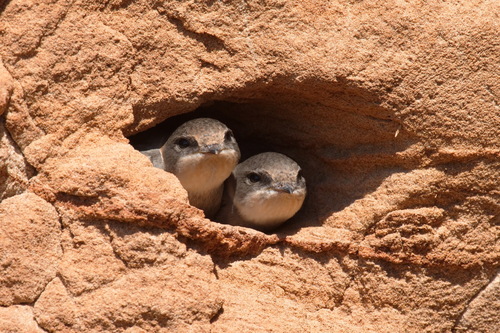
Tree Swallow

Tree Swallow

Tachycineta bicolor

Silhouette: Andy Wilson · PhyloPic

LCLeast ConcernNTVUENCR
Daily sighting probability ~10% · With luck
at Baltimore

In 3 days ~30% in a week ~50%

1,161 Verified sightings at Baltimore
35,065 In all 56 parks From 2019 to 2026
May Best month
☀️ Diurnal When it's spotted

About the Tree Swallow

The tree swallow (Tachycineta bicolor) is a migratory bird of the family Hirundinidae. Found in the Americas, the tree swallow was first described in 1807 by French ornithologist Louis Vieillot as Hirundo bicolor. It has since been moved to its current genus, Tachycineta, within which its phylogenetic placement is debated. The tree swallow has glossy blue-green upperparts, with the exception of the blackish wings and tail, and white underparts. The bill is black, the eyes dark brown, and the legs and feet pale brown. The female is generally duller than the male, and the first-year female has mostly brown upperparts, with some blue feathers. Juveniles have brown upperparts, and gray-brown-washed breasts. The tree swallow breeds in the US and Canada. It winters along southern US coasts south, along the Gulf Coast, to Panama and the northwestern coast of South America, and in the West Indies.

The tree swallow nests either in isolated pairs or loose groups, in both natural and artificial cavities. Breeding can start as soon as early May, although this date is occurring earlier because of climate change, and it can end as late as July. This bird is generally socially monogamous (although about 8% of males are polygynous), with high levels of extra-pair paternity. This can benefit the male, but since the female controls copulation, the lack of resolution on how this behavior benefits females makes the high level of extra-pair paternity puzzling. The female incubates the clutch of two to eight (but usually four to seven) pure white eggs for around 14 to 15 days. The chicks hatch slightly asynchronously, allowing the female to prioritize which chicks to feed in times of food shortage. They generally fledge about 18 to 22 days after hatching. The tree swallow is sometimes considered a model organism, due to the large amount of research done on it.

An aerial insectivore, the tree swallow forages both alone and in groups, eating mostly insects, in addition to mollusks, spiders, and fruit. The nestlings, like the adult, primarily eat insects, fed to it by both sexes. This swallow is vulnerable to parasites, but, when on nestlings, these do little damage. The effect of disease can become stronger as a tree swallow gets older, as some parts of the immune system decline with age. Acquired T cell-mediated immunity, for example, decreases with age, whereas both innate and acquired humoral immunity do not. Because of its large range and stable population, the tree swallow is considered to be least concern by the International Union for Conservation of Nature. Wikipedia →

Sounds

Call0:15

United States · 2022

© AUDEVARD Aurélien · XC1045720 · CC BY-NC-SA 4.0

Alarm call0:11

United States · 2009

© Paul Driver · XC781096 · CC BY-NC-SA 4.0

Flight call0:16

United States · 2021

© Paul Marvin · XC634796 · CC BY-NC-SA 4.0

Global Distribution

Parks Where Found

# Park Country Daily sighting probability
1 Point Pelee National Park 🇨🇦 Canada
~70%
2 Katmai National Park 🇺🇸 United States
~40%
3 Kluane National Park 🇨🇦 Canada
~30%
4 Yellowstone National Park 🇺🇸 United States
~30%
5 Glacier National Park 🇺🇸 United States
~30%
6 Elk Island National Park 🇨🇦 Canada
~30%
7 Grand Teton National Park 🇺🇸 United States
~30%
8 Everglades National Park 🇺🇸 United States
~30%
9 Gros Morne National Park 🇨🇦 Canada
~30%
10 Merritt Island National Wildlife Refuge 🇺🇸 United States
~30%
11 Wrangell-St. Elias National Park 🇺🇸 United States
~30%
12 Channel Islands National Park 🇺🇸 United States
~30%
13 Big Cypress National Preserve 🇺🇸 United States
~20%
14 Riding Mountain National Park 🇨🇦 Canada
~20%
15 Rocky Mountain National Park 🇺🇸 United States
~20%
16 Great Smoky Mountains National Park 🇺🇸 United States
~10%
17 Redwood National Park 🇺🇸 United States
~10%
18 Lago de Yojoa 🇭🇳 Honduras
~10%
19 Badlands National Park 🇺🇸 United States
~10%
20 Death Valley National Park 🇺🇸 United States
~10%
21 Shenandoah National Park 🇺🇸 United States
~10%
22 Ciénaga de Zapata 🇨🇺 Cuba
~10%
23 Banff National Park 🇨🇦 Canada
~10%
24 Acadia National Park 🇺🇸 United States
~10%
25 Great Bear Rainforest 🇨🇦 Canada
~10%
26 Jasper National Park 🇨🇦 Canada
~10%
27 Denali National Park 🇺🇸 United States
~10%
28 Cape Breton Highlands National Park 🇨🇦 Canada
~10%
29 Ría Lagartos Biosphere Reserve 🇲🇽 Mexico
~10%
30 Celestún Biosphere Reserve 🇲🇽 Mexico
<5%
31 Padre Island National Seashore 🇺🇸 United States
<5%
32 Kenai Fjords National Park 🇺🇸 United States
<5%
33 Cerro Azul Meámbar National Park 🇭🇳 Honduras
<5%
34 San Lorenzo Protected Forest 🇵🇦 Panama
<5%
35 Voyageurs National Park 🇺🇸 United States
<5%
36 El Vizcaíno Biosphere Reserve 🇲🇽 Mexico
<5%
37 Sian Ka'an Biosphere Reserve 🇲🇽 Mexico
<5%
38 Pacific Rim National Park Reserve 🇨🇦 Canada
<5%
39 Olympic National Park 🇺🇸 United States
<5%
40 Congaree National Park 🇺🇸 United States
<5%
41 Grand Canyon National Park 🇺🇸 United States
<5%
42 Arrecifes de Cozumel National Park 🇲🇽 Mexico
<5%
43 Zion National Park 🇺🇸 United States
<5%
44 Yosemite National Park 🇺🇸 United States
<5%
45 Tortuguero National Park 🇨🇷 Costa Rica
<5%
46 Joshua Tree National Park 🇺🇸 United States
<5%
47 Ostional Wildlife Refuge 🇨🇷 Costa Rica
<5%
48 Bahía de Loreto National Park 🇲🇽 Mexico
<5%
49 Sequoia and Kings Canyon National Parks 🇺🇸 United States
<5%
50 Saguaro National Park 🇺🇸 United States
<5%
51 Big Bend National Park 🇺🇸 United States
<5%
52 Las Baulas Marine National Park 🇨🇷 Costa Rica
<5%
53 Bastimentos Island National Marine Park 🇵🇦 Panama
<5%
54 Arenal Volcano National Park 🇨🇷 Costa Rica
<5%
55 La Amistad International Park (Panama) 🇵🇦 Panama
<5%
56 Monteverde Cloud Forest Reserve 🇨🇷 Costa Rica
<5%

Cities Where Found

# City Country Daily sighting probability
1 Anchorage 🇺🇸 United States
~30%
2 Montreal 🇨🇦 Canada
~20%
3 Sacramento 🇺🇸 United States
~20%
4 Calgary 🇨🇦 Canada
~20%
5 Chicago 🇺🇸 United States
~20%
6 Toronto 🇨🇦 Canada
~20%
7 Vancouver 🇨🇦 Canada
~20%
8 Boston 🇺🇸 United States
~10%
9 Los Angeles 🇺🇸 United States
~10%
10 Philadelphia 🇺🇸 United States
~10%

Before you go

What are the chances of seeing a Tree Swallow in Baltimore?

With luck

About 10% of wildlife watchers report a Tree Swallow sighting in Baltimore on a given day, based on 1,161 verified sightings from GBIF citizen-science data. It is the 70th most-seen of the 246 birds we can rate there. Over three days the chance rises to about 30%, and over a week to about 50%, if each day is a fresh chance.

When is the best time to see a Tree Swallow in Baltimore?

April to June

In those months about 20% of wildlife watchers report a Tree Swallow in Baltimore on a given day, against under 5% in July and September–February, the lowest months.

What time of day is best to see a Tree Swallow?

Between 9 am and noon

Across all the parks we cover, that three-hour window holds the most Tree Swallow sightings with a recorded time, and about 9 in 10 of them come between 6 am and 6 pm: it is a daytime animal.

Is Baltimore the best place to see a Tree Swallow?

18th of 36

Of the 36 cities where we can rate Tree Swallow sightings, Baltimore ranks 18th at about 10%. The best odds are in Anchorage (United States, about 30%), Montreal (Canada, about 20%) and Sacramento (United States, about 20%).

Which relatives of the Tree Swallow live in Baltimore?

Same family: Hirundinidae

The closest relatives of the Tree Swallow that you can see in Baltimore (family Hirundinidae, Swallows and Martins) are Barn Swallow (about 20%) and Northern Rough-winged Swallow (about 10%), with each one's daily chance of a sighting.

Where does the Tree Swallow sighting chance come from?

GBIF citizen-science records

It is estimated from how often the Tree Swallow is recorded against all the birds logged in Baltimore (1,161 verified sightings), calibrated against known sighting rates. Figures are rounded to the nearest 10% because citizen-science data supports honest approximations, not decimals, and months with records from fewer than five people show "—". How it works.

← Back to Baltimore