
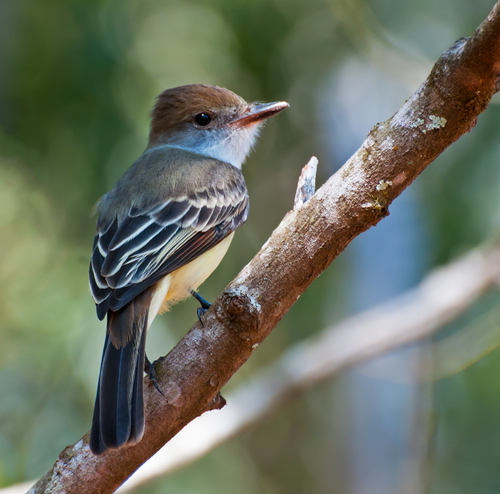
Alder Flycatcher

Alder Flycatcher

Empidonax alnorum

Silhouette: Emily Willoughby · PhyloPic

LCLeast ConcernNTVUENCR
Daily sighting probability <5% · Rare
at Miami

In 3 days <5%

30 Verified sightings at Miami
2,548 In all 37 parks From 2019 to 2026
September Best month
☀️ Diurnal When it's spotted

About the Alder Flycatcher

The alder flycatcher (Empidonax alnorum) is a small insect-eating bird in the tyrant flycatcher family. The genus name Empidonax is from Ancient Greek empis, "gnat", and anax, "master". The specific alnorum is Latin and means "of the alders".

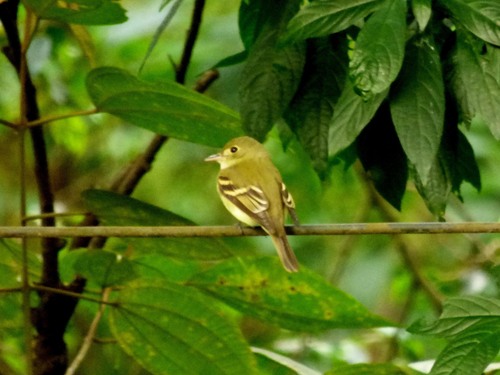
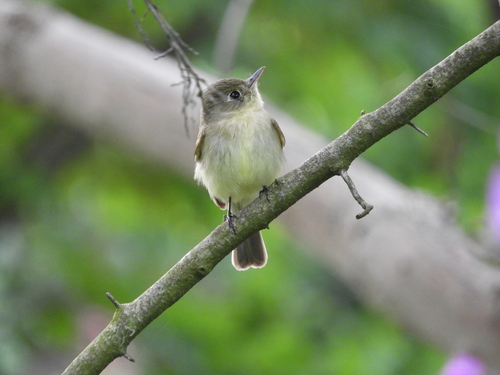
E. alnorum is one of the larger Empidonax species, attaining a length of 13–17 cm (5.1–6.7 in), and a weight of 12–14 g (0.42–0.49 oz). The wingspan ranges from 21–24 cm (8.3–9.4 in). The upperparts of E. alnorum are dull greenish-olive. The crown is a slightly darker olive-green than the back. The throat is white, with a darker breast band. Thin white rings surround the eyes. The bill is wide and moderate in length, with pinkish or yellow-orange lower mandible and black upper mandible. Wings are generally black, with white wing bars and white edges of the innermost secondaries (tertials). Juveniles have brownish upperparts, yellow underparts, and yellowish brown or buff wingbars.

E. alnorum is similar in appearance to the eastern wood pewee (Contopus virens) and the eastern phoebe (Sayornis phoebe), as well as the nearly identical willow flycatcher (Empidonax traillii) but E. alnorum can be distinguished by its smaller size and... Wikipedia →

Sounds

Song0:23

United States · 2025

© David A. Brinkman · XC1011247 · CC BY-NC-SA 4.0

Recording1:13

United States · 2021

© Matt Wistrand · XC656687 · CC BY-NC-SA 4.0

Call0:32

United States · 2016

© Peter Boesman · XC323015 · CC BY-NC-ND 4.0

Global Distribution

Parks Where Found

# Park Country Daily sighting probability
1 Wrangell-St. Elias National Park 🇺🇸 United States
~20%
2 Elk Island National Park 🇨🇦 Canada
~20%
3 Riding Mountain National Park 🇨🇦 Canada
~20%
4 Isle Royale National Park 🇺🇸 United States
~10%
5 Acadia National Park 🇺🇸 United States
~10%
6 Kluane National Park 🇨🇦 Canada
~10%
7 Cape Breton Highlands National Park 🇨🇦 Canada
~10%
8 Katmai National Park 🇺🇸 United States
~10%
9 Wood Buffalo National Park 🇨🇦 Canada
~10%
10 Gros Morne National Park 🇨🇦 Canada
~10%
11 Jasper National Park 🇨🇦 Canada
~10%
12 Voyageurs National Park 🇺🇸 United States
<5%
13 Denali National Park 🇺🇸 United States
<5%
14 Gandoca-Manzanillo Wildlife Refuge 🇨🇷 Costa Rica
<5%
15 Bastimentos Island National Marine Park 🇵🇦 Panama
<5%
16 Point Pelee National Park 🇨🇦 Canada
<5%
17 Chagres National Park 🇵🇦 Panama
<5%
18 Glacier National Park 🇺🇸 United States
<5%
19 Rincón de la Vieja National Park 🇨🇷 Costa Rica
<5%
20 La Amistad International Park (Panama) 🇵🇦 Panama
<5%
21 Everglades National Park 🇺🇸 United States
<5%
22 Kenai Fjords National Park 🇺🇸 United States
<5%
23 Banff National Park 🇨🇦 Canada
<5%
24 Marino Ballena National Park 🇨🇷 Costa Rica
<5%
25 Palo Verde National Park 🇨🇷 Costa Rica
<5%
26 Cahuita National Park 🇨🇷 Costa Rica
<5%
27 Great Bear Rainforest 🇨🇦 Canada
<5%
28 Parque Natural Metropolitano 🇵🇦 Panama
<5%
29 Manuel Antonio National Park 🇨🇷 Costa Rica
<5%
30 Great Smoky Mountains National Park 🇺🇸 United States
<5%
31 Piedras Blancas National Park 🇨🇷 Costa Rica
<5%
32 Poás Volcano National Park 🇨🇷 Costa Rica
<5%
33 Manu National Park 🇵🇪 Peru
<5%
34 Monteverde Cloud Forest Reserve 🇨🇷 Costa Rica
<5%
35 Soberanía National Park 🇵🇦 Panama
<5%
36 Carara National Park 🇨🇷 Costa Rica
<5%
37 Tenorio Volcano National Park 🇨🇷 Costa Rica
<5%

Cities Where Found

# City Country Daily sighting probability
1 Anchorage 🇺🇸 United States
~10%
2 Bogota 🇨🇴 Colombia
<5%
3 Santa Cruz de la Sierra 🇧🇴 Bolivia
<5%
4 Houston 🇺🇸 United States
<5%
5 Chicago 🇺🇸 United States
<5%
6 Montreal 🇨🇦 Canada
<5%
7 Edmonton 🇨🇦 Canada
<5%
8 San José 🇨🇷 Costa Rica
<5%
9 Calgary 🇨🇦 Canada
<5%
10 Minneapolis [Saint Paul] 🇺🇸 United States
<5%

Before you go

What are the chances of seeing an Alder Flycatcher in Miami?

Rare

Under 5% of wildlife watchers report an Alder Flycatcher sighting in Miami on a given day, based on 30 verified sightings from GBIF citizen-science data. It is the 275th most-seen of the 325 birds we can rate there. Over three days the chance rises to under 5%, if each day is a fresh chance.

When is the best time to see an Alder Flycatcher in Miami?

Any time of year

In every month with enough records, under 5% of wildlife watchers report an Alder Flycatcher in Miami on a given day, so our monthly data shows no clear season.

What time of day is best to see an Alder Flycatcher?

Between 8 and 11 am

Across all the parks we cover, that three-hour window holds the most Alder Flycatcher sightings with a recorded time, and about 9 in 10 of them come between 6 am and 6 pm: it is a daytime animal.

Is Miami the best place to see an Alder Flycatcher?

21st of 24

Of the 24 cities where we can rate Alder Flycatcher sightings, Miami ranks 21st at under 5%. The best odds are in Anchorage (United States, about 10%), Bogota (Colombia, under 5%) and Santa Cruz de la Sierra (Bolivia, under 5%).

Where does the Alder Flycatcher sighting chance come from?

GBIF citizen-science records

It is estimated from how often the Alder Flycatcher is recorded against all the birds logged in Miami (30 verified sightings), calibrated against known sighting rates. Figures are rounded to the nearest 10% because citizen-science data supports honest approximations, not decimals, and months with records from fewer than five people show "—". How it works.

← Back to Miami