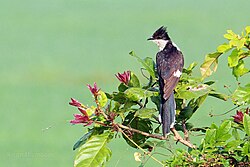
Jacobin Cuckoo

Jacobin Cuckoo

Clamator jacobinus

Silhouette: Nicolas Huet le Jeune and Jean-Gabriel Prêtre (vectorized by T. Michael Keesey) · PhyloPic

LCLeast ConcernNTVUENCR
Daily sighting probability <5% · Rare
at Vadodara

In 3 days ~10% in a week ~20%

34 Verified sightings at Vadodara
4,494 In all 55 parks From 2019 to 2026
September Best month
☀️ Diurnal When it's spotted

About the Jacobin Cuckoo

The Jacobin cuckoo (Clamator jacobinus), also pied cuckoo or pied crested cuckoo, is a member of the cuckoo order of birds that is found in Africa and Asia. It is partially migratory and in India, it has been considered a harbinger of the monsoon rains due to the timing of its arrival. It has been associated with a bird in Indian mythology and poetry, known as the chātaka (Sanskrit: चातक) represented as a bird with a beak on its head that waits for rains to quench its thirst.

The Jacobin cuckoo was described by the French polymath Georges-Louis Leclerc, Comte de Buffon in his Histoire Naturelle des Oiseaux in 1780. The bird was also illustrated in a hand-coloured plate engraved by François-Nicolas Martinet in the Planches Enluminées D'Histoire Naturelle. This was produced under the supervision of Edme-Louis Daubenton to accompany Buffon's text. Neither the plate caption nor Buffon's description included a scientific name but in 1783 the Dutch naturalist Pieter Boddaert coined the binomial name Cuculus jacobinus in his catalogue of the Planches Enluminées. The type locality is the Coromandel Coast of southeast India.

The current genus Clamator was erected by German naturalist... Wikipedia →

Sounds

Call0:05

Kenya · 2026

© He Wenjin · XC1169093 · CC BY-NC-SA 4.0

Flight call0:07

Sri Lanka · 2026

© Uku Paal · XC1096536 · CC BY-NC-SA 4.0

Song0:45

South Africa · 2013

© Peter Boesman · XC280148 · CC BY-NC-ND 4.0

Global Distribution

Parks Where Found

# Park Country Daily sighting probability
1 Udawalawe National Park 🇱🇰 Sri Lanka
~30%
2 Tsavo West National Park 🇰🇪 Kenya
~20%
3 Meru National Park 🇰🇪 Kenya
~20%
4 Yala National Park 🇱🇰 Sri Lanka
~20%
5 Kruger National Park 🇿🇦 South Africa
~20%
6 Mkomazi National Park 🇹🇿 Tanzania
~10%
7 Samburu National Reserve 🇰🇪 Kenya
~10%
8 uMkhuze Game Reserve 🇿🇦 South Africa
~10%
9 Murchison Falls National Park 🇺🇬 Uganda
~10%
10 Tsavo East National Park 🇰🇪 Kenya
~10%
11 Mana Pools National Park 🇿🇼 Zimbabwe
~10%
12 Keoladeo National Park 🇮🇳 India
~10%
13 Ngorongoro Conservation Area 🇹🇿 Tanzania
~10%
14 Lake Manyara National Park 🇹🇿 Tanzania
~10%
15 Serengeti National Park 🇹🇿 Tanzania
~10%
16 Ruaha National Park 🇹🇿 Tanzania
~10%
17 Tarangire National Park 🇹🇿 Tanzania
~10%
18 Mudumalai National Park 🇮🇳 India
~10%
19 Hluhluwe-Imfolozi Park 🇿🇦 South Africa
~10%
20 Wilpattu National Park 🇱🇰 Sri Lanka
~10%
21 Gonarezhou National Park 🇿🇼 Zimbabwe
~10%
22 Awash National Park 🇪🇹 Ethiopia
~10%
23 Lower Zambezi National Park 🇿🇲 Zambia
~10%
24 Nairobi National Park 🇰🇪 Kenya
<5%
25 Bandipur National Park 🇮🇳 India
<5%
26 Ranthambore National Park 🇮🇳 India
<5%
27 Kidepo Valley National Park 🇺🇬 Uganda
<5%
28 Hwange National Park 🇿🇼 Zimbabwe
<5%
29 Kafue National Park 🇿🇲 Zambia
<5%
30 South Luangwa National Park 🇿🇲 Zambia
<5%
31 Arusha National Park 🇹🇿 Tanzania
<5%
32 Amboseli National Park 🇰🇪 Kenya
<5%
33 Satpura National Park 🇮🇳 India
<5%
34 Queen Elizabeth National Park 🇺🇬 Uganda
<5%
35 Liwonde National Park 🇲🇼 Malawi
<5%
36 Chobe National Park 🇧🇼 Botswana
<5%
37 Kanha National Park 🇮🇳 India
<5%
38 Addo Elephant National Park 🇿🇦 South Africa
<5%
39 Akagera National Park 🇷🇼 Rwanda
<5%
40 Jim Corbett National Park 🇮🇳 India
<5%
41 Nagarhole National Park 🇮🇳 India
<5%
42 Lake Mburo National Park 🇺🇬 Uganda
<5%
43 Moremi Game Reserve 🇧🇼 Botswana
<5%
44 Pilanesberg National Park 🇿🇦 South Africa
<5%
45 Minneriya National Park 🇱🇰 Sri Lanka
<5%
46 Chitwan National Park 🇳🇵 Nepal
<5%
47 Bandhavgarh National Park 🇮🇳 India
<5%
48 iSimangaliso Wetland Park 🇿🇦 South Africa
<5%
49 Etosha National Park 🇳🇦 Namibia
<5%
50 Sundarbans National Park 🇮🇳 India
<5%
51 Masai Mara National Reserve 🇰🇪 Kenya
<5%
52 Lake Nakuru National Park 🇰🇪 Kenya
<5%
53 Kibale National Park 🇺🇬 Uganda
<5%
54 Manas National Park 🇮🇳 India
<5%
55 Periyar National Park 🇮🇳 India
<5%

Cities Where Found

# City Country Daily sighting probability
1 Tiruchirappalli 🇮🇳 India
~20%
2 Coimbatore 🇮🇳 India
~20%
3 Tiruppur 🇮🇳 India
~10%
4 Berhampore 🇮🇳 India
~10%
5 Madurai 🇮🇳 India
~10%
6 Rajkot 🇮🇳 India
~10%
7 Vijayawada 🇮🇳 India
~10%
8 Jaipur 🇮🇳 India
~10%
9 Vasai-Virar 🇮🇳 India
~10%
10 Chennai 🇮🇳 India
~10%

Before you go

What are the chances of seeing a Jacobin Cuckoo in Vadodara?

Rare

Under 5% of wildlife watchers report a Jacobin Cuckoo sighting in Vadodara on a given day, based on 34 verified sightings from GBIF citizen-science data. It is the 104th most-seen of the 168 birds we can rate there. Over three days the chance rises to about 10%, and over a week to about 20%, if each day is a fresh chance.

When is the best time to see a Jacobin Cuckoo in Vadodara?

June–July and September

In those months about 10% of wildlife watchers report a Jacobin Cuckoo in Vadodara on a given day, against under 5% in August and October–May, the lowest months. Those are among Vadodara's wettest months, with about 210 mm of rain a month against almost none in January.

What time of day is best to see a Jacobin Cuckoo?

Between 6 and 9 am

Across all the parks we cover, that three-hour window holds the most Jacobin Cuckoo sightings with a recorded time, and about 9 in 10 of them come between 6 am and 6 pm: it is a daytime animal.

Is Vadodara the best place to see a Jacobin Cuckoo?

26th of 51

Of the 51 cities where we can rate Jacobin Cuckoo sightings, Vadodara ranks 26th at under 5%. The best odds are in Tiruchirappalli (India, about 20%), Coimbatore (India, about 20%) and Tiruppur (India, about 10%).

Which relatives of the Jacobin Cuckoo live in Vadodara?

Same family: Cuculidae

The closest relatives of the Jacobin Cuckoo that you can see in Vadodara (family Cuculidae, Cuckoos) are Asian Koel (about 50%), Greater Coucal (about 20%) and Common Hawk-Cuckoo (about 10%), with each one's daily chance of a sighting.

Where does the Jacobin Cuckoo sighting chance come from?

GBIF citizen-science records

It is estimated from how often the Jacobin Cuckoo is recorded against all the birds logged in Vadodara (34 verified sightings), calibrated against known sighting rates. Figures are rounded to the nearest 10% because citizen-science data supports honest approximations, not decimals, and months with records from fewer than five people show "—". How it works.

← Back to Vadodara