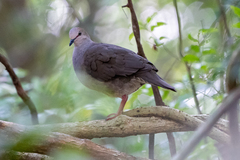
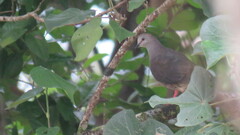

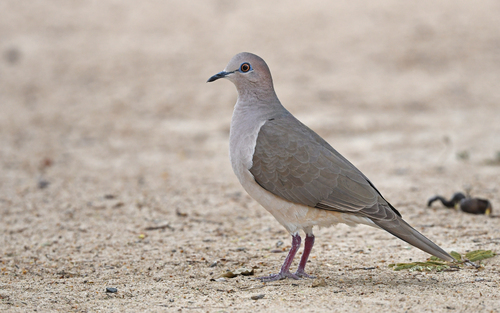
Gray-chested Dove

Gray-chested Dove

Leptotila cassinii

Silhouette: Sheatherius · PhyloPic

LCLeast ConcernNTVUENCR
Daily sighting probability ~30% · Possible
at Cockscomb Basin Wildlife Sanctuary

In 3 days ~70% in a week ~90%

420 Verified sightings at Cockscomb Basin Wildlife Sanctuary From 2019 to 2026
6,687 In all 29 parks
August Best month
☀️ Diurnal When it's spotted

About the Gray-chested Dove

The grey-chested dove (Leptotila cassinii) is a species of bird in the family Columbidae. It is found in Belize, Colombia, Costa Rica, Guatemala, Honduras, Mexico, Nicaragua, and Panama. The grey-chested dove is closely related to the Tolima dove (Leptotila conoveri) and ochre-bellied dove (L. ochraceiventris), and might form a superspecies with them.

The grey-chested dove is 22.5 to 28 cm (8.9 to 11.0 in) long and weighs 132 to 179 g (4.7 to 6.3 oz). The nominate subspecies has a pinkish gray forehead and face, dark brown crown and nape, and an iridescent grayish purple hindneck. Its upperparts are olive-brown with an iridescent green or purple mantle. The tail is darker than the back and the outer feathers have white tips. Its throat is white, the breast reddish gray, and the belly reddish. The eye is shades of yellow surrounded by bare gray skin that is reddish at its front and back. The legs and feet are red. Males and females are essentially alike but that the female is darker overall. L. c. rufinucha is paler than the nominate, with... Wikipedia →

Sounds

Song0:48

Costa Rica · 2020

© Johan Chaves · XC545550 · CC BY-NC-SA 4.0

Call0:57

Honduras · 2015

© Guillermo Funes · XC253754 · CC BY-NC-SA 4.0

Song0:32

Costa Rica · 2019

© Hans Matheve · XC518296 · CC BY-NC-ND 4.0

Global Distribution

Parks Where Found

# Park Country Daily sighting probability
1 Cockscomb Basin Wildlife Sanctuary 🇧🇿 Belize
~30%
2 Piedras Blancas National Park 🇨🇷 Costa Rica
~30%
3 Corcovado National Park 🇨🇷 Costa Rica
~20%
4 Soberanía National Park 🇵🇦 Panama
~10%
5 Carara National Park 🇨🇷 Costa Rica
~10%
6 Tenorio Volcano National Park 🇨🇷 Costa Rica
~10%
7 Cerro Azul Meámbar National Park 🇭🇳 Honduras
~10%
8 San Lorenzo Protected Forest 🇵🇦 Panama
~10%
9 Pico Bonito National Park 🇭🇳 Honduras
~10%
10 Darién National Park 🇵🇦 Panama
~10%
11 Arenal Volcano National Park 🇨🇷 Costa Rica
~10%
12 Rincón de la Vieja National Park 🇨🇷 Costa Rica
~10%
13 Cahuita National Park 🇨🇷 Costa Rica
~10%
14 Braulio Carrillo National Park 🇨🇷 Costa Rica
~10%
15 Montes Azules Biosphere Reserve 🇲🇽 Mexico
<5%
16 Chagres National Park 🇵🇦 Panama
<5%
17 Gandoca-Manzanillo Wildlife Refuge 🇨🇷 Costa Rica
<5%
18 Tortuguero National Park 🇨🇷 Costa Rica
<5%
19 Parque Natural Metropolitano 🇵🇦 Panama
<5%
20 Bastimentos Island National Marine Park 🇵🇦 Panama
<5%
21 Lago de Yojoa 🇭🇳 Honduras
<5%
22 Chirripó National Park 🇨🇷 Costa Rica
<5%
23 La Amistad International Park (Panama) 🇵🇦 Panama
<5%
24 Marino Ballena National Park 🇨🇷 Costa Rica
<5%
25 Tapantí-Macizo de la Muerte National Park 🇨🇷 Costa Rica
<5%
26 Tikal National Park 🇬🇹 Guatemala
<5%
27 Manuel Antonio National Park 🇨🇷 Costa Rica
<5%
28 Poás Volcano National Park 🇨🇷 Costa Rica
<5%
29 Monteverde Cloud Forest Reserve 🇨🇷 Costa Rica
<5%

Cities Where Found

# City Country Daily sighting probability
1 Panama City 🇵🇦 Panama
<5%
2 San José 🇨🇷 Costa Rica
<5%

Before you go

What are the chances of seeing a Gray-chested Dove in Cockscomb Basin Wildlife Sanctuary?

Possible

About 30% of wildlife watchers report a Gray-chested Dove sighting in Cockscomb Basin Wildlife Sanctuary on a given day, based on 420 verified sightings from GBIF citizen-science data from 2019 to 2026. It is the 54th most-seen of the 277 birds we can rate there. Over three days the chance rises to about 70%, and over a week to about 90%, if each day is a fresh chance.

When is the best time to see a Gray-chested Dove in Cockscomb Basin Wildlife Sanctuary?

August

In that month about 50% of wildlife watchers report a Gray-chested Dove in Cockscomb Basin Wildlife Sanctuary on a given day, against about 10% in October, the lowest month. That is one of Cockscomb Basin Wildlife Sanctuary's wettest months, with about 250 mm of rain against 75 mm in April.

What time of day is best to see a Gray-chested Dove?

Between 7 and 10 am

Across all the parks we cover, that three-hour window holds the most Gray-chested Dove sightings with a recorded time, and about 9 in 10 of them come between 6 am and 6 pm: it is a daytime animal.

Is Cockscomb Basin Wildlife Sanctuary the best place to see a Gray-chested Dove?

Yes

Of the 29 parks where we can rate Gray-chested Dove sightings, Cockscomb Basin Wildlife Sanctuary has the highest daily chance: about 30%. Next come Piedras Blancas National Park (Costa Rica, about 30%) and Corcovado National Park (Costa Rica, about 20%).

Which relatives of the Gray-chested Dove live in Cockscomb Basin Wildlife Sanctuary?

Same genus: Leptotila

The closest relatives of the Gray-chested Dove that you can see in Cockscomb Basin Wildlife Sanctuary (genus Leptotila, Leptotila Doves) are Gray-headed Dove (about 20%) and White-tipped Dove (about 20%), with each one's daily chance of a sighting.

Where does the Gray-chested Dove sighting chance come from?

GBIF citizen-science records

It is estimated from how often the Gray-chested Dove is recorded against all the birds logged in Cockscomb Basin Wildlife Sanctuary (420 verified sightings from 2019 to 2026), calibrated against known sighting rates. Figures are rounded to the nearest 10% because citizen-science data supports honest approximations, not decimals, and months with records from fewer than five people show "—". How it works.

← Back to Cockscomb Basin Wildlife Sanctuary