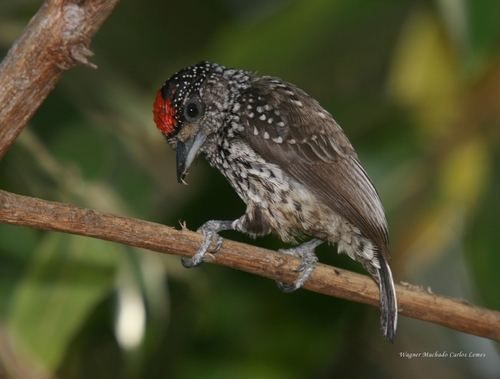
Rufous-tailed Jacamar

Rufous-tailed Jacamar

Galbula ruficauda

Silhouette: FJDegrange · PhyloPic

LCLeast ConcernNTVUENCR
Daily sighting probability ~50% · Likely
at Parque Estadual Encontro das Águas

In 3 days ~90% in a week >90%

1,107 Verified sightings at Parque Estadual Encontro das Águas From 2019 to 2026
14,286 In all 30 parks
August Best month
☀️ Diurnal When it's spotted

About the Rufous-tailed Jacamar

The rufous-tailed jacamar (Galbula ruficauda) is a near passerine bird which breeds in the tropical New World in southern Mexico, Central America and South America as far south as southern Brazil and Ecuador. Like other jacamars they are elegant, brightly coloured birds with long bills and tails. The rufous-tailed jacamar is typically 25 cm (10 in) long with a 5 cm (2 in) long black bill. The subspecies G. r. brevirostris has, as its name implies, a shorter bill. This bird is metallic green above, and the underparts are mainly orange, including the undertail, but there is a green breast band. Sexes differ in that the male has a white throat, and the female a buff throat; she also tends to have paler underparts. The race G. r. pallens has a copper-coloured back in both sexes.

This insectivore hunts from a perch, sitting with its bill tilted up, then flying out to catch flying insects. One commonly preyed upon insect is the social wasp Agelaia vicina. Other insect prey include flies, beetles, bees, dragonflies, and butterflies. Further, the bird distinguishes between edible and unpalatable butterflies mainly according to body shape. Wikipedia →

Sounds

Call0:08

Brazil · 2026

© JAYRSON ARAUJO DE OLIVEIRA · XC1080142 · CC BY-NC-SA 4.0

Song0:07

Colombia · 2025

© Sue Riffe · XC1039073 · CC BY-NC-SA 4.0

Canto0:10

Brazil · 2014

© Caio Brito · XC427405 · CC BY-NC-SA 4.0

Global Distribution

Parks Where Found

# Park Country Daily sighting probability
1 Main Ridge Forest Reserve 🇹🇹 Trinidad and Tobago
~70%
2 Parque Estadual Encontro das Águas 🇧🇷 Brazil
~50%
3 Tayrona National Natural Park 🇨🇴 Colombia
~40%
4 Arenal Volcano National Park 🇨🇷 Costa Rica
~30%
5 Serra dos Órgãos National Park 🇧🇷 Brazil
~30%
6 Cockscomb Basin Wildlife Sanctuary 🇧🇿 Belize
~30%
7 Tikal National Park 🇬🇹 Guatemala
~30%
8 Montes Azules Biosphere Reserve 🇲🇽 Mexico
~30%
9 Chapada Diamantina National Park 🇧🇷 Brazil
~20%
10 Emas National Park 🇧🇷 Brazil
~20%
11 Henri Pittier National Park 🇻🇪 Venezuela
~20%
12 Cusuco National Park 🇭🇳 Honduras
~20%
13 Tenorio Volcano National Park 🇨🇷 Costa Rica
~20%
14 Carara National Park 🇨🇷 Costa Rica
~10%
15 Piedras Blancas National Park 🇨🇷 Costa Rica
~10%
16 Serra da Canastra National Park 🇧🇷 Brazil
~10%
17 Corcovado National Park 🇨🇷 Costa Rica
~10%
18 Braulio Carrillo National Park 🇨🇷 Costa Rica
~10%
19 Utría National Natural Park 🇨🇴 Colombia
~10%
20 Chapada dos Guimarães National Park 🇧🇷 Brazil
~10%
21 Farallones de Cali National Natural Park 🇨🇴 Colombia
~10%
22 Calakmul Biosphere Reserve 🇲🇽 Mexico
<5%
23 Pico Bonito National Park 🇭🇳 Honduras
<5%
24 Tapantí-Macizo de la Muerte National Park 🇨🇷 Costa Rica
<5%
25 Biotopo Cerro Cahuí 🇬🇹 Guatemala
<5%
26 Rincón de la Vieja National Park 🇨🇷 Costa Rica
<5%
27 Cerro Azul Meámbar National Park 🇭🇳 Honduras
<5%
28 Darién National Park 🇵🇦 Panama
<5%
29 Monteverde Cloud Forest Reserve 🇨🇷 Costa Rica
<5%
30 La Amistad International Park (Panama) 🇵🇦 Panama
<5%

Cities Where Found

# City Country Daily sighting probability
1 João Pessoa 🇧🇷 Brazil
~20%
2 Goiânia 🇧🇷 Brazil
~20%
3 Valencia 🇻🇪 Venezuela
~20%
4 Recife 🇧🇷 Brazil
~20%
5 Caracas 🇻🇪 Venezuela
~10%
6 Maceió 🇧🇷 Brazil
~10%
7 Campo Grande 🇧🇷 Brazil
~10%
8 Belo Horizonte 🇧🇷 Brazil
~10%
9 Brasilia 🇧🇷 Brazil
~10%
10 Santa Cruz de la Sierra 🇧🇴 Bolivia
<5%

Before you go

What are the chances of seeing a Rufous-tailed Jacamar in Parque Estadual Encontro das Águas?

Likely

About 50% of wildlife watchers report a Rufous-tailed Jacamar sighting in Parque Estadual Encontro das Águas on a given day, based on 1,107 verified sightings from GBIF citizen-science data from 2019 to 2026. It is the 39th most-seen of the 308 birds we can rate there. Over three days the chance rises to about 90%, and over a week to over 90%, if each day is a fresh chance.

When is the best time to see a Rufous-tailed Jacamar in Parque Estadual Encontro das Águas?

May, July–August and October–November

In those months about 60% of wildlife watchers report a Rufous-tailed Jacamar in Parque Estadual Encontro das Águas on a given day, against about 40% in June, the lowest month. January to April have too few records to rate.

What time of day is best to see a Rufous-tailed Jacamar?

Between 8 and 11 am

Across all the parks we cover, that three-hour window holds the most Rufous-tailed Jacamar sightings with a recorded time, and about 9 in 10 of them come between 6 am and 6 pm: it is a daytime animal.

Is Parque Estadual Encontro das Águas the best place to see a Rufous-tailed Jacamar?

2nd of 30

Of the 30 parks where we can rate Rufous-tailed Jacamar sightings, Parque Estadual Encontro das Águas ranks 2nd at about 50%. The best odds are in Main Ridge Forest Reserve (Trinidad and Tobago, about 70%). All parks ranked.

Which relatives of the Rufous-tailed Jacamar live in Parque Estadual Encontro das Águas?

Same order: Piciformes

The closest relatives of the Rufous-tailed Jacamar that you can see in Parque Estadual Encontro das Águas (order Piciformes, Woodpeckers and Allies) are Toco Toucan (about 50%), Black-fronted Nunbird (about 40%) and Little Woodpecker (about 20%), with each one's daily chance of a sighting.

Where does the Rufous-tailed Jacamar sighting chance come from?

GBIF citizen-science records

It is estimated from how often the Rufous-tailed Jacamar is recorded against all the birds logged in Parque Estadual Encontro das Águas (1,107 verified sightings from 2019 to 2026), calibrated against known sighting rates. Figures are rounded to the nearest 10% because citizen-science data supports honest approximations, not decimals, and months with records from fewer than five people show "—". How it works.

← Back to Parque Estadual Encontro das Águas