Band-tailed Pigeon

Band-tailed Pigeon

Patagioenas fasciata

Silhouette: Ferran Sayol · PhyloPic

LCLeast ConcernNTVUENCR
Daily sighting probability ~10% · With luck
at Henri Pittier National Park

In 3 days ~20% in a week ~30%

28 Verified sightings at Henri Pittier National Park From 2019 to 2026
19,816 In all 35 parks
June Best month
☀️ Diurnal When it's spotted

About the Band-tailed Pigeon

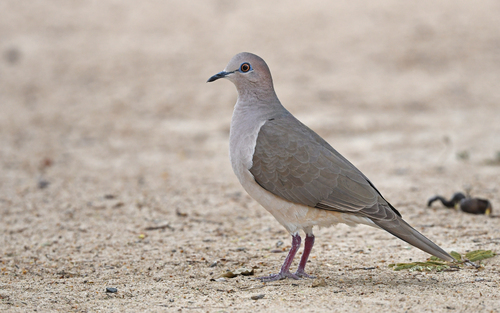
The band-tailed pigeon (Patagioenas fasciata) is a pigeon native to the Americas, and one of the largest pigeons in this region. It is largely gray, but with a thin white collar on the nape and a purple-gray breast. The band-tailed pigeon is one of the largest pigeons in the Americas, measuring 33 to 40 cm (13 to 16 in) long and weighing 226–460 g (8.0–16.2 oz), with the males on average slightly larger than females, but with much overlap. Although sometimes cited as the largest North American pigeon, the red-billed pigeon (P. flavirostris) is about the same size, weighing 268–424 g (9.5–15.0 oz). Band-tailed pigeons have thick-based, pointed wings, with a wingspan of 66 cm (26 in).

The plumage is gray, somewhat darker above. The head and underparts have a faint pink cast, especially in the adult male; the belly is nearly white. The distal half of the tail is also pale (except in the subspecies of Baja California) with a darker gray band at the base, whence the English name. The bill and feet are yellow, good identification marks at sufficiently close range. Adults have green iridescence on the back of the neck, adjacent to the thin white collar on the nape. Juvenile... Wikipedia →

Sounds

Song0:56

Colombia · 2022

© Frank Lambert · XC1043193 · CC BY-NC-ND 4.0

Wing beats0:05

United States · 2022

© Kayla Brown · XC749411 · CC BY-NC-SA 4.0

Call0:07

United States · 2020

© Richard E. Webster · XC632233 · CC BY-NC-SA 4.0

Global Distribution

Parks Where Found

# Park Country Daily sighting probability
1 Irazú Volcano National Park 🇨🇷 Costa Rica
~60%
2 Los Quetzales National Park 🇨🇷 Costa Rica
~40%
3 Podocarpus National Park 🇪🇨 Ecuador
~40%
4 Chingaza National Natural Park 🇨🇴 Colombia
~40%
5 Volcán Barú National Park 🇵🇦 Panama
~40%
6 Tapantí-Macizo de la Muerte National Park 🇨🇷 Costa Rica
~30%
7 Redwood National Park 🇺🇸 United States
~30%
8 Cumbres de Monterrey National Park 🇲🇽 Mexico
~20%
9 Los Nevados National Natural Park 🇨🇴 Colombia
~20%
10 El Triunfo 🇲🇽 Mexico
~20%
11 La Amistad International Park (Panama) 🇵🇦 Panama
~20%
12 Olympic National Park 🇺🇸 United States
~10%
13 Yosemite National Park 🇺🇸 United States
~10%
14 Monteverde Cloud Forest Reserve 🇨🇷 Costa Rica
~10%
15 Pacific Rim National Park Reserve 🇨🇦 Canada
~10%
16 Chirripó National Park 🇨🇷 Costa Rica
~10%
17 Rocky Mountain National Park 🇺🇸 United States
~10%
18 Poás Volcano National Park 🇨🇷 Costa Rica
~10%
19 Farallones de Cali National Natural Park 🇨🇴 Colombia
~10%
20 Sequoia and Kings Canyon National Parks 🇺🇸 United States
~10%
21 Big Bend National Park 🇺🇸 United States
~10%
22 Celaque National Park 🇭🇳 Honduras
~10%
23 Great Bear Rainforest 🇨🇦 Canada
~10%
24 Henri Pittier National Park 🇻🇪 Venezuela
~10%
25 Braulio Carrillo National Park 🇨🇷 Costa Rica
~10%
26 La Tigra National Park 🇭🇳 Honduras
<5%
27 Arenal Volcano National Park 🇨🇷 Costa Rica
<5%
28 Guadalupe Mountains National Park 🇺🇸 United States
<5%
29 Rincón de la Vieja National Park 🇨🇷 Costa Rica
<5%
30 Zion National Park 🇺🇸 United States
<5%
31 Amboró National Park 🇧🇴 Bolivia
<5%
32 Tenorio Volcano National Park 🇨🇷 Costa Rica
<5%
33 Manuel Antonio National Park 🇨🇷 Costa Rica
<5%
34 Channel Islands National Park 🇺🇸 United States
<5%
35 Grand Canyon National Park 🇺🇸 United States
<5%

Cities Where Found

# City Country Daily sighting probability
1 Quito 🇪🇨 Ecuador
~20%
2 Los Angeles 🇺🇸 United States
~10%
3 San Francisco 🇺🇸 United States
~10%
4 Portland 🇺🇸 United States
~10%
5 Seattle 🇺🇸 United States
~10%
6 Bogota 🇨🇴 Colombia
<5%
7 Vancouver 🇨🇦 Canada
<5%
8 Medellín 🇨🇴 Colombia
<5%
9 San José 🇨🇷 Costa Rica
<5%
10 Cali 🇨🇴 Colombia
<5%

Zoos & Centres Where Found

# Zoo / Centre Country
1 National Zoological Park 🇺🇸 United States In captivity
2 Bronx Zoo 🇺🇸 United States In captivity
3 Arizona-Sonora Desert Museum 🇺🇸 United States In captivity
4 El Nispero Zoo 🇵🇦 Panama In captivity
5 Sequoia Park Zoo 🇺🇸 United States In captivity
6 Lindsay Wildlife Experience 🇺🇸 United States In captivity

Before you go

What are the chances of seeing a Band-tailed Pigeon in Henri Pittier National Park?

With luck

About 10% of wildlife watchers report a Band-tailed Pigeon sighting in Henri Pittier National Park on a given day, based on 28 verified sightings from GBIF citizen-science data from 2019 to 2026. It is the 198th most-seen of the 358 birds we can rate there. Over three days the chance rises to about 20%, and over a week to about 30%, if each day is a fresh chance.

When is the best time to see a Band-tailed Pigeon in Henri Pittier National Park?

June

In that month about 30% of wildlife watchers report a Band-tailed Pigeon in Henri Pittier National Park on a given day, against under 5% in January–April and July–November, the lowest months.

What time of day is best to see a Band-tailed Pigeon?

Between 8 and 11 am

Across all the parks we cover, that three-hour window holds the most Band-tailed Pigeon sightings with a recorded time, and nearly all of them come between 6 am and 6 pm: it is a daytime animal.

Which relatives of the Band-tailed Pigeon live in Henri Pittier National Park?

Same genus: Patagioenas

The closest relatives of the Band-tailed Pigeon that you can see in Henri Pittier National Park (genus Patagioenas, New World Pigeons) are Pale-vented Pigeon (about 10%) and Ruddy Pigeon (about 10%), with each one's daily chance of a sighting.

Where does the Band-tailed Pigeon sighting chance come from?

GBIF citizen-science records

It is estimated from how often the Band-tailed Pigeon is recorded against all the birds logged in Henri Pittier National Park (28 verified sightings from 2019 to 2026), calibrated against known sighting rates. Figures are rounded to the nearest 10% because citizen-science data supports honest approximations, not decimals, and months with records from fewer than five people show "—". How it works.

← Back to Henri Pittier National Park