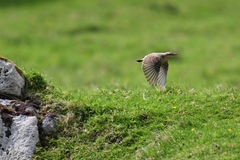
Northern Wheatear

Northern Wheatear

Oenanthe oenanthe

Silhouette: Charles J. Sharp · PhyloPic

LCLeast ConcernNTVUENCR
Daily sighting probability ~10% · With luck
at Kiskunság National Park

In 3 days ~30% in a week ~50%

90 Verified sightings at Kiskunság National Park From 2019 to 2026
9,166 In all 48 parks
August Best month
☀️ Diurnal When it's spotted

About the Northern Wheatear

The northern wheatear or wheatear (Oenanthe oenanthe) is a small passerine bird in the Old World flycatcher family. It is the most widespread member of the wheatear genus Oenanthe in Europe and North and Central Asia. The northern wheatear is a migratory insectivorous species breeding in open stony country in Europe and east across the Palearctic with footholds in northeastern Canada and Greenland as well as in northwestern Canada and Alaska. It nests in rock crevices and rabbit burrows. All birds spend most of their winter in Africa.

The northern wheatear belongs to a distinctive group of Old World flycatchers, known as chats, that were formerly thought to be thrushes. Genetic analysis showed that they were in fact a type of flycatcher (Muscicapidae), with the resemblance to thrushes being the result of convergent evolution. The northern wheatear was first formally described by the Swedish naturalist Carl Linnaeus in 1758 in the 10th edition of his Systema Naturae as Motacilla oenanthe. The species is now placed in the genus Oenanthe that was introduced by the French ornithologist Louis Pierre Vieillot in 1816. The generic name, Oenanthe, is also the... Wikipedia →

Sounds

Call0:29

France · 2026

Sonothèque ADVL · XC1182674 · CC0

Alarm call1:07

Sweden · 2025

© Lennart Jeppsson · XC1017574 · CC BY-NC-SA 4.0

Song0:10

Estonia · 2023

© Uku Paal · XC804794 · CC BY-NC-SA 4.0

Global Distribution

Parks Where Found

# Park Country Daily sighting probability
1 Mercantour National Park 🇫🇷 France
~50%
2 Vanoise National Park 🇫🇷 France
~50%
3 Aigüestortes National Park 🇪🇸 Spain
~30%
4 Ecrins National Park 🇫🇷 France
~30%
5 Ordesa y Monte Perdido National Park 🇪🇸 Spain
~30%
6 Picos de Europa National Park 🇪🇸 Spain
~30%
7 Kidepo Valley National Park 🇺🇬 Uganda
~20%
8 Hohe Tauern National Park 🇦🇹 Austria
~20%
9 Pyrénées National Park 🇫🇷 France
~20%
10 Tsavo East National Park 🇰🇪 Kenya
~20%
11 Gobi Gurvansaikhan National Park 🇲🇳 Mongolia
~20%
12 Cévennes National Park 🇫🇷 France
~20%
13 Awash National Park 🇪🇹 Ethiopia
~20%
14 Sierra Nevada National Park 🇪🇸 Spain
~20%
15 Samburu National Reserve 🇰🇪 Kenya
~20%
16 Wadden Sea National Park 🇩🇪 Germany
~20%
17 Tsavo West National Park 🇰🇪 Kenya
~10%
18 Meru National Park 🇰🇪 Kenya
~10%
19 Sierra de Guadarrama National Park 🇪🇸 Spain
~10%
20 Snowdonia National Park 🇬🇧 United Kingdom
~10%
21 Hortobágy National Park 🇭🇺 Hungary
~10%
22 Nairobi National Park 🇰🇪 Kenya
~10%
23 Ngorongoro Conservation Area 🇹🇿 Tanzania
~10%
24 Masai Mara National Reserve 🇰🇪 Kenya
~10%
25 Amboseli National Park 🇰🇪 Kenya
~10%
26 Serengeti National Park 🇹🇿 Tanzania
~10%
27 Vatnajokull National Park 🇮🇸 Iceland
~10%
28 Kiskunság National Park 🇭🇺 Hungary
~10%
29 Cairngorms National Park 🇬🇧 United Kingdom
~10%
30 Murchison Falls National Park 🇺🇬 Uganda
~10%
31 Mkomazi National Park 🇹🇿 Tanzania
~10%
32 Lake Nakuru National Park 🇰🇪 Kenya
~10%
33 Biebrza National Park 🇵🇱 Poland
~10%
34 Doñana National Park 🇪🇸 Spain
~10%
35 Triglav National Park 🇸🇮 Slovenia
<5%
36 Gauja National Park 🇱🇻 Latvia
<5%
37 Camargue 🇫🇷 France
<5%
38 Aberdare National Park 🇰🇪 Kenya
<5%
39 Białowieża National Park 🇵🇱 Poland
<5%
40 Fertő-Hanság National Park 🇭🇺 Hungary
<5%
41 Tatra National Park 🇸🇰 Slovakia
<5%
42 Denali National Park 🇺🇸 United States
<5%
43 Lake Manyara National Park 🇹🇿 Tanzania
<5%
44 Tarangire National Park 🇹🇿 Tanzania
<5%
45 Monfragüe National Park 🇪🇸 Spain
<5%
46 Svalbard 🇳🇴 Norway
<5%
47 Bavarian Forest National Park 🇩🇪 Germany
<5%
48 Queen Elizabeth National Park 🇺🇬 Uganda
<5%

Cities Where Found

# City Country Daily sighting probability
1 Ulaanbaatar 🇲🇳 Mongolia
~30%
2 Novosibirsk 🇷🇺 Russia
~10%
3 Sincan 🇹🇷 Turkey
~10%
4 Helsinki 🇫🇮 Finland
~10%
5 Liverpool 🇬🇧 United Kingdom
~10%
6 Berlin 🇩🇪 Germany
~10%
7 Tel Aviv 🇮🇱 Israel
~10%
8 Beirut 🇱🇧 Lebanon
~10%
9 Izmir 🇹🇷 Turkey
~10%
10 Kuwait City 🇰🇼 Kuwait
<5%

Before you go

What are the chances of seeing a Northern Wheatear in Kiskunság National Park?

With luck

About 10% of wildlife watchers report a Northern Wheatear sighting in Kiskunság National Park on a given day, based on 90 verified sightings from GBIF citizen-science data from 2019 to 2026. It is the 142nd most-seen of the 222 birds we can rate there. Over three days the chance rises to about 30%, and over a week to about 50%, if each day is a fresh chance.

When is the best time to see a Northern Wheatear in Kiskunság National Park?

May and August

In those months about 20% of wildlife watchers report a Northern Wheatear in Kiskunság National Park on a given day, against under 5% in July and November–March, the lowest months.

What time of day is best to see a Northern Wheatear?

Between 10 am and 1 pm

Across all the parks we cover, that three-hour window holds the most Northern Wheatear sightings with a recorded time, and about 9 in 10 of them come between 6 am and 6 pm: it is a daytime animal.

Which relatives of the Northern Wheatear live in Kiskunság National Park?

Same family: Muscicapidae

The closest relatives of the Northern Wheatear that you can see in Kiskunság National Park (family Muscicapidae, Old World Flycatchers, Robins, and Chats) are European Stonechat (about 60%), Common Nightingale (about 30%) and European Robin (about 20%), with each one's daily chance of a sighting.

Where does the Northern Wheatear sighting chance come from?

GBIF citizen-science records

It is estimated from how often the Northern Wheatear is recorded against all the birds logged in Kiskunság National Park (90 verified sightings from 2019 to 2026), calibrated against known sighting rates. Figures are rounded to the nearest 10% because citizen-science data supports honest approximations, not decimals, and months with records from fewer than five people show "—". How it works.

← Back to Kiskunság National Park