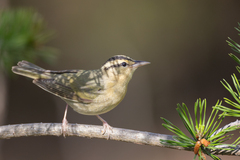
Worm-eating Warbler

Worm-eating Warbler

Helmitheros vermivorum

Silhouette: Andy Wilson · PhyloPic

LCLeast ConcernNTVUENCR
Daily sighting probability <5% · Rare
at Merritt Island National Wildlife Refuge

In 3 days <5% in a week ~10%

93 Verified sightings at Merritt Island National Wildlife Refuge From 2019 to 2026
2,888 In all 38 parks
September Best month
☀️ Diurnal When it's spotted

About the Worm-eating Warbler

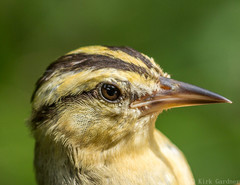
The worm-eating warbler (Helmitheros vermivorum) is a small New World warbler that breeds in the Eastern United States and migrates to southern Mexico, the Caribbean, and Central America for the winter. It is the only species in the genus Helmitheros.

The worm-eating warbler was formally described in 1789 by the German naturalist Johann Friedrich Gmelin in his revised and expanded edition of Carl Linnaeus's Systema Naturae. He placed it with the wagtails in the genus Motacilla and coined the binomial name Motacilla vermivora. Gmelin based his account on the "worm-eater" that had been described and illustrated in 1760 by the English naturalist George Edwards in his Gleanings of Natural History. Edwards had received a specimen from the American naturalist William Bartram that had been collected in Pennsylvania. The worm-eating warbler is now placed in the genus Helmitheros that was introduced in 1819 by the French polymath Constantine Samuel Rafinesque. The genus name combines the Ancient Greek helmins meaning "worm", and -thēras meaning "hunter". The specific epithet vermivorum is from Latin vermis meaning "worm" and -vorus meaning "-eating". The species is monotypic:... Wikipedia →

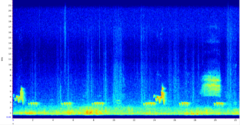
Sounds

Song0:06

United States · 2025

© Bobby Wilcox · XC1038386 · CC BY-NC-SA 4.0

Call1:07

United States · 2017

© Eric Hough · XC383681 · CC BY-NC-SA 4.0

Flight call0:04

United States · 2016

© Paul Marvin · XC333384 · CC BY-NC-SA 4.0

Global Distribution

Parks Where Found

# Park Country Daily sighting probability
1 Blue and John Crow Mountains National Park 🇯🇲 Jamaica
~20%
2 Tikal National Park 🇬🇹 Guatemala
~20%
3 Biotopo Cerro Cahuí 🇬🇹 Guatemala
~10%
4 Great Smoky Mountains National Park 🇺🇸 United States
~10%
5 Calakmul Biosphere Reserve 🇲🇽 Mexico
~10%
6 Cockscomb Basin Wildlife Sanctuary 🇧🇿 Belize
~10%
7 Shenandoah National Park 🇺🇸 United States
~10%
8 Pico Bonito National Park 🇭🇳 Honduras
~10%
9 El Triunfo 🇲🇽 Mexico
~10%
10 Sian Ka'an Biosphere Reserve 🇲🇽 Mexico
~10%
11 Cañón del Sumidero National Park 🇲🇽 Mexico
~10%
12 Arrecifes de Cozumel National Park 🇲🇽 Mexico
<5%
13 La Tigra National Park 🇭🇳 Honduras
<5%
14 Ciénaga de Zapata 🇨🇺 Cuba
<5%
15 Cusuco National Park 🇭🇳 Honduras
<5%
16 Congaree National Park 🇺🇸 United States
<5%
17 Cabo Blanco Absolute Nature Reserve 🇨🇷 Costa Rica
<5%
18 Santa Rosa National Park 🇨🇷 Costa Rica
<5%
19 Rincón de la Vieja National Park 🇨🇷 Costa Rica
<5%
20 Everglades National Park 🇺🇸 United States
<5%
21 Manuel Antonio National Park 🇨🇷 Costa Rica
<5%
22 Carara National Park 🇨🇷 Costa Rica
<5%
23 Lago de Yojoa 🇭🇳 Honduras
<5%
24 Merritt Island National Wildlife Refuge 🇺🇸 United States
<5%
25 Cerro Azul Meámbar National Park 🇭🇳 Honduras
<5%
26 Bastimentos Island National Marine Park 🇵🇦 Panama
<5%
27 Celestún Biosphere Reserve 🇲🇽 Mexico
<5%
28 Point Pelee National Park 🇨🇦 Canada
<5%
29 Big Cypress National Preserve 🇺🇸 United States
<5%
30 Monteverde Cloud Forest Reserve 🇨🇷 Costa Rica
<5%
31 La Amistad International Park (Panama) 🇵🇦 Panama
<5%
32 Volcán Barú National Park 🇵🇦 Panama
<5%
33 Marino Ballena National Park 🇨🇷 Costa Rica
<5%
34 Tenorio Volcano National Park 🇨🇷 Costa Rica
<5%
35 Poás Volcano National Park 🇨🇷 Costa Rica
<5%
36 Arenal Volcano National Park 🇨🇷 Costa Rica
<5%
37 Soberanía National Park 🇵🇦 Panama
<5%
38 Tapantí-Macizo de la Muerte National Park 🇨🇷 Costa Rica
<5%

Cities Where Found

# City Country Daily sighting probability
1 Miami 🇺🇸 United States
<5%
2 Havana 🇨🇺 Cuba
<5%
3 Orlando 🇺🇸 United States
<5%
4 New York City 🇺🇸 United States
<5%
5 Houston 🇺🇸 United States
<5%
6 Baltimore 🇺🇸 United States
<5%
7 Santo Domingo 🇩🇴 Dominican Republic
<5%
8 Philadelphia 🇺🇸 United States
<5%
9 Washington 🇺🇸 United States
<5%
10 Guatemala City 🇬🇹 Guatemala
<5%

Zoos & Centres Where Found

# Zoo / Centre Country
1 North Carolina Zoo 🇺🇸 United States In captivity

Before you go

What are the chances of seeing a Worm-eating Warbler in Merritt Island National Wildlife Refuge?

Rare

Under 5% of wildlife watchers report a Worm-eating Warbler sighting in Merritt Island National Wildlife Refuge on a given day, based on 93 verified sightings from GBIF citizen-science data from 2019 to 2026. It is the 174th most-seen of the 279 birds we can rate there. Over three days the chance rises to under 5%, and over a week to about 10%, if each day is a fresh chance.

When is the best time to see a Worm-eating Warbler in Merritt Island National Wildlife Refuge?

September

In that month about 10% of wildlife watchers report a Worm-eating Warbler in Merritt Island National Wildlife Refuge on a given day, against under 5% in October to August, the lowest months. That is one of Merritt Island National Wildlife Refuge's wettest months, with about 210 mm of rain against 50 mm in March.

What time of day is best to see a Worm-eating Warbler?

Between 9 am and noon

Across all the parks we cover, that three-hour window holds the most Worm-eating Warbler sightings with a recorded time, and about 9 in 10 of them come between 6 am and 6 pm: it is a daytime animal.

Which relatives of the Worm-eating Warbler live in Merritt Island National Wildlife Refuge?

Same family: Parulidae

The closest relatives of the Worm-eating Warbler that you can see in Merritt Island National Wildlife Refuge (family Parulidae, New World Warblers) are Yellow-rumped Warbler (about 40%), Palm Warbler (about 40%) and Common Yellowthroat (about 30%), with each one's daily chance of a sighting.

Where does the Worm-eating Warbler sighting chance come from?

GBIF citizen-science records

It is estimated from how often the Worm-eating Warbler is recorded against all the birds logged in Merritt Island National Wildlife Refuge (93 verified sightings from 2019 to 2026), calibrated against known sighting rates. Figures are rounded to the nearest 10% because citizen-science data supports honest approximations, not decimals, and months with records from fewer than five people show "—". How it works.

← Back to Merritt Island National Wildlife Refuge