
Skylark

Skylark

Alauda arvensis

Silhouette: Gossipguy and T. Michael Keesey · PhyloPic

LCLeast ConcernNTVUENCR
Daily sighting probability <5% · Rare
at Monfragüe National Park

In 3 days ~10%

95 Verified sightings at Monfragüe National Park From 2019 to 2026
8,542 In all 36 parks
November Best month
☀️ Diurnal When it's spotted

About the Skylark

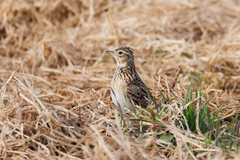
The Eurasian skylark (Alauda arvensis), commonly referred to in Europe as the lark, is a passerine bird in the lark family, Alaudidae. It is a widespread species found across Europe and the Palearctic with introduced populations in Australia, New Zealand, Canada, and on the Hawaiian Islands. It is a bird of open farmland and heath, known for the song of the male, which is delivered in hovering flight from heights of 50 to 100 metres (160 to 330 ft). The sexes are alike. It is streaked greyish-brown above and on the breast and has a buff-white belly.

The female Eurasian skylark builds an open nest in a shallow depression on open ground well away from trees, bushes and hedges. She lays three to five eggs which she incubates for around 11 days. The chicks are fed by both parents but leave the nest after eight to ten days, well before they can fly. They scatter and hide in the vegetation but continue to be fed by the parents until they can fly at 18 to 20 days of age. Nests are subject to high predation rates by larger birds and small mammals. The parents can have several broods in a single season.

The Eurasian skylark was described by the Swedish naturalist... Wikipedia →

Sounds

Nocturnal flight call0:13

France · 2026

© MILLON Xavier · XC1187009 · CC BY-NC-SA 4.0

Flight call0:12

France · 2025

© Guillaume Bigayon · XC1186822 · CC BY-NC-SA 4.0

Call0:09

United Kingdom · 2026

© Mark James Pearson · XC1186003 · CC BY-NC-SA 4.0

Global Distribution

Parks Where Found

# Park Country Daily sighting probability
1 Biebrza National Park 🇵🇱 Poland
~50%
2 Kiskunság National Park 🇭🇺 Hungary
~50%
3 Fertő-Hanság National Park 🇭🇺 Hungary
~40%
4 Hortobágy National Park 🇭🇺 Hungary
~40%
5 Mercantour National Park 🇫🇷 France
~30%
6 Wadden Sea National Park 🇩🇪 Germany
~30%
7 Aoraki Mount Cook National Park 🇳🇿 New Zealand
~30%
8 Cévennes National Park 🇫🇷 France
~30%
9 Białowieża National Park 🇵🇱 Poland
~20%
10 Fiordland National Park 🇳🇿 New Zealand
~20%
11 Camargue 🇫🇷 France
~20%
12 Arthur's Pass National Park 🇳🇿 New Zealand
~20%
13 Egmont National Park 🇳🇿 New Zealand
~20%
14 Ecrins National Park 🇫🇷 France
~20%
15 Snowdonia National Park 🇬🇧 United Kingdom
~10%
16 Ordesa y Monte Perdido National Park 🇪🇸 Spain
~10%
17 Bavarian Forest National Park 🇩🇪 Germany
~10%
18 Gauja National Park 🇱🇻 Latvia
~10%
19 Vanoise National Park 🇫🇷 France
~10%
20 Aigüestortes National Park 🇪🇸 Spain
~10%
21 Pyrénées National Park 🇫🇷 France
~10%
22 Cairngorms National Park 🇬🇧 United Kingdom
~10%
23 Sierra Nevada National Park 🇪🇸 Spain
~10%
24 Sierra de Guadarrama National Park 🇪🇸 Spain
~10%
25 Abel Tasman National Park 🇳🇿 New Zealand
~10%
26 Picos de Europa National Park 🇪🇸 Spain
~10%
27 Gobi Gurvansaikhan National Park 🇲🇳 Mongolia
~10%
28 Doñana National Park 🇪🇸 Spain
~10%
29 Maria Island National Park 🇦🇺 Australia
~10%
30 Plitvice Lakes National Park 🇭🇷 Croatia
<5%
31 Tatra National Park 🇸🇰 Slovakia
<5%
32 Nikko National Park 🇯🇵 Japan
<5%
33 Great Otway National Park 🇦🇺 Australia
<5%
34 Rakiura National Park 🇳🇿 New Zealand
<5%
35 Wilsons Promontory National Park 🇦🇺 Australia
<5%
36 Monfragüe National Park 🇪🇸 Spain
<5%

Cities Where Found

# City Country Daily sighting probability
1 Berlin 🇩🇪 Germany
~10%
2 Auckland 🇳🇿 New Zealand
~10%
3 Liverpool 🇬🇧 United Kingdom
~10%
4 Nagoya 🇯🇵 Japan
~10%
5 Helsinki 🇫🇮 Finland
~10%
6 Nanchang 🇨🇳 China
~10%
7 London 🇬🇧 United Kingdom
~10%
8 Karaj 🇮🇷 Iran
~10%
9 Tokyo 🇯🇵 Japan
~10%
10 Copenhagen 🇩🇰 Denmark
~10%

Zoos & Centres Where Found

# Zoo / Centre Country
1 Beijing Wildlife Park 🇨🇳 China In captivity
2 Beijing Zoo 🇨🇳 China In captivity
3 Inokashira Park Zoo 🇯🇵 Japan In captivity
4 Featherdale Sydney Wildlife Park 🇦🇺 Australia In captivity

Before you go

What are the chances of seeing a Skylark in Monfragüe National Park?

Rare

Under 5% of wildlife watchers report a Skylark sighting in Monfragüe National Park on a given day, based on 95 verified sightings from GBIF citizen-science data from 2019 to 2026. It is the 141st most-seen of the 205 birds we can rate there. Over three days the chance rises to about 10%, if each day is a fresh chance.

When is the best time to see a Skylark in Monfragüe National Park?

November to January

In those months about 10% of wildlife watchers report a Skylark in Monfragüe National Park on a given day, against under 5% in February to October, the lowest months.

What time of day is best to see a Skylark?

Between noon and 3 pm

Across all the parks we cover, that three-hour window holds the most Skylark sightings with a recorded time, and about 9 in 10 of them come between 6 am and 6 pm: it is a daytime animal.

Which relatives of the Skylark live in Monfragüe National Park?

Same family: Alaudidae

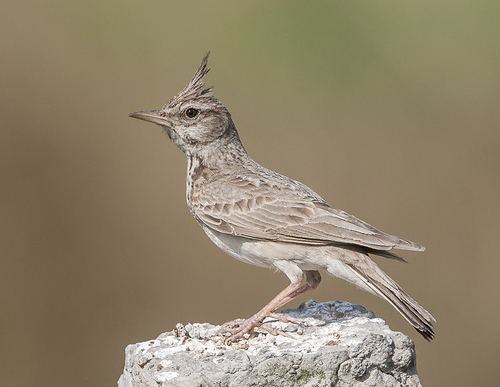
The closest relatives of the Skylark that you can see in Monfragüe National Park (family Alaudidae, Larks) are Crested Lark (about 30%), Thekla Lark (about 20%) and Woodlark (about 20%), with each one's daily chance of a sighting.

Where does the Skylark sighting chance come from?

GBIF citizen-science records

It is estimated from how often the Skylark is recorded against all the birds logged in Monfragüe National Park (95 verified sightings from 2019 to 2026), calibrated against known sighting rates. Figures are rounded to the nearest 10% because citizen-science data supports honest approximations, not decimals, and months with records from fewer than five people show "—". How it works.

← Back to Monfragüe National Park