Grey Fantail

Grey Fantail

Rhipidura albiscapa

Silhouette: Michael Scroggie · PhyloPic

LCLeast ConcernNTVUENCR
Daily sighting probability ~10% · With luck
at Ningaloo Marine Park

In 3 days ~20% in a week ~50%

25 Verified sightings at Ningaloo Marine Park From 2019 to 2026
12,786 In all 21 parks
June Best month
☀️ Diurnal When it's spotted

About the Grey Fantail

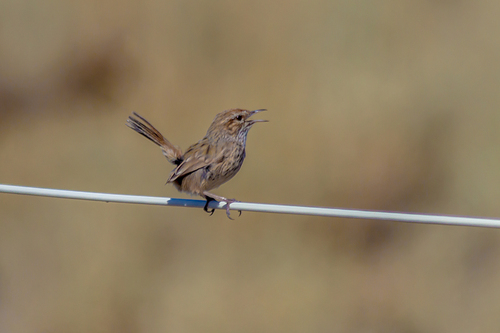
The grey fantail (Rhipidura albiscapa) is a small insectivorous bird. There is no sexual dimorphism. It is a common fantail found in Australia, the Solomon Islands, Vanuatu and New Caledonia. The species is considered by many to be conspecific with the New Zealand fantail (Rhipidura fuliginosa); however, differences in its calls lead some authorities to treat it as a separate species. The studies of grey fantail in 1999 by Richard Schodde and Ian Mason recommended that Tasmanian grey fantail was formally classified as R. albiscapa and New Zealand fantails populations as R. fuliginosa

This species is mid-to-dark grey or grey-brown above, lighter (often yellowish/orange) below, with a white throat, white markings over the eye, and with (depending on the race) either white-edged or entirely white outer tail feathers. It grows to 16 cm (6.3 in) in length, of which half is the tail, which, as the name implies, is often displayed fanned out. This reveals that the outer tail feathers are light and the centre ones are dark. Some races, such as keasti, have a darker plumage.

This species is easily seen while walking in eucalypt forest, rainforest, mangroves, heath, and wooded... Wikipedia →

Sounds

Begging call1:09

Australia · 2024

© Romuald Mikusek · XC1173777 · CC BY-NC-SA 4.0

Call0:32

Australia · 2025

© Marc Anderson · XC1088943 · CC BY-NC-ND 4.0

Song0:30

Australia · 2025

© Étienne Leroy · XC1069702 · CC BY-NC-SA 4.0

Global Distribution

Parks Where Found

# Park Country Daily sighting probability
1 Maria Island National Park 🇦🇺 Australia
~80%
2 Great Otway National Park 🇦🇺 Australia
~70%
3 Flinders Chase 🇦🇺 Australia
~70%
4 Wilsons Promontory National Park 🇦🇺 Australia
~70%
5 Freycinet National Park 🇦🇺 Australia
~70%
6 Kosciuszko National Park 🇦🇺 Australia
~70%
7 Grampians National Park 🇦🇺 Australia
~60%
8 Cradle Mountain-Lake St Clair National Park 🇦🇺 Australia
~60%
9 Blue Mountains National Park 🇦🇺 Australia
~50%
10 Lamington National Park 🇦🇺 Australia
~50%
11 Booderee National Park 🇦🇺 Australia
~50%
12 Royal National Park 🇦🇺 Australia
~50%
13 Springbrook National Park 🇦🇺 Australia
~40%
14 Flinders Ranges National Park 🇦🇺 Australia
~30%
15 Noosa National Park 🇦🇺 Australia
~20%
16 Hattah-Kulkyne National Park 🇦🇺 Australia
~10%
17 Rottnest Island 🇦🇺 Australia
~10%
18 Ningaloo Marine Park 🇦🇺 Australia
~10%
19 Cape Range 🇦🇺 Australia
~10%
20 Daintree National Park 🇦🇺 Australia
~10%
21 Uluru-Kata Tjuta National Park 🇦🇺 Australia
<5%

Cities Where Found

# City Country Daily sighting probability
1 Hobart 🇦🇺 Australia
~40%
2 Melbourne 🇦🇺 Australia
~40%
3 Brisbane 🇦🇺 Australia
~30%
4 Perth 🇦🇺 Australia
~30%
5 Sydney 🇦🇺 Australia
~20%

Before you go

What are the chances of seeing a Grey Fantail in Ningaloo Marine Park?

With luck

About 10% of wildlife watchers report a Grey Fantail sighting in Ningaloo Marine Park on a given day, based on 25 verified sightings from GBIF citizen-science data from 2019 to 2026. It is the 61st most-seen of the 102 birds we can rate there. Over three days the chance rises to about 20%, and over a week to about 50%, if each day is a fresh chance.

When is the best time to see a Grey Fantail in Ningaloo Marine Park?

June

In that month about 20% of wildlife watchers report a Grey Fantail in Ningaloo Marine Park on a given day, against under 5% in September to May, the lowest months. That is one of Ningaloo Marine Park's wettest months, with about 50 mm of rain against almost none in October.

What time of day is best to see a Grey Fantail?

Between noon and 3 pm

Across all the parks we cover, that three-hour window holds the most Grey Fantail sightings with a recorded time, and nearly all of them come between 6 am and 6 pm: it is a daytime animal.

Which relatives of the Grey Fantail live in Ningaloo Marine Park?

Same genus: Rhipidura

The closest relatives of the Grey Fantail that you can see in Ningaloo Marine Park (genus Rhipidura, Fantails) are Mangrove Fantail (about 30%) and Willie Wagtail (about 10%), with each one's daily chance of a sighting.

Where does the Grey Fantail sighting chance come from?

GBIF citizen-science records

It is estimated from how often the Grey Fantail is recorded against all the birds logged in Ningaloo Marine Park (25 verified sightings from 2019 to 2026), calibrated against known sighting rates. Figures are rounded to the nearest 10% because citizen-science data supports honest approximations, not decimals, and months with records from fewer than five people show "—". How it works.

← Back to Ningaloo Marine Park