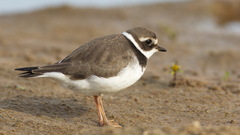
Common Ringed Plover

Common Ringed Plover

Charadrius hiaticula

Silhouette: Alexandre Vong · PhyloPic

LCLeast ConcernNTVUENCR
Daily sighting probability <5% · Rare
at Niokolo-Koba National Park

In 3 days ~10%

7 Verified sightings at Niokolo-Koba National Park From 2019 to 2026
8,326 In all 44 parks
April Best month
☀️ Diurnal When it's spotted

About the Common Ringed Plover

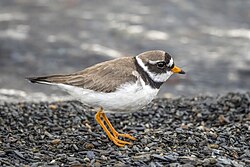
The common ringed plover, great ringed plover or ringed plover (Charadrius hiaticula) is a species of bird in the family Charadriidae. It breeds across much of northern Eurasia, as well as Greenland. The common ringed plover was formally described in 1758 by the Swedish naturalist Carl Linnaeus in the tenth edition of his Systema Naturae under the current binomial name Charadrius hiaticula. Linnaeus specified the type locality as "Europa & America" but this is now restricted to Sweden. The specific epithet hiaticula is late Medieval Latin for a plover.

Three subspecies are recognised: Lawrence Island (north Bering Sea; erratic... Wikipedia →

Sounds

Call0:09

Norway · 2026

© Mats Rellmar · XC1173212 · CC BY-NC-SA 4.0

Flight call0:20

Sweden · 2025

© Lars Edenius · XC1033971 · CC BY-NC-SA 4.0

Alarm call1:09

Finland · 2025

© Eetu Paljakka · XC1002342 · CC BY-NC-SA 4.0

Global Distribution

Parks Where Found

# Park Country Daily sighting probability
1 West Coast National Park 🇿🇦 South Africa
~50%
2 Wadden Sea National Park 🇩🇪 Germany
~30%
3 Svalbard 🇳🇴 Norway
~30%
4 Doñana National Park 🇪🇸 Spain
~30%
5 Vatnajokull National Park 🇮🇸 Iceland
~30%
6 Lake Nakuru National Park 🇰🇪 Kenya
~20%
7 Camargue 🇫🇷 France
~20%
8 Ngorongoro Conservation Area 🇹🇿 Tanzania
~10%
9 Amboseli National Park 🇰🇪 Kenya
~10%
10 Arusha National Park 🇹🇿 Tanzania
~10%
11 iSimangaliso Wetland Park 🇿🇦 South Africa
~10%
12 Lake Manyara National Park 🇹🇿 Tanzania
~10%
13 Kiskunság National Park 🇭🇺 Hungary
~10%
14 Queen Elizabeth National Park 🇺🇬 Uganda
~10%
15 Snowdonia National Park 🇬🇧 United Kingdom
~10%
16 Murchison Falls National Park 🇺🇬 Uganda
~10%
17 Serengeti National Park 🇹🇿 Tanzania
~10%
18 Hortobágy National Park 🇭🇺 Hungary
~10%
19 Tsavo East National Park 🇰🇪 Kenya
~10%
20 De Hoop Nature Reserve 🇿🇦 South Africa
~10%
21 Liwonde National Park 🇲🇼 Malawi
~10%
22 Nairobi National Park 🇰🇪 Kenya
<5%
23 Tarangire National Park 🇹🇿 Tanzania
<5%
24 Addo Elephant National Park 🇿🇦 South Africa
<5%
25 Sierra de Guadarrama National Park 🇪🇸 Spain
<5%
26 Białowieża National Park 🇵🇱 Poland
<5%
27 Fertő-Hanság National Park 🇭🇺 Hungary
<5%
28 Garden Route National Park 🇿🇦 South Africa
<5%
29 Moremi Game Reserve 🇧🇼 Botswana
<5%
30 Samburu National Reserve 🇰🇪 Kenya
<5%
31 Tsavo West National Park 🇰🇪 Kenya
<5%
32 Table Mountain National Park 🇿🇦 South Africa
<5%
33 Niokolo-Koba National Park 🇸🇳 Senegal
<5%
34 Yala National Park 🇱🇰 Sri Lanka
<5%
35 Cairngorms National Park 🇬🇧 United Kingdom
<5%
36 South Luangwa National Park 🇿🇲 Zambia
<5%
37 Kafue National Park 🇿🇲 Zambia
<5%
38 Hwange National Park 🇿🇼 Zimbabwe
<5%
39 Etosha National Park 🇳🇦 Namibia
<5%
40 Masai Mara National Reserve 🇰🇪 Kenya
<5%
41 Chobe National Park 🇧🇼 Botswana
<5%
42 Kruger National Park 🇿🇦 South Africa
<5%
43 Biebrza National Park 🇵🇱 Poland
<5%
44 Monfragüe National Park 🇪🇸 Spain
<5%

Cities Where Found

# City Country Daily sighting probability
1 Zanzibar City 🇹🇿 Tanzania
~50%
2 Kuwait City 🇰🇼 Kuwait
~30%
3 Ouagadougou 🇧🇫 Burkina Faso
~30%
4 Manama 🇧🇭 Bahrain
~20%
5 Liverpool 🇬🇧 United Kingdom
~20%
6 Dar es-Salaam 🇹🇿 Tanzania
~20%
7 Casablanca 🇲🇦 Morocco
~20%
8 Maputo 🇲🇿 Mozambique
~20%
9 Mombasa 🇰🇪 Kenya
~20%
10 Jeddah 🇸🇦 Saudi Arabia
~10%

Zoos & Centres Where Found

# Zoo / Centre Country
1 Dresden Zoo 🇩🇪 Germany In captivity
2 Slimbridge Wetland Centre 🇬🇧 United Kingdom In captivity
3 Wildpark Schwarze Berge 🇩🇪 Germany In captivity
4 Cologne Zoological Garden 🇩🇪 Germany In captivity
5 Aachener Tierpark Euregiozoo 🇩🇪 Germany In captivity
6 Cologne Zoo Aquarium 🇩🇪 Germany In captivity

Before you go

What are the chances of seeing a Common Ringed Plover in Niokolo-Koba National Park?

Rare

Under 5% of wildlife watchers report a Common Ringed Plover sighting in Niokolo-Koba National Park on a given day, based on 7 verified sightings from GBIF citizen-science data from 2019 to 2026. It is the 201st most-seen of the 215 birds we can rate there. Over three days the chance rises to about 10%, if each day is a fresh chance.

When is the best time to see a Common Ringed Plover in Niokolo-Koba National Park?

April

In that month about 20% of wildlife watchers report a Common Ringed Plover in Niokolo-Koba National Park on a given day, against under 5% in August–September and November–March, the lowest months. That is one of Niokolo-Koba National Park's driest months, with almost no rain against 300 mm in August. May–July and October have too few records to rate.

What time of day is best to see a Common Ringed Plover?

Between noon and 3 pm

Across all the parks we cover, that three-hour window holds the most Common Ringed Plover sightings with a recorded time, and about 8 in 10 of them come between 6 am and 6 pm: it is a daytime animal.

Is Niokolo-Koba National Park the best place to see a Common Ringed Plover?

33rd of 44

Of the 44 parks where we can rate Common Ringed Plover sightings, Niokolo-Koba National Park ranks 33rd at under 5%. The best odds are in West Coast National Park (South Africa, about 50%), Wadden Sea National Park (Germany, about 30%) and Svalbard (Norway, about 30%). All parks ranked.

Which relatives of the Common Ringed Plover live in Niokolo-Koba National Park?

Same family: Charadriidae

The closest relatives of the Common Ringed Plover that you can see in Niokolo-Koba National Park (family Charadriidae, Plovers and Lapwings) are Spur-winged Lapwing (about 60%), African Wattled Lapwing (about 60%) and White-headed Lapwing (about 40%), with each one's daily chance of a sighting.

Where does the Common Ringed Plover sighting chance come from?

GBIF citizen-science records

It is estimated from how often the Common Ringed Plover is recorded against all the birds logged in Niokolo-Koba National Park (7 verified sightings from 2019 to 2026), calibrated against known sighting rates. Figures are rounded to the nearest 10% because citizen-science data supports honest approximations, not decimals, and months with records from fewer than five people show "—". How it works.

← Back to Niokolo-Koba National Park