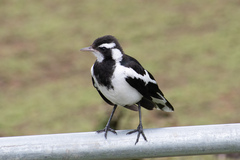
Magpie-lark

Magpie-lark

Grallina cyanoleuca

Silhouette: Sheatherius · PhyloPic

LCLeast ConcernNTVUENCR
Daily sighting probability ~40% · Likely
at Phillip Island Nature Park

In 3 days ~80% in a week >90%

744 Verified sightings at Phillip Island Nature Park From 2019 to 2026
6,309 In all 22 parks
May Best month
☀️ Diurnal When it's spotted

About the Magpie-lark

The magpie-lark (Grallina cyanoleuca), also known as wee magpie, peewee, peewit, mudlark or Murray magpie, is a passerine bird native to Australia, Timor, and southern New Guinea. The male and female both have black and white plumage, though with different patterns. John Latham described the species in 1801. Long thought to be a member of the mudnest builder family Corcoracidae, it has been reclassified in the family Monarchidae (the monarch flycatchers). Two subspecies are recognized.

The magpie-lark was originally described by the English ornithologist John Latham in the genus Corvus in 1801 (as Corvus cyanoleucus). Its species name is derived from the Ancient Greek words cyanos "dark blue" and leukos "white" despite the black and white plumage. However, there can be a bluish sheen to the black back. In the same publication, Latham described the same species as Gracula picata. In 1843, Hugh Edwin Strickland proposed using the second name as it was the more accurate, resulting in Grallina picata. Formerly, some authorities have classified the magpie-lark as belonging to a genus of bee-eaters, Merops.

Latham gave the species the common names of blue and...

Wikipedia →

Sounds

Call0:09

Australia · 2026

© Faustino Hollmann · XC1176847 · CC BY-NC-SA 4.0

Song0:51

Australia · 2026

© Marc Anderson · XC1084964 · CC BY-NC-ND 4.0

Alarm call0:36

Australia · 2021

© James Lambert · XC692383 · CC BY-NC-ND 4.0

Global Distribution

Parks Where Found

# Park Country Daily sighting probability
1 Hattah-Kulkyne National Park 🇦🇺 Australia
~50%
2 Kakadu National Park 🇦🇺 Australia
~40%
3 Phillip Island Nature Park 🇦🇺 Australia
~40%
4 Uluru-Kata Tjuta National Park 🇦🇺 Australia
~40%
5 Nitmiluk National Park 🇦🇺 Australia
~30%
6 Litchfield National Park 🇦🇺 Australia
~30%
7 Flinders Ranges National Park 🇦🇺 Australia
~30%
8 Blue Mountains National Park 🇦🇺 Australia
~30%
9 Kosciuszko National Park 🇦🇺 Australia
~30%
10 Noosa National Park 🇦🇺 Australia
~20%
11 Great Otway National Park 🇦🇺 Australia
~20%
12 Royal National Park 🇦🇺 Australia
~20%
13 Daintree National Park 🇦🇺 Australia
~20%
14 Booderee National Park 🇦🇺 Australia
~20%
15 Wilsons Promontory National Park 🇦🇺 Australia
~20%
16 Flinders Chase 🇦🇺 Australia
~10%
17 Grampians National Park 🇦🇺 Australia
~10%
18 Rottnest Island 🇦🇺 Australia
~10%
19 Pilliga National Park 🇦🇺 Australia
~10%
20 Springbrook National Park 🇦🇺 Australia
~10%
21 Cape Range 🇦🇺 Australia
~10%
22 Lamington National Park 🇦🇺 Australia
<5%

Cities Where Found

# City Country Daily sighting probability
1 Melbourne 🇦🇺 Australia
~80%
2 Brisbane 🇦🇺 Australia
~60%
3 Perth 🇦🇺 Australia
~50%
4 Sydney 🇦🇺 Australia
~50%

Zoos & Centres Where Found

# Zoo / Centre Country
1 Australian Reptile Park 🇦🇺 Australia In captivity
2 Birdworld Kuranda 🇦🇺 Australia In captivity
3 Kuranda Koala Gardens 🇦🇺 Australia In captivity

Before you go

What are the chances of seeing a Magpie-lark in Phillip Island Nature Park?

Likely

About 40% of wildlife watchers report a Magpie-lark sighting in Phillip Island Nature Park on a given day, based on 744 verified sightings from GBIF citizen-science data from 2019 to 2026. It is the 26th most-seen of the 149 birds we can rate there. Over three days the chance rises to about 80%, and over a week to over 90%, if each day is a fresh chance.

When is the best time to see a Magpie-lark in Phillip Island Nature Park?

May

In that month about 50% of wildlife watchers report a Magpie-lark in Phillip Island Nature Park on a given day, against about 30% in September, the lowest month.

What time of day is best to see a Magpie-lark?

Between 11 am and 2 pm

Across all the parks we cover, that three-hour window holds the most Magpie-lark sightings with a recorded time, and nearly all of them come between 6 am and 6 pm: it is a daytime animal.

Is Phillip Island Nature Park the best place to see a Magpie-lark?

3rd of 22

Of the 22 parks where we can rate Magpie-lark sightings, Phillip Island Nature Park ranks 3rd at about 40%. The best odds are in Hattah-Kulkyne National Park (Australia, about 50%) and Kakadu National Park (Australia, about 40%). All parks ranked.

Where does the Magpie-lark sighting chance come from?

GBIF citizen-science records

It is estimated from how often the Magpie-lark is recorded against all the birds logged in Phillip Island Nature Park (744 verified sightings from 2019 to 2026), calibrated against known sighting rates. Figures are rounded to the nearest 10% because citizen-science data supports honest approximations, not decimals, and months with records from fewer than five people show "—". How it works.

← Back to Phillip Island Nature Park