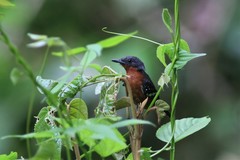
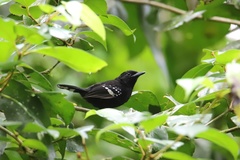
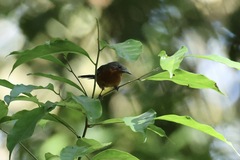

Dot-winged Antwren

Dot-winged Antwren

Microrhopias quixensis

Silhouette: Sheatherius · PhyloPic

LCLeast ConcernNTVUENCR
Daily sighting probability <5% · Rare
at Tikal National Park

In 3 days ~10% in a week ~20%

57 Verified sightings at Tikal National Park From 2019 to 2026
11,932 In all 27 parks
October Best month
☀️ Diurnal When it's spotted

About the Dot-winged Antwren

The dot-winged antwren (Microrhopias quixensis) or velvety antwren is a passerine bird in subfamily Thamnophilinae of family Thamnophilidae, the "typical antbirds". It is found in Mexico, every Central American country except El Salvador, Bolivia, Brazil, Colombia, Ecuador, French Guiana, Guyana, Peru, and Suriname.

The dot-winged antwren is the only member of genus Microrhopias, which was erected by the English zoologist Philip Sclater in 1862. Several authors have suggested that some of the subspecies deserve recognition as species due to differences in plumage, voice, and habitat associations. Wikipedia →

Sounds

Call0:53

Ecuador · 2025

© Manuel Sánchez-Nivicela · XC1155505 · CC BY-NC-ND 4.0

Song0:43

Brazil · 2023

© JAYRSON ARAUJO DE OLIVEIRA · XC821616 · CC BY-NC-SA 4.0

Alarm call0:29

Brazil · 2021

© Felipe Arantes · XC681192 · CC BY-NC-SA 4.0

Global Distribution

Parks Where Found

# Park Country Daily sighting probability
1 Soberanía National Park 🇵🇦 Panama
~50%
2 Cockscomb Basin Wildlife Sanctuary 🇧🇿 Belize
~40%
3 Corcovado National Park 🇨🇷 Costa Rica
~30%
4 Carara National Park 🇨🇷 Costa Rica
~20%
5 Darién National Park 🇵🇦 Panama
~20%
6 Bastimentos Island National Marine Park 🇵🇦 Panama
~20%
7 Cahuita National Park 🇨🇷 Costa Rica
~20%
8 Piedras Blancas National Park 🇨🇷 Costa Rica
~10%
9 San Lorenzo Protected Forest 🇵🇦 Panama
~10%
10 Montes Azules Biosphere Reserve 🇲🇽 Mexico
~10%
11 Manu National Park 🇵🇪 Peru
~10%
12 Parque Natural Metropolitano 🇵🇦 Panama
~10%
13 La Amistad International Park (Panama) 🇵🇦 Panama
~10%
14 Chagres National Park 🇵🇦 Panama
<5%
15 Gandoca-Manzanillo Wildlife Refuge 🇨🇷 Costa Rica
<5%
16 Tikal National Park 🇬🇹 Guatemala
<5%
17 Marino Ballena National Park 🇨🇷 Costa Rica
<5%
18 Tambopata National Reserve 🇵🇪 Peru
<5%
19 Cusuco National Park 🇭🇳 Honduras
<5%
20 Pico Bonito National Park 🇭🇳 Honduras
<5%
21 Manuel Antonio National Park 🇨🇷 Costa Rica
<5%
22 Yasuní National Park 🇪🇨 Ecuador
<5%
23 Tapantí-Macizo de la Muerte National Park 🇨🇷 Costa Rica
<5%
24 Braulio Carrillo National Park 🇨🇷 Costa Rica
<5%
25 Farallones de Cali National Natural Park 🇨🇴 Colombia
<5%
26 Arenal Volcano National Park 🇨🇷 Costa Rica
<5%
27 Tortuguero National Park 🇨🇷 Costa Rica
<5%

Before you go

What are the chances of seeing a Dot-winged Antwren in Tikal National Park?

Rare

Under 5% of wildlife watchers report a Dot-winged Antwren sighting in Tikal National Park on a given day, based on 57 verified sightings from GBIF citizen-science data from 2019 to 2026. It is the 195th most-seen of the 300 birds we can rate there. Over three days the chance rises to about 10%, and over a week to about 20%, if each day is a fresh chance.

When is the best time to see a Dot-winged Antwren in Tikal National Park?

August, October and December

In those months about 10% of wildlife watchers report a Dot-winged Antwren in Tikal National Park on a given day, against under 5% in January–July, September and November, the lowest months.

What time of day is best to see a Dot-winged Antwren?

Between 8 and 11 am

Across all the parks we cover, that three-hour window holds the most Dot-winged Antwren sightings with a recorded time, and about 9 in 10 of them come between 6 am and 6 pm: it is a daytime animal.

Where does the Dot-winged Antwren sighting chance come from?

GBIF citizen-science records

It is estimated from how often the Dot-winged Antwren is recorded against all the birds logged in Tikal National Park (57 verified sightings from 2019 to 2026), calibrated against known sighting rates. Figures are rounded to the nearest 10% because citizen-science data supports honest approximations, not decimals, and months with records from fewer than five people show "—". How it works.

← Back to Tikal National Park