Gray-cheeked Thrush

Gray-cheeked Thrush

Catharus minimus

Silhouette: Sharon Wegner-Larsen · PhyloPic

LCLeast ConcernNTVUENCR
Daily sighting probability <5% · Rare
at Edmonton

In 3 days <5%

24 Verified sightings at Edmonton
1,850 In all 37 parks From 2019 to 2026
May Best month
☀️ Diurnal When it's spotted

About the Gray-cheeked Thrush

The gray-cheeked thrush (Catharus minimus) is a medium-sized thrush. This species is 15–17 cm (5.9–6.7 in) in length, and has the white-dark-white underwing pattern characteristic of Catharus thrushes. It is a member of a close-knit group of migrant species together with the veery and Bicknell's thrush; it forms a cryptic species pair with the latter. The gray-cheeked thrush is all but indistinguishable from Bicknell's thrush except by its slightly larger size and different song. The two were formerly considered conspecific. Of all the American spotted thrushes, the gray-cheeked has the most northern breeding range.

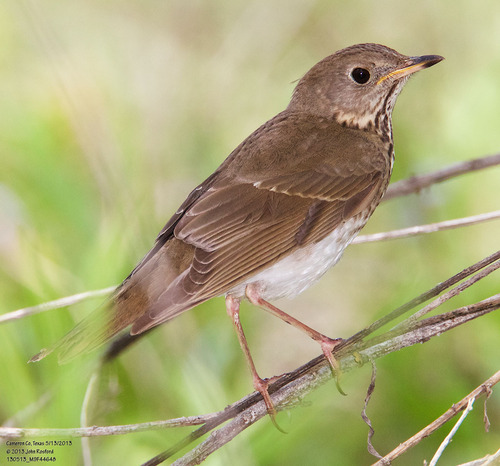
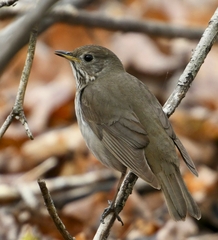
The gray-cheeked thrush is slightly larger than other Catharus thrushes, about 16 to 17 cm (6.7 in) in height and weighing between 26 and 30g. Wingspan ranges from 12.6-13.4 in (32-34 cm). The bird can be identified by its grayish face, partial pale eyering, drab gray-brown upperside and extensively dusky flanks. The area between the eye and the beak is grayish as well, but the area running from the beak to above the eye is grayish white. The gray-cheeked thrush is nearly identical to the Bicknell's Thrush.

There are two subspecies: the northern gray... Wikipedia →

Sounds

Song0:08

United States · 2024

© Seth Beaudreault (Toolik Field Station) · XC940496 · CC BY-NC-SA 4.0

Nocturnal flight call0:04

Canada · 2023

© David Tattersley · XC811540 · CC BY-NC-SA 4.0

Call1:09

Colombia · 2022

© Mauricio Cuéllar Ramírez · XC762296 · CC BY-NC-SA 4.0

Global Distribution

Parks Where Found

# Park Country Daily sighting probability
1 Denali National Park 🇺🇸 United States
~10%
2 Katmai National Park 🇺🇸 United States
~10%
3 Point Pelee National Park 🇨🇦 Canada
~10%
4 Wrangell-St. Elias National Park 🇺🇸 United States
<5%
5 Joshua Tree National Park 🇺🇸 United States
<5%
6 Brownsberg Nature Park 🇸🇷 Suriname
<5%
7 Kenai Fjords National Park 🇺🇸 United States
<5%
8 Gandoca-Manzanillo Wildlife Refuge 🇨🇷 Costa Rica
<5%
9 Cahuita National Park 🇨🇷 Costa Rica
<5%
10 Tayrona National Natural Park 🇨🇴 Colombia
<5%
11 Pico Bonito National Park 🇭🇳 Honduras
<5%
12 Bastimentos Island National Marine Park 🇵🇦 Panama
<5%
13 Celestún Biosphere Reserve 🇲🇽 Mexico
<5%
14 Soberanía National Park 🇵🇦 Panama
<5%
15 Congaree National Park 🇺🇸 United States
<5%
16 Chagres National Park 🇵🇦 Panama
<5%
17 Henri Pittier National Park 🇻🇪 Venezuela
<5%
18 Tortuguero National Park 🇨🇷 Costa Rica
<5%
19 Tenorio Volcano National Park 🇨🇷 Costa Rica
<5%
20 Tikal National Park 🇬🇹 Guatemala
<5%
21 La Amistad International Park (Panama) 🇵🇦 Panama
<5%
22 Great Smoky Mountains National Park 🇺🇸 United States
<5%
23 Parque Natural Metropolitano 🇵🇦 Panama
<5%
24 Gros Morne National Park 🇨🇦 Canada
<5%
25 Rincón de la Vieja National Park 🇨🇷 Costa Rica
<5%
26 Braulio Carrillo National Park 🇨🇷 Costa Rica
<5%
27 Cockscomb Basin Wildlife Sanctuary 🇧🇿 Belize
<5%
28 Sierra de la Macarena National Park 🇨🇴 Colombia
<5%
29 Everglades National Park 🇺🇸 United States
<5%
30 Volcán Barú National Park 🇵🇦 Panama
<5%
31 Big Cypress National Preserve 🇺🇸 United States
<5%
32 Arenal Volcano National Park 🇨🇷 Costa Rica
<5%
33 Sian Ka'an Biosphere Reserve 🇲🇽 Mexico
<5%
34 Shenandoah National Park 🇺🇸 United States
<5%
35 Tapantí-Macizo de la Muerte National Park 🇨🇷 Costa Rica
<5%
36 Merritt Island National Wildlife Refuge 🇺🇸 United States
<5%
37 Monteverde Cloud Forest Reserve 🇨🇷 Costa Rica
<5%

Cities Where Found

# City Country Daily sighting probability
1 Chicago 🇺🇸 United States
<5%
2 Havana 🇨🇺 Cuba
<5%
3 Bogota 🇨🇴 Colombia
<5%
4 New York City 🇺🇸 United States
<5%
5 Minneapolis [Saint Paul] 🇺🇸 United States
<5%
6 Baltimore 🇺🇸 United States
<5%
7 Detroit 🇺🇸 United States
<5%
8 Toronto 🇨🇦 Canada
<5%
9 Houston 🇺🇸 United States
<5%
10 Miami 🇺🇸 United States
<5%

Zoos & Centres Where Found

# Zoo / Centre Country
1 Ralph Perkins II Wildlife Center and Woods Garden 🇺🇸 United States In captivity

Before you go

What are the chances of seeing a Gray-cheeked Thrush in Edmonton?

Rare

Under 5% of wildlife watchers report a Gray-cheeked Thrush sighting in Edmonton on a given day, based on 24 verified sightings from GBIF citizen-science data. It is the 161st most-seen of the 190 birds we can rate there. Over three days the chance rises to under 5%, if each day is a fresh chance.

When is the best time to see a Gray-cheeked Thrush in Edmonton?

Any time of year

In every month with enough records, under 5% of wildlife watchers report a Gray-cheeked Thrush in Edmonton on a given day, so our monthly data shows no clear season.

What time of day is best to see a Gray-cheeked Thrush?

Between 8 and 11 am

Across all the parks we cover, that three-hour window holds the most Gray-cheeked Thrush sightings with a recorded time, and about 9 in 10 of them come between 6 am and 6 pm: it is a daytime animal.

Is Edmonton the best place to see a Gray-cheeked Thrush?

Among the best

Of the 23 cities where we can rate Gray-cheeked Thrush sightings, Edmonton ranks 17th at under 5%, level with the leaders once rounded. The best odds are in Chicago (United States, under 5%), Havana (Cuba, under 5%) and Bogota (Colombia, under 5%).

Where does the Gray-cheeked Thrush sighting chance come from?

GBIF citizen-science records

It is estimated from how often the Gray-cheeked Thrush is recorded against all the birds logged in Edmonton (24 verified sightings), calibrated against known sighting rates. Figures are rounded to the nearest 10% because citizen-science data supports honest approximations, not decimals, and months with records from fewer than five people show "—". How it works.
← Back to Edmonton