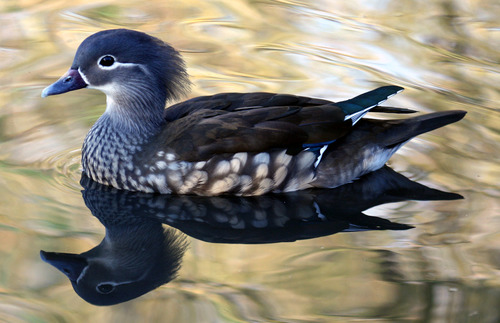
Eurasian Teal

Eurasian Teal

Anas crecca

Silhouette: Sheatherius · PhyloPic

LCLeast ConcernNTVUENCR
Daily sighting probability ~20% · Possible
at Hangzhou

In 3 days ~50% in a week ~80%

365 Verified sightings at Hangzhou
10,686 In all 33 parks From 2019 to 2026
February Best month
☀️ Diurnal When it's spotted

About the Eurasian Teal

The Eurasian teal (Anas crecca), common teal, or Eurasian green-winged teal is a common and widespread duck that breeds in temperate Eurosiberia and migrates south in winter. The Eurasian teal is often called simply the teal due to being the only one of these small dabbling ducks in much of its range. The bird gives its name to the blue-green colour teal.

It is a highly gregarious duck outside the breeding season and can form large flocks. It is commonly found in sheltered wetlands and feeds on seeds and aquatic invertebrates. The North American green-winged teal (A. carolinensis) was formerly (and sometimes is still) considered a subspecies of A. crecca.

The Eurasian teal belongs to the "true" teals, a group of small Anas dabbling ducks closely related to the mallard (A. platyrhynchos) and its relatives; that latter group in fact seems to have evolved from a true teal. It forms a superspecies with the green-winged teal and the speckled teal (A. flavirostris). A formerly proposed subspecies, A. c. nimia, from the Aleutian Islands, differs only in slightly larger size; it is no longer considered distinct.

Whether the Eurasian and green-winged teals are to be treated as... Wikipedia →

Sounds

Flight call0:17

Sweden · 2026

© Lars Edenius · XC1106784 · CC BY-NC-SA 4.0

Call0:49

Sweden · 2025

© Ulf Elman · XC991881 · CC BY-NC-ND 4.0

Nocturnal flight call0:28

Ireland · 2022

© Irish Wildlife Sounds · XC775089 · CC BY-NC-ND 4.0

Global Distribution

Parks Where Found

# Park Country Daily sighting probability
1 Kaziranga National Park 🇮🇳 India
~60%
2 Keoladeo National Park 🇮🇳 India
~50%
3 Kiskunság National Park 🇭🇺 Hungary
~40%
4 Hortobágy National Park 🇭🇺 Hungary
~40%
5 Wadden Sea National Park 🇩🇪 Germany
~30%
6 Fertő-Hanság National Park 🇭🇺 Hungary
~30%
7 Snowdonia National Park 🇬🇧 United Kingdom
~30%
8 Doñana National Park 🇪🇸 Spain
~20%
9 Camargue 🇫🇷 France
~20%
10 Ranthambore National Park 🇮🇳 India
~20%
11 Biebrza National Park 🇵🇱 Poland
~20%
12 Cairngorms National Park 🇬🇧 United Kingdom
~10%
13 Bavarian Forest National Park 🇩🇪 Germany
~10%
14 Vatnajokull National Park 🇮🇸 Iceland
~10%
15 Manas National Park 🇮🇳 India
~10%
16 Nikko National Park 🇯🇵 Japan
~10%
17 Białowieża National Park 🇵🇱 Poland
~10%
18 Kanha National Park 🇮🇳 India
~10%
19 Monfragüe National Park 🇪🇸 Spain
<5%
20 Chitwan National Park 🇳🇵 Nepal
<5%
21 Bale Mountains National Park 🇪🇹 Ethiopia
<5%
22 Sierra de Guadarrama National Park 🇪🇸 Spain
<5%
23 Royal Bardia National Park 🇳🇵 Nepal
<5%
24 Bandipur National Park 🇮🇳 India
<5%
25 Sierra Nevada National Park 🇪🇸 Spain
<5%
26 Gauja National Park 🇱🇻 Latvia
<5%
27 Svalbard 🇳🇴 Norway
<5%
28 Satpura National Park 🇮🇳 India
<5%
29 Nagarhole National Park 🇮🇳 India
<5%
30 Royal Manas National Park 🇧🇹 Bhutan
<5%
31 Jim Corbett National Park 🇮🇳 India
<5%
32 Bandhavgarh National Park 🇮🇳 India
<5%
33 Pyrénées National Park 🇫🇷 France
<5%

Cities Where Found

# City Country Daily sighting probability
1 Sendai 🇯🇵 Japan
~50%
2 Nagoya 🇯🇵 Japan
~40%
3 Naha 🇯🇵 Japan
~40%
4 Quanzhou 🇨🇳 China
~40%
5 Daejeon 🇰🇷 South Korea
~40%
6 Helsinki 🇫🇮 Finland
~40%
7 Liverpool 🇬🇧 United Kingdom
~30%
8 Tokyo 🇯🇵 Japan
~30%
9 Osaka 🇯🇵 Japan
~30%
10 Tuen Mun 🇨🇳 China
~30%

Zoos & Centres Where Found

# Zoo / Centre Country
1 SeaWorld Orlando 🇺🇸 United States In captivity
2 Prague Zoo 🇨🇿 Czechia In captivity
3 National Zoological Park 🇺🇸 United States In captivity
4 Denver Zoo 🇺🇸 United States In captivity
5 Dresden Zoo 🇩🇪 Germany In captivity
6 Abilene Zoological Gardens 🇺🇸 United States In captivity
7 Taipei Zoo 🇹🇼 Taiwan In captivity
8 Wildpark Poing 🇩🇪 Germany In captivity
9 Oregon Zoo 🇺🇸 United States In captivity
10 Centro Cicogne e Anatidi 🇮🇹 Italy In captivity
11 Wanpi World Zoo 🇹🇼 Taiwan In captivity
12 Augsburg Zoo 🇩🇪 Germany In captivity
13 Bird Paradise 🇸🇬 Singapore In captivity
14 Rosamond Gifford Zoo 🇺🇸 United States In captivity
15 Lincoln Park Zoo 🇺🇸 United States In captivity
16 Rainforest Wild Asia 🇸🇬 Singapore In captivity
17 The Abilene Zoo 🇺🇸 United States In captivity
18 Van Blanckendaell Park 🇳🇱 Netherlands In captivity
19 Inokashira Park Zoo 🇯🇵 Japan In captivity
20 Oasi Naturalistica di Sant'Alessio 🇮🇹 Italy In captivity
21 L'Oceanogràfic 🇪🇸 Spain In captivity
22 Bois de la Bâtie 🇨🇭 Switzerland In captivity
23 Alpenzoo Innsbruck 🇦🇹 Austria In captivity
24 Tracy Aviary 🇺🇸 United States In captivity
25 Brandywine Zoo 🇺🇸 United States In captivity
26 蘭陽動植物王國 🇹🇼 Taiwan In captivity
27 Freilandanlage, Wasserstern 1904, Terrarien, Aquarien 🇩🇪 Germany In captivity
28 Rákosův pavilon 🇨🇿 Czechia In captivity
29 Velemlokárium 🇨🇿 Czechia In captivity

Before you go

What are the chances of seeing a Eurasian Teal in Hangzhou?

Possible

About 20% of wildlife watchers report a Eurasian Teal sighting in Hangzhou on a given day, based on 365 verified sightings from GBIF citizen-science data. It is the 36th most-seen of the 219 birds we can rate there. Over three days the chance rises to about 50%, and over a week to about 80%, if each day is a fresh chance.

When is the best time to see a Eurasian Teal in Hangzhou?

November to February

In those months about 40% of wildlife watchers report a Eurasian Teal in Hangzhou on a given day, against under 5% in April to September, the lowest months.

What time of day is best to see a Eurasian Teal?

Between noon and 3 pm

Across all the parks we cover, that three-hour window holds the most Eurasian Teal sightings with a recorded time, and nearly all of them come between 6 am and 6 pm: it is a daytime animal.

Is Hangzhou the best place to see a Eurasian Teal?

14th of 115

Of the 115 cities where we can rate Eurasian Teal sightings, Hangzhou ranks 14th at about 20%. The best odds are in Sendai (Japan, about 50%), Nagoya (Japan, about 40%) and Naha (Japan, about 40%).

Which relatives of the Eurasian Teal live in Hangzhou?

Same genus: Anas

The closest relatives of the Eurasian Teal that you can see in Hangzhou (genus Anas, Mallards, Pintails, and Allies) are Eastern Spot-billed Duck (about 50%) and Mallard (about 20%), with each one's daily chance of a sighting.

Where does the Eurasian Teal sighting chance come from?

GBIF citizen-science records

It is estimated from how often the Eurasian Teal is recorded against all the birds logged in Hangzhou (365 verified sightings), calibrated against known sighting rates. Figures are rounded to the nearest 10% because citizen-science data supports honest approximations, not decimals, and months with records from fewer than five people show "—". How it works.

← Back to Hangzhou