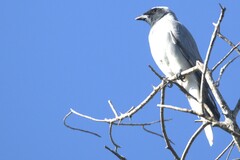
Black-faced Cuckoo-shrike

Black-faced Cuckoo-shrike

Coracina novaehollandiae

Silhouette: PhyloPic

LCLeast ConcernNTVUENCR
Daily sighting probability <5% · Rare
at Hobart

In 3 days ~10% in a week ~20%

54 Verified sightings at Hobart
4,151 In all 24 parks From 2019 to 2026
December Best month
☀️ Diurnal When it's spotted

About the Black-faced Cuckoo-shrike

The black-faced cuckooshrike (Coracina novaehollandiae) is a common omnivorous passerine bird native to Australia and southern New Guinea. It has a protected status in New South Wales, under the National Parks and Wildlife Act, 1974.

They are widely distributed in almost any wooded habitat throughout the region, except in rainforests. But they can also occur in urban areas, and are a fairly common sight on power lines in Australian cities such as Sydney and Perth.

The black-faced cuckooshrike was formally described in 1789 by the German naturalist Johann Friedrich Gmelin in his revised and expanded edition of Carl Linnaeus's Systema Naturae. He placed it with the thrushes in the genus Turdus and coined the binomial name Turdus novaehollandiae. Gmelin based his description on the "New Holland thrush" that had been described in 1783 by the English ornithologist John Latham in his book A General Synopsis of Birds. Lathan had examined a specimen in the collection of the naturalist Joseph Banks that had come from Adventure Bay in southern Tasmania. Adventure Bay had been visited by Captain James Cook in January 1777 on his third voyage to the Pacific Ocean. A painting of the... Wikipedia →

Sounds

Song0:38

Australia · 2024

© Romuald Mikusek · XC1173921 · CC BY-NC-SA 4.0

Call0:42

Australia · 2026

© Marc Anderson · XC1084944 · CC BY-NC-ND 4.0

Flight call0:53

Australia · 2026

© Khristos Nizamis · XC1073875 · CC BY-NC-ND 4.0

Global Distribution

Parks Where Found

# Park Country Daily sighting probability
1 Uluru-Kata Tjuta National Park 🇦🇺 Australia
~50%
2 Hattah-Kulkyne National Park 🇦🇺 Australia
~40%
3 Royal National Park 🇦🇺 Australia
~20%
4 Kosciuszko National Park 🇦🇺 Australia
~20%
5 Springbrook National Park 🇦🇺 Australia
~20%
6 Nitmiluk National Park 🇦🇺 Australia
~20%
7 Noosa National Park 🇦🇺 Australia
~20%
8 Blue Mountains National Park 🇦🇺 Australia
~20%
9 Grampians National Park 🇦🇺 Australia
~20%
10 Flinders Chase 🇦🇺 Australia
~20%
11 Kakadu National Park 🇦🇺 Australia
~20%
12 Flinders Ranges National Park 🇦🇺 Australia
~20%
13 Booderee National Park 🇦🇺 Australia
~10%
14 Daintree National Park 🇦🇺 Australia
~10%
15 Litchfield National Park 🇦🇺 Australia
~10%
16 Maria Island National Park 🇦🇺 Australia
~10%
17 Ningaloo Marine Park 🇦🇺 Australia
~10%
18 Freycinet National Park 🇦🇺 Australia
~10%
19 Cradle Mountain-Lake St Clair National Park 🇦🇺 Australia
~10%
20 Great Otway National Park 🇦🇺 Australia
~10%
21 Rottnest Island 🇦🇺 Australia
~10%
22 Wilsons Promontory National Park 🇦🇺 Australia
~10%
23 Cape Range 🇦🇺 Australia
~10%
24 Lamington National Park 🇦🇺 Australia
~10%

Cities Where Found

# City Country Daily sighting probability
1 Brisbane 🇦🇺 Australia
~40%
2 Perth 🇦🇺 Australia
~30%
3 Sydney 🇦🇺 Australia
~10%
4 Melbourne 🇦🇺 Australia
~10%
5 Hobart 🇦🇺 Australia
<5%

Zoos & Centres Where Found

# Zoo / Centre Country
1 Alice Springs Desert Park 🇦🇺 Australia In captivity
2 Healesville Sanctuary 🇦🇺 Australia In captivity
3 Taronga Zoo 🇦🇺 Australia In captivity
4 Caversham Wildlife Park 🇦🇺 Australia In captivity

Before you go

What are the chances of seeing a Black-faced Cuckoo-shrike in Hobart?

Rare

Under 5% of wildlife watchers report a Black-faced Cuckoo-shrike sighting in Hobart on a given day, based on 54 verified sightings from GBIF citizen-science data. It is the 56th most-seen of the 79 birds we can rate there. Over three days the chance rises to about 10%, and over a week to about 20%, if each day is a fresh chance.

When is the best time to see a Black-faced Cuckoo-shrike in Hobart?

September–October and December

In those months about 10% of wildlife watchers report a Black-faced Cuckoo-shrike in Hobart on a given day, against under 5% in January–August and November, the lowest months.

What time of day is best to see a Black-faced Cuckoo-shrike?

Between 8 and 11 am

Across all the parks we cover, that three-hour window holds the most Black-faced Cuckoo-shrike sightings with a recorded time, and nearly all of them come between 6 am and 6 pm: it is a daytime animal.

Is Hobart the best place to see a Black-faced Cuckoo-shrike?

5th of 5

Of the 5 cities where we can rate Black-faced Cuckoo-shrike sightings, Hobart ranks 5th at under 5%. The best odds are in Brisbane (Australia, about 40%), Perth (Australia, about 30%) and Sydney (Australia, about 10%).

Which relatives of the Black-faced Cuckoo-shrike live in Hobart?

Same order: Passeriformes

The closest relatives of the Black-faced Cuckoo-shrike that you can see in Hobart (order Passeriformes, Perching Birds) are Eurasian Blackbird (about 90%), Forest Raven (about 80%) and Silvereye (about 70%), with each one's daily chance of a sighting.

Where does the Black-faced Cuckoo-shrike sighting chance come from?

GBIF citizen-science records

It is estimated from how often the Black-faced Cuckoo-shrike is recorded against all the birds logged in Hobart (54 verified sightings), calibrated against known sighting rates. Figures are rounded to the nearest 10% because citizen-science data supports honest approximations, not decimals, and months with records from fewer than five people show "—". How it works.

← Back to Hobart