Asian Palm-Swift

Asian Palm-Swift

Cypsiurus balasiensis

Silhouette: Aviceda (vectorized by T. Michael Keesey) · PhyloPic

LCLeast ConcernNTVUENCR
Daily sighting probability ~30% · Possible
at Mumbai

In 3 days ~60% in a week ~90%

2,363 Verified sightings at Mumbai
8,408 In all 36 parks From 2019 to 2026
February Best month
🌅 Crepuscular When it's spotted

About the Asian Palm-Swift

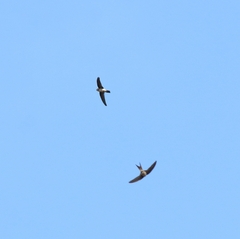
The Asian palm swift (Cypsiurus balasiensis) is a small swift. It is very similar to the African palm swift, Cypsiurus parvus, and was formerly considered to be the same species. It is a common resident breeder in tropical Asia from India to the Philippines. The down and feather nest is glued to the underside of a palm leaf with saliva, which is also used to secure the usually two or three eggs. This is a bird of open country and cultivation, which is strongly associated with oil palms.

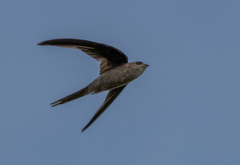
This 13 cm long species is mainly pale brown in colour. It has long swept-back wings that resemble a crescent or a boomerang. The body is slender, and the tail is long and deeply forked, although it is usually held closed. The call is a loud shrill scream.

Sexes are similar, and young birds differ from adults mainly in their shorter tails. Asian palm swift has very short legs which it uses only for clinging to vertical surfaces, since swifts never settle voluntarily on the ground.

These swifts spend most of their lives in the air, living on the insects they catch in their beaks. Asian palm swifts often feed near the ground, and they drink on the wing. Compilers: Stuart... Wikipedia →

Sounds

Flight call0:05

Malaysia · 2024

© Lim Ying Hien · XC894474 · CC BY-NC-ND 4.0

Call0:32

China · 2021

© Dave Guo · XC769799 · CC BY-NC-SA 4.0

Song0:17

Sri Lanka · 2021

© THILANKA EDIRISINGHE · XC647259 · CC BY-NC-SA 4.0

Global Distribution

Parks Where Found

# Park Country Daily sighting probability
1 Sundarbans National Park 🇮🇳 India
~40%
2 Khao Yai National Park 🇹🇭 Thailand
~40%
3 Udawalawe National Park 🇱🇰 Sri Lanka
~40%
4 Wilpattu National Park 🇱🇰 Sri Lanka
~30%
5 Minneriya National Park 🇱🇰 Sri Lanka
~30%
6 Kaziranga National Park 🇮🇳 India
~30%
7 Kaeng Krachan National Park 🇹🇭 Thailand
~20%
8 Cat Tien National Park 🇻🇳 Vietnam
~20%
9 Sinharaja Forest Reserve 🇱🇰 Sri Lanka
~20%
10 Yala National Park 🇱🇰 Sri Lanka
~20%
11 Way Kambas National Park 🇮🇩 Indonesia
~20%
12 Manas National Park 🇮🇳 India
~20%
13 Doi Inthanon National Park 🇹🇭 Thailand
~20%
14 Khao Sok National Park 🇹🇭 Thailand
~10%
15 Bandipur National Park 🇮🇳 India
~10%
16 Khao Luang National Park 🇹🇭 Thailand
~10%
17 Mudumalai National Park 🇮🇳 India
~10%
18 Nagarhole National Park 🇮🇳 India
~10%
19 Namdapha National Park 🇮🇳 India
~10%
20 Royal Manas National Park 🇧🇹 Bhutan
~10%
21 Bako National Park 🇲🇾 Malaysia
~10%
22 Periyar National Park 🇮🇳 India
~10%
23 Sepilok 🇲🇾 Malaysia
~10%
24 Chitwan National Park 🇳🇵 Nepal
<5%
25 Bali Barat National Park 🇮🇩 Indonesia
<5%
26 Tangkoko Nature Reserve 🇮🇩 Indonesia
<5%
27 Gunung Leuser National Park 🇮🇩 Indonesia
<5%
28 Taman Negara National Park 🇲🇾 Malaysia
<5%
29 Horton Plains National Park 🇱🇰 Sri Lanka
<5%
30 Cuc Phuong National Park 🇻🇳 Vietnam
<5%
31 Bandhavgarh National Park 🇮🇳 India
<5%
32 Kanha National Park 🇮🇳 India
<5%
33 Kinabatangan Wildlife Sanctuary 🇲🇾 Malaysia
<5%
34 Danum Valley Conservation Area 🇲🇾 Malaysia
<5%
35 Keoladeo National Park 🇮🇳 India
<5%
36 Kinabalu Park 🇲🇾 Malaysia
<5%

Cities Where Found

# City Country Daily sighting probability
1 Tamluk 🇮🇳 India
~80%
2 Vasai-Virar 🇮🇳 India
~70%
3 Hajipur 🇮🇳 India
~70%
4 Hanoi 🇻🇳 Vietnam
~60%
5 Yangon 🇲🇲 Myanmar
~60%
6 Savar 🇧🇩 Bangladesh
~50%
7 Dhaka 🇧🇩 Bangladesh
~50%
8 Salem 🇮🇳 India
~50%
9 Tiruchirappalli 🇮🇳 India
~50%
10 Bangkok 🇹🇭 Thailand
~40%

Before you go

What are the chances of seeing an Asian Palm-Swift in Mumbai?

Possible

About 30% of wildlife watchers report an Asian Palm-Swift sighting in Mumbai on a given day, based on 2,363 verified sightings from GBIF citizen-science data. It is the 23rd most-seen of the 283 birds we can rate there. Over three days the chance rises to about 60%, and over a week to about 90%, if each day is a fresh chance.

When is the best time to see an Asian Palm-Swift in Mumbai?

February

In that month about 40% of wildlife watchers report an Asian Palm-Swift in Mumbai on a given day, against about 10% in July, the lowest month. That is one of Mumbai's driest months, with almost no rain against 830 mm in July.

What time of day is best to see an Asian Palm-Swift?

Between 2 and 5 am

Across all the parks we cover, that three-hour window holds the most Asian Palm-Swift sightings with a recorded time, and about half of them come between 6 am and 6 pm: it is most active around dawn and dusk.

Is Mumbai the best place to see an Asian Palm-Swift?

23rd of 56

Of the 56 cities where we can rate Asian Palm-Swift sightings, Mumbai ranks 23rd at about 30%. The best odds are in Tamluk (India, about 80%), Vasai-Virar (India, about 70%) and Hajipur (India, about 70%).

Where does the Asian Palm-Swift sighting chance come from?

GBIF citizen-science records

It is estimated from how often the Asian Palm-Swift is recorded against all the birds logged in Mumbai (2,363 verified sightings), calibrated against known sighting rates. Figures are rounded to the nearest 10% because citizen-science data supports honest approximations, not decimals, and months with records from fewer than five people show "—". How it works.

← Back to Mumbai