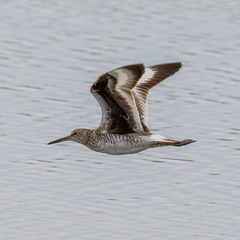
Willet

Willet

Tringa semipalmata

Silhouette: Andy Wilson · PhyloPic

LCLeast ConcernNTVUENCR
Daily sighting probability ~30% · Possible
at Panama City

In 3 days ~60% in a week ~90%

1,872 Verified sightings at Panama City
16,832 In all 42 parks From 2019 to 2026
September Best month
☀️ Diurnal When it's spotted

About the Willet

The willet (Tringa semipalmata) is a large shorebird in the family Scolopacidae. It is a relatively large and robust sandpiper and is the largest of the species called "shanks" in the genus Tringa. Its closest relative is the lesser yellowlegs, a much smaller bird with a very different appearance apart from the fine, clear, and dense pattern of the neck, which both species show in breeding plumage. It breeds in North America and the West Indies and winters in southern North America, Central America, the West Indies and South America.

The willet was formally described in 1789 by the German naturalist Johann Friedrich Gmelin in his revised and expanded edition of Carl Linnaeus's Systema Naturae. He placed it in the genus Scolopax and coined the binomial name Scolopax semipalmata. Gmelin based his description on the "semipalmated snipe" from New York that had been described in 1785 by both the English ornithologist John Latham and by the Welsh naturalist Thomas Pennant. The willet was formerly assigned to the genus Catoptrophorus that had been introduced for the species in 1827 by Charles Lucien Bonaparte. In 2006 it was moved to the current genus Tringa based on a molecular... Wikipedia →

Sounds

Song0:34

United States · 2025

© Ed Pandolfino · XC1007052 · CC BY-NC-SA 4.0

Call0:05

Cuba · 2025

© FREDERIC Lionel · XC995148 · CC BY-NC-SA 4.0

Flight call0:15

United States · 2024

© David Tattersley · XC901132 · CC BY-NC-SA 4.0

Global Distribution

Parks Where Found

# Park Country Daily sighting probability
1 Padre Island National Seashore 🇺🇸 United States
~90%
2 Ría Lagartos Biosphere Reserve 🇲🇽 Mexico
~60%
3 El Vizcaíno Biosphere Reserve 🇲🇽 Mexico
~50%
4 Celestún Biosphere Reserve 🇲🇽 Mexico
~40%
5 Ostional Wildlife Refuge 🇨🇷 Costa Rica
~30%
6 Merritt Island National Wildlife Refuge 🇺🇸 United States
~30%
7 Bahía de Loreto National Park 🇲🇽 Mexico
~30%
8 Channel Islands National Park 🇺🇸 United States
~30%
9 Carara National Park 🇨🇷 Costa Rica
~20%
10 Las Baulas Marine National Park 🇨🇷 Costa Rica
~20%
11 Ciénaga de Zapata 🇨🇺 Cuba
~20%
12 Cabo Blanco Absolute Nature Reserve 🇨🇷 Costa Rica
~20%
13 Coiba National Park 🇵🇦 Panama
~20%
14 Marino Ballena National Park 🇨🇷 Costa Rica
~10%
15 Arrecifes de Cozumel National Park 🇲🇽 Mexico
~10%
16 Utría National Natural Park 🇨🇴 Colombia
~10%
17 Everglades National Park 🇺🇸 United States
~10%
18 Jaragua National Park 🇩🇴 Dominican Republic
~10%
19 Bastimentos Island National Marine Park 🇵🇦 Panama
~10%
20 Tortuguero National Park 🇨🇷 Costa Rica
~10%
21 Cahuita National Park 🇨🇷 Costa Rica
~10%
22 Gandoca-Manzanillo Wildlife Refuge 🇨🇷 Costa Rica
~10%
23 Santa Rosa National Park 🇨🇷 Costa Rica
~10%
24 Piedras Blancas National Park 🇨🇷 Costa Rica
<5%
25 Corcovado National Park 🇨🇷 Costa Rica
<5%
26 La Amistad International Park (Panama) 🇵🇦 Panama
<5%
27 Darién National Park 🇵🇦 Panama
<5%
28 Palo Verde National Park 🇨🇷 Costa Rica
<5%
29 Parque Natural Metropolitano 🇵🇦 Panama
<5%
30 Manuel Antonio National Park 🇨🇷 Costa Rica
<5%
31 Tayrona National Natural Park 🇨🇴 Colombia
<5%
32 Caroni Swamp 🇹🇹 Trinidad and Tobago
<5%
33 Cape Breton Highlands National Park 🇨🇦 Canada
<5%
34 Sian Ka'an Biosphere Reserve 🇲🇽 Mexico
<5%
35 Machalilla National Park 🇪🇨 Ecuador
<5%
36 Galápagos Islands 🇪🇨 Ecuador
<5%
37 Point Pelee National Park 🇨🇦 Canada
<5%
38 Big Cypress National Preserve 🇺🇸 United States
<5%
39 Yellowstone National Park 🇺🇸 United States
<5%
40 Grand Teton National Park 🇺🇸 United States
<5%
41 Rocky Mountain National Park 🇺🇸 United States
<5%
42 Acadia National Park 🇺🇸 United States
<5%

Cities Where Found

# City Country Daily sighting probability
1 Panama City 🇵🇦 Panama
~30%
2 San Diego 🇺🇸 United States
~30%
3 San Francisco 🇺🇸 United States
~20%
4 São Luís 🇧🇷 Brazil
~20%
5 Havana 🇨🇺 Cuba
~20%
6 Los Angeles 🇺🇸 United States
~10%
7 Tijuana 🇲🇽 México
~10%
8 Lima 🇵🇪 Peru
~10%
9 Boston 🇺🇸 United States
<5%
10 Miami 🇺🇸 United States
<5%

Zoos & Centres Where Found

# Zoo / Centre Country
1 National Zoological Park 🇺🇸 United States In captivity
2 Columbus Zoo and Aquarium 🇺🇸 United States In captivity
3 Aquarium of the Pacific 🇺🇸 United States In captivity
4 Monterey Bay Aquarium 🇺🇸 United States In captivity

Before you go

What are the chances of seeing a Willet in Panama City?

Possible

About 30% of wildlife watchers report a Willet sighting in Panama City on a given day, based on 1,872 verified sightings from GBIF citizen-science data. It is the 33rd most-seen of the 363 birds we can rate there. Over three days the chance rises to about 60%, and over a week to about 90%, if each day is a fresh chance.

When is the best time to see a Willet in Panama City?

January and September

In those months about 40% of wildlife watchers report a Willet in Panama City on a given day, against about 20% in March, July and October, the lowest months.

What time of day is best to see a Willet?

Between 3 and 6 pm

Across all the parks we cover, that three-hour window holds the most Willet sightings with a recorded time, and about 9 in 10 of them come between 6 am and 6 pm: it is a daytime animal.

Is Panama City the best place to see a Willet?

Yes

Of the 23 cities where we can rate Willet sightings, Panama City has the highest daily chance: about 30%. Next come San Diego (United States, about 30%) and San Francisco (United States, about 20%).

Which relatives of the Willet live in Panama City?

Same genus: Tringa

The closest relatives of the Willet that you can see in Panama City (genus Tringa, Shanks, Tattlers, and Allies) are Lesser Yellowlegs (about 10%), Greater Yellowlegs (about 10%) and Solitary Sandpiper (about 10%), with each one's daily chance of a sighting.

Where does the Willet sighting chance come from?

GBIF citizen-science records

It is estimated from how often the Willet is recorded against all the birds logged in Panama City (1,872 verified sightings), calibrated against known sighting rates. Figures are rounded to the nearest 10% because citizen-science data supports honest approximations, not decimals, and months with records from fewer than five people show "—". How it works.

← Back to Panama City