American Coot

American Coot

Fulica americana

Silhouette: Andy Wilson · PhyloPic

LCLeast ConcernNTVUENCR
Daily sighting probability ~10% · With luck
at San Antonio

In 3 days ~20% in a week ~30%

471 Verified sightings at San Antonio
17,921 In all 47 parks From 2019 to 2026
January Best month
☀️ Diurnal When it's spotted

About the American Coot

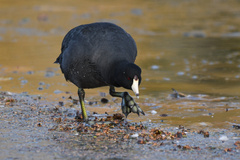
The American coot (Fulica americana), also known as a mud hen or pouldeau, is a bird of the family Rallidae. Though commonly mistaken for ducks, American coots are only distantly related to ducks, belonging to a separate order. Unlike the webbed feet of ducks, coots have broad, lobed scales on their lower legs and toes that fold back with each step to facilitate walking on dry land. Coots live near water, typically inhabiting wetlands and open water bodies in North America. Groups of coots are called covers or rafts. The oldest known coot lived to be 22 years old.

The American coot is a migratory bird that occupies most of North America. It lives in the Pacific and southwestern United States and Mexico year-round and occupies more northeastern regions during the summer breeding season. In the winter they can be found as far south as Panama. Coots generally build floating nests and lay 8–12 eggs per clutch. Females and males have similar appearances, but they can be distinguished during aggressive displays by the larger ruff (head plumage) on the male. American coots eat primarily algae and other aquatic plants but also animals (both vertebrates and invertebrates) when available.

The American coot is closely related to the Eurasian coot (Fulica atra), which occupies the same ecological niche in Eurasia and Australia as the American coot does in North America. Eurasian coots can be distinguished from this species by the absence of a red callus above the bird's frontal shield.

The American coot is listed as "Least Concern" under the IUCN conservation ratings. Hunters generally avoid killing American coots because their meat is not as sought after as that of ducks. American coots display several interesting breeding habits; mothers will preferentially feed offspring with the brightest plume feathers, which has resulted in coot chicks having brightly ornamented plumage which becomes drabber as they age. American coots are also susceptible to conspecific brood parasitism and have evolved mechanisms to differentiate their offspring from those of parasitic females. Wikipedia →

Sounds

Call1:08

United States · 2025

© Greg Irving · XC1040451 · CC BY-NC-SA 4.0

Begging call0:54

Mexico · 2022

© Manuel Grosselet · XC754221 · CC BY-NC-SA 4.0

Alarm call0:41

Mexico · 2017

© fernando mondaca fernandez · XC383912 · CC BY-NC-SA 4.0

Global Distribution

Parks Where Found

# Park Country Daily sighting probability
1 Death Valley National Park 🇺🇸 United States
~60%
2 Merritt Island National Wildlife Refuge 🇺🇸 United States
~50%
3 Channel Islands National Park 🇺🇸 United States
~50%
4 Elk Island National Park 🇨🇦 Canada
~40%
5 Lago de Yojoa 🇭🇳 Honduras
~30%
6 Yellowstone National Park 🇺🇸 United States
~30%
7 Banff National Park 🇨🇦 Canada
~30%
8 El Vizcaíno Biosphere Reserve 🇲🇽 Mexico
~30%
9 Arrecifes de Cozumel National Park 🇲🇽 Mexico
~20%
10 Bahía de Loreto National Park 🇲🇽 Mexico
~20%
11 Everglades National Park 🇺🇸 United States
~10%
12 Cerro Azul Meámbar National Park 🇭🇳 Honduras
~10%
13 Chingaza National Natural Park 🇨🇴 Colombia
~10%
14 Big Bend National Park 🇺🇸 United States
~10%
15 Ciénaga de Zapata 🇨🇺 Cuba
~10%
16 Isla del Coco National Park 🇨🇷 Costa Rica
~10%
17 Zion National Park 🇺🇸 United States
~10%
18 Riding Mountain National Park 🇨🇦 Canada
~10%
19 Redwood National Park 🇺🇸 United States
~10%
20 Celestún Biosphere Reserve 🇲🇽 Mexico
~10%
21 Grand Canyon National Park 🇺🇸 United States
~10%
22 Grand Teton National Park 🇺🇸 United States
<5%
23 Badlands National Park 🇺🇸 United States
<5%
24 Padre Island National Seashore 🇺🇸 United States
<5%
25 Palo Verde National Park 🇨🇷 Costa Rica
<5%
26 Jasper National Park 🇨🇦 Canada
<5%
27 Biotopo Cerro Cahuí 🇬🇹 Guatemala
<5%
28 La Amistad International Park (Panama) 🇵🇦 Panama
<5%
29 Bastimentos Island National Marine Park 🇵🇦 Panama
<5%
30 Big Cypress National Preserve 🇺🇸 United States
<5%
31 Pacific Rim National Park Reserve 🇨🇦 Canada
<5%
32 Sian Ka'an Biosphere Reserve 🇲🇽 Mexico
<5%
33 Sequoia and Kings Canyon National Parks 🇺🇸 United States
<5%
34 Great Bear Rainforest 🇨🇦 Canada
<5%
35 Calakmul Biosphere Reserve 🇲🇽 Mexico
<5%
36 Saguaro National Park 🇺🇸 United States
<5%
37 Ría Lagartos Biosphere Reserve 🇲🇽 Mexico
<5%
38 Rocky Mountain National Park 🇺🇸 United States
<5%
39 Point Pelee National Park 🇨🇦 Canada
<5%
40 Tortuguero National Park 🇨🇷 Costa Rica
<5%
41 Acadia National Park 🇺🇸 United States
<5%
42 Glacier National Park 🇺🇸 United States
<5%
43 Los Nevados National Natural Park 🇨🇴 Colombia
<5%
44 Soberanía National Park 🇵🇦 Panama
<5%
45 Cumbres de Monterrey National Park 🇲🇽 Mexico
<5%
46 Olympic National Park 🇺🇸 United States
<5%
47 Arenal Volcano National Park 🇨🇷 Costa Rica
<5%

Cities Where Found

# City Country Daily sighting probability
1 Ciudad Juárez 🇲🇽 México
~70%
2 Mesa 🇺🇸 United States
~60%
3 Tijuana 🇲🇽 México
~50%
4 León 🇲🇽 México
~40%
5 Las Vegas 🇺🇸 United States
~40%
6 Bogota 🇨🇴 Colombia
~40%
7 Los Angeles 🇺🇸 United States
~40%
8 San Francisco 🇺🇸 United States
~40%
9 Puebla 🇲🇽 México
~30%
10 Mexico City 🇲🇽 México
~30%

Zoos & Centres Where Found

# Zoo / Centre Country
1 San Diego Zoo Safari Park 🇺🇸 United States In captivity
2 Columbus Zoo and Aquarium 🇺🇸 United States In captivity
3 Ecological Center of Sonora 🇲🇽 Mexico In captivity
4 Oklahoma City Zoo and Botanical Garden 🇺🇸 United States In captivity
5 Gran Acuario de Mazatlán "Mar de Cortés" 🇲🇽 Mexico In captivity
6 Ralph Perkins II Wildlife Center and Woods Garden 🇺🇸 United States In captivity
7 The Wildlife Habitat 🇺🇸 United States In captivity
8 The Mirage Aquarium 🇺🇸 United States In captivity

Before you go

What are the chances of seeing an American Coot in San Antonio?

With luck

About 10% of wildlife watchers report an American Coot sighting in San Antonio on a given day, based on 471 verified sightings from GBIF citizen-science data. It is the 77th most-seen of the 255 birds we can rate there. Over three days the chance rises to about 20%, and over a week to about 30%, if each day is a fresh chance.

When is the best time to see an American Coot in San Antonio?

November to March

In those months about 10% of wildlife watchers report an American Coot in San Antonio on a given day, against under 5% in April to October, the lowest months.

What time of day is best to see an American Coot?

Between 3 and 6 pm

Across all the parks we cover, that three-hour window holds the most American Coot sightings with a recorded time, and about 9 in 10 of them come between 6 am and 6 pm: it is a daytime animal.

Is San Antonio the best place to see an American Coot?

32nd of 46

Of the 46 cities where we can rate American Coot sightings, San Antonio ranks 32nd at about 10%. The best odds are in Ciudad Juárez (México, about 70%), Mesa (United States, about 60%) and Tijuana (México, about 50%).

Where does the American Coot sighting chance come from?

GBIF citizen-science records

It is estimated from how often the American Coot is recorded against all the birds logged in San Antonio (471 verified sightings), calibrated against known sighting rates. Figures are rounded to the nearest 10% because citizen-science data supports honest approximations, not decimals, and months with records from fewer than five people show "—". How it works.

← Back to San Antonio