
Purple-crowned Fairy

Purple-crowned Fairy

Heliothryx barroti

Silhouette: Ferran Sayol · PhyloPic

LCLeast ConcernNTVUENCR
Daily sighting probability <5% · Rare
at Cockscomb Basin Wildlife Sanctuary

In 3 days ~10%

18 Verified sightings at Cockscomb Basin Wildlife Sanctuary From 2019 to 2026
9,239 In all 32 parks
August Best month
☀️ Diurnal When it's spotted

About the Purple-crowned Fairy

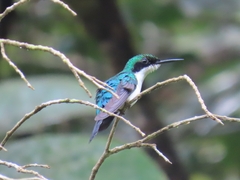
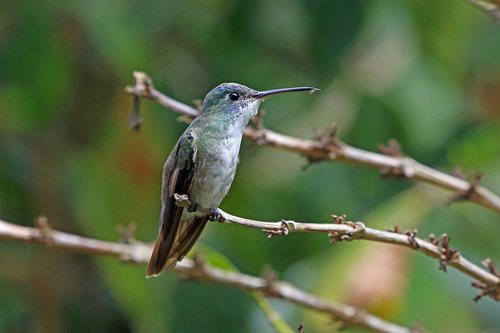
The purple-crowned fairy (Heliothryx barroti) is a species of hummingbird in the subfamily Polytminae, the mangoes. It is found from southeastern Mexico south into northern Peru. The purple-crowned fairy was originally described as Trochilus Barroti. It and the black-eared fairy (Heliothryx auritus) were treated as conspecific by some authors but are now considered to be a superspecies; they are the only members of the genus. Its scientific name commemorates Adolphe Barrot (1801–1870), a French diplomat who served in Colombia from 1831 to 1835.

The purple-crowned fairy is monotypic. The purple-crowned fairy is 9 to 13 cm (3.5 to 5.1 in) long and weighs about 5.5 g (0.19 oz). It is slender and has bright emerald green upperparts, pure white underparts, and a long pointed tail which has blue-black central and white outer feathers. It has a black patch through the eye and the bill is short, straight, and black. The male has a metallic violet forecrown; the eye patch has a metallic violet spot behind it and bright emerald green below it. The female has a green crown and the face has less black, no violet spot, and no green below the black... Wikipedia →

Sounds

Call0:09

Ecuador · 2023

© rudy gelis · XC833596 · CC BY-NC-SA 4.0

Song0:39

Ecuador · 1997

© Olaf Jahn · XC261778 · CC BY-NC-SA 4.0

Begging call0:21

Ecuador · 2003

© Niels Krabbe · XC238372 · CC BY-NC-SA 3.0

Global Distribution

Parks Where Found

# Park Country Daily sighting probability
1 Pico Bonito National Park 🇭🇳 Honduras
~20%
2 Tikal National Park 🇬🇹 Guatemala
~20%
3 Darién National Park 🇵🇦 Panama
~20%
4 Arenal Volcano National Park 🇨🇷 Costa Rica
~20%
5 Bastimentos Island National Marine Park 🇵🇦 Panama
~10%
6 Piedras Blancas National Park 🇨🇷 Costa Rica
~10%
7 Corcovado National Park 🇨🇷 Costa Rica
~10%
8 Braulio Carrillo National Park 🇨🇷 Costa Rica
~10%
9 Soberanía National Park 🇵🇦 Panama
~10%
10 Utría National Natural Park 🇨🇴 Colombia
~10%
11 Carara National Park 🇨🇷 Costa Rica
~10%
12 Chagres National Park 🇵🇦 Panama
~10%
13 Tenorio Volcano National Park 🇨🇷 Costa Rica
~10%
14 Chirripó National Park 🇨🇷 Costa Rica
~10%
15 Farallones de Cali National Natural Park 🇨🇴 Colombia
~10%
16 Tapantí-Macizo de la Muerte National Park 🇨🇷 Costa Rica
~10%
17 Marino Ballena National Park 🇨🇷 Costa Rica
~10%
18 Manuel Antonio National Park 🇨🇷 Costa Rica
~10%
19 La Amistad International Park (Panama) 🇵🇦 Panama
~10%
20 San Lorenzo Protected Forest 🇵🇦 Panama
~10%
21 Gandoca-Manzanillo Wildlife Refuge 🇨🇷 Costa Rica
~10%
22 Montes Azules Biosphere Reserve 🇲🇽 Mexico
<5%
23 Machalilla National Park 🇪🇨 Ecuador
<5%
24 Calakmul Biosphere Reserve 🇲🇽 Mexico
<5%
25 Cockscomb Basin Wildlife Sanctuary 🇧🇿 Belize
<5%
26 Cahuita National Park 🇨🇷 Costa Rica
<5%
27 Rincón de la Vieja National Park 🇨🇷 Costa Rica
<5%
28 Tortuguero National Park 🇨🇷 Costa Rica
<5%
29 Parque Natural Metropolitano 🇵🇦 Panama
<5%
30 Poás Volcano National Park 🇨🇷 Costa Rica
<5%
31 Monteverde Cloud Forest Reserve 🇨🇷 Costa Rica
<5%
32 Los Quetzales National Park 🇨🇷 Costa Rica
<5%

Before you go

What are the chances of seeing a Purple-crowned Fairy in Cockscomb Basin Wildlife Sanctuary?

Rare

Under 5% of wildlife watchers report a Purple-crowned Fairy sighting in Cockscomb Basin Wildlife Sanctuary on a given day, based on 18 verified sightings from GBIF citizen-science data from 2019 to 2026. It is the 221st most-seen of the 277 birds we can rate there. Over three days the chance rises to about 10%, if each day is a fresh chance.

When is the best time to see a Purple-crowned Fairy in Cockscomb Basin Wildlife Sanctuary?

August

In that month about 10% of wildlife watchers report a Purple-crowned Fairy in Cockscomb Basin Wildlife Sanctuary on a given day, against under 5% in September to July, the lowest months. That is one of Cockscomb Basin Wildlife Sanctuary's wettest months, with about 250 mm of rain against 75 mm in April.

What time of day is best to see a Purple-crowned Fairy?

Between 8 and 11 am

Across all the parks we cover, that three-hour window holds the most Purple-crowned Fairy sightings with a recorded time, and about 9 in 10 of them come between 6 am and 6 pm: it is a daytime animal.

Is Cockscomb Basin Wildlife Sanctuary the best place to see a Purple-crowned Fairy?

25th of 32

Of the 32 parks where we can rate Purple-crowned Fairy sightings, Cockscomb Basin Wildlife Sanctuary ranks 25th at under 5%. The best odds are in Pico Bonito National Park (Honduras, about 20%), Tikal National Park (Guatemala, about 20%) and Darién National Park (Panama, about 20%).

Which relatives of the Purple-crowned Fairy live in Cockscomb Basin Wildlife Sanctuary?

Same family: Trochilidae

The closest relatives of the Purple-crowned Fairy that you can see in Cockscomb Basin Wildlife Sanctuary (family Trochilidae, Hummingbirds) are Rufous-tailed Hummingbird (about 60%), Stripe-throated Hermit (about 40%) and Long-billed Hermit (about 30%), with each one's daily chance of a sighting.

Where does the Purple-crowned Fairy sighting chance come from?

GBIF citizen-science records

It is estimated from how often the Purple-crowned Fairy is recorded against all the birds logged in Cockscomb Basin Wildlife Sanctuary (18 verified sightings from 2019 to 2026), calibrated against known sighting rates. Figures are rounded to the nearest 10% because citizen-science data supports honest approximations, not decimals, and months with records from fewer than five people show "—". How it works.

← Back to Cockscomb Basin Wildlife Sanctuary