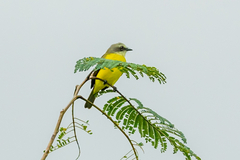
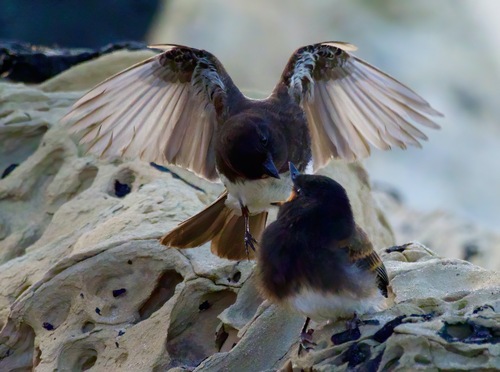
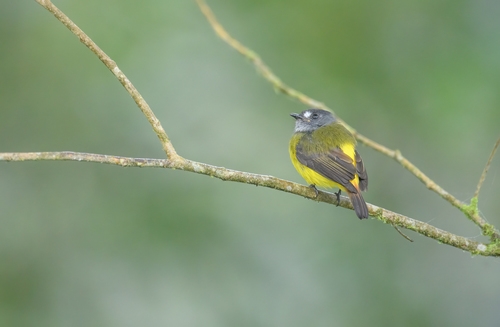
Gray-capped Flycatcher

Gray-capped Flycatcher

Myiozetetes granadensis

Silhouette: Emily Willoughby · PhyloPic

LCLeast ConcernNTVUENCR
Daily sighting probability <5% · Rare
at Farallones de Cali National Natural Park

In 3 days <5% in a week ~10%

49 Verified sightings at Farallones de Cali National Natural Park From 2019 to 2026
15,271 In all 29 parks
June Best month
☀️ Diurnal When it's spotted

About the Gray-capped Flycatcher

The grey-capped flycatcher (Myiozetetes granadensis) is a passerine bird, a member of the large tyrant flycatcher family Tyrannidae. It is found in Bolivia, Brazil, Colombia, Costa Rica, Ecuador, Honduras, Nicaragua, Panama, Peru, and Venezuela.

At least one author has suggested that M. g. occidentalis should be merged into the nominate. The grey-capped flycatcher is 16 to 18 cm (6.3 to 7.1 in) long and weighs 28 to 30 g (0.99 to 1.1 oz). The sexes have almost the same plumage. Adult males of the nominate subspecies have a gray crown and nape with a mostly hidden orange-yellow to reddish orange patch in the center of the crown. Females sometimes have a smaller patch or none at all. Adults of both sexes have a white forehead that extends as a thin supercilium to just past the eye. They have dusky lores and ear coverts. Their upperparts are mostly olive-green with dusky to dark olive uppertail coverts that have paler edges. Their wings are dusky grayish brown with pale... Wikipedia →

Sounds

Call0:55

Brazil · 2026

© JAYRSON ARAUJO DE OLIVEIRA · XC1183747 · CC BY-NC-SA 4.0

Song0:04

Colombia · 2020

© Mauricio Cuellar Ramirez (@Birding.travel) · XC573809 · CC BY-NC-SA 4.0

Dawn song0:14

Ecuador · 1997

© Olaf Jahn · XC262246 · CC BY-NC-SA 4.0

Global Distribution

Parks Where Found

# Park Country Daily sighting probability
1 Piedras Blancas National Park 🇨🇷 Costa Rica
~50%
2 Arenal Volcano National Park 🇨🇷 Costa Rica
~30%
3 Manu National Park 🇵🇪 Peru
~20%
4 Gandoca-Manzanillo Wildlife Refuge 🇨🇷 Costa Rica
~20%
5 Braulio Carrillo National Park 🇨🇷 Costa Rica
~20%
6 Carara National Park 🇨🇷 Costa Rica
~20%
7 Yasuní National Park 🇪🇨 Ecuador
~20%
8 Chirripó National Park 🇨🇷 Costa Rica
~20%
9 Corcovado National Park 🇨🇷 Costa Rica
~20%
10 Cahuita National Park 🇨🇷 Costa Rica
~20%
11 Amacayacu National Natural Park 🇨🇴 Colombia
~10%
12 La Amistad International Park (Panama) 🇵🇦 Panama
~10%
13 Tambopata National Reserve 🇵🇪 Peru
~10%
14 San Lorenzo Protected Forest 🇵🇦 Panama
~10%
15 Marino Ballena National Park 🇨🇷 Costa Rica
~10%
16 Bastimentos Island National Marine Park 🇵🇦 Panama
~10%
17 Tortuguero National Park 🇨🇷 Costa Rica
~10%
18 Rincón de la Vieja National Park 🇨🇷 Costa Rica
~10%
19 Tapantí-Macizo de la Muerte National Park 🇨🇷 Costa Rica
~10%
20 Sierra de la Macarena National Park 🇨🇴 Colombia
~10%
21 Tenorio Volcano National Park 🇨🇷 Costa Rica
<5%
22 Cuyabeno Wildlife Reserve 🇪🇨 Ecuador
<5%
23 Darién National Park 🇵🇦 Panama
<5%
24 Manuel Antonio National Park 🇨🇷 Costa Rica
<5%
25 Farallones de Cali National Natural Park 🇨🇴 Colombia
<5%
26 Volcán Barú National Park 🇵🇦 Panama
<5%
27 Podocarpus National Park 🇪🇨 Ecuador
<5%
28 Poás Volcano National Park 🇨🇷 Costa Rica
<5%
29 Soberanía National Park 🇵🇦 Panama
<5%

Cities Where Found

# City Country Daily sighting probability
1 San José 🇨🇷 Costa Rica
<5%

Before you go

What are the chances of seeing a Gray-capped Flycatcher in Farallones de Cali National Natural Park?

Rare

Under 5% of wildlife watchers report a Gray-capped Flycatcher sighting in Farallones de Cali National Natural Park on a given day, based on 49 verified sightings from GBIF citizen-science data from 2019 to 2026. It is the 346th most-seen of the 542 birds we can rate there. Over three days the chance rises to under 5%, and over a week to about 10%, if each day is a fresh chance.

When is the best time to see a Gray-capped Flycatcher in Farallones de Cali National Natural Park?

June

In that month about 10% of wildlife watchers report a Gray-capped Flycatcher in Farallones de Cali National Natural Park on a given day, against under 5% in July to May, the lowest months.

What time of day is best to see a Gray-capped Flycatcher?

Between 2 and 5 pm

Across all the parks we cover, that three-hour window holds the most Gray-capped Flycatcher sightings with a recorded time, and about 8 in 10 of them come between 6 am and 6 pm: it is a daytime animal.

Where does the Gray-capped Flycatcher sighting chance come from?

GBIF citizen-science records

It is estimated from how often the Gray-capped Flycatcher is recorded against all the birds logged in Farallones de Cali National Natural Park (49 verified sightings from 2019 to 2026), calibrated against known sighting rates. Figures are rounded to the nearest 10% because citizen-science data supports honest approximations, not decimals, and months with records from fewer than five people show "—". How it works.

← Back to Farallones de Cali National Natural Park