Willow Flycatcher

Willow Flycatcher

Empidonax traillii

Silhouette: Emily Willoughby · PhyloPic

LCLeast ConcernNTVUENCR
Daily sighting probability ~10% · With luck
at Grand Teton National Park

In 3 days ~20% in a week ~40%

189 Verified sightings at Grand Teton National Park From 2019 to 2026
2,632 In all 42 parks
June Best month
☀️ Diurnal When it's spotted

About the Willow Flycatcher

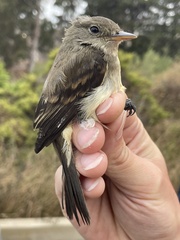
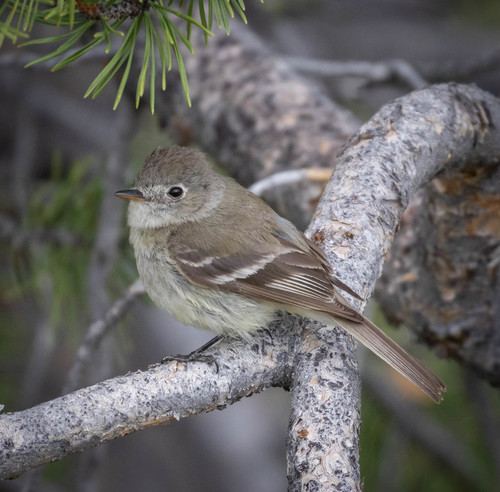
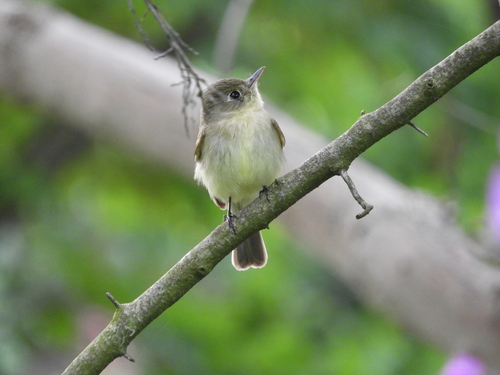
The willow flycatcher (Empidonax traillii) is a small insect-eating, migrant bird of the tyrant flycatcher family native to North America. The willow flycatcher was included by the Franco-American ornithologist John James Audubon in his book The Birds of America based on a specimen collected in the "woods along the prairie banks of the Arkansas River". The section of the book containing the willow flycatcher was published in 1828. There are two variants of the plate illustrating the flycatcher. On one the binomial name is given as Muscicapa trailli and on the other as Muscicapa traillii. The latter spelling was used in 1831 by Audubon when describing the species in his Ornithological Biography that was published to accompany the plates and is now the accepted spelling. The specific epithet was chosen by Audubon to honour his friend the Scottish physician and zoologist Thomas Stewart Traill. The willow flycatcher is now one of 14 species placed in the genus Empidonax that was introduced in 1855 by the German ornithologist Jean Cabanis.

There are four subspecies recognized, all of which breed in North America (including three subspecies that breed in California). At one... Wikipedia →

Sounds

Song1:03

United States · 2026

© Greg Irving · XC1149493 · CC BY-NC-SA 4.0

Call0:37

United States · 2023

© David A. Brinkman · XC807543 · CC BY-NC-SA 4.0

Burry phrase0:35

Canada · 2014

© Richard E. Webster · XC196034 · CC BY-NC-SA 4.0

Global Distribution

Parks Where Found

# Park Country Daily sighting probability
1 Glacier National Park 🇺🇸 United States
~20%
2 Banff National Park 🇨🇦 Canada
~10%
3 Grand Teton National Park 🇺🇸 United States
~10%
4 Lago de Yojoa 🇭🇳 Honduras
<5%
5 Death Valley National Park 🇺🇸 United States
<5%
6 Cerro Azul Meámbar National Park 🇭🇳 Honduras
<5%
7 Point Pelee National Park 🇨🇦 Canada
<5%
8 Jasper National Park 🇨🇦 Canada
<5%
9 Yellowstone National Park 🇺🇸 United States
<5%
10 Yosemite National Park 🇺🇸 United States
<5%
11 Joshua Tree National Park 🇺🇸 United States
<5%
12 Olympic National Park 🇺🇸 United States
<5%
13 Great Bear Rainforest 🇨🇦 Canada
<5%
14 Palo Verde National Park 🇨🇷 Costa Rica
<5%
15 Manuel Antonio National Park 🇨🇷 Costa Rica
<5%
16 Cumbres de Monterrey National Park 🇲🇽 Mexico
<5%
17 Santa Rosa National Park 🇨🇷 Costa Rica
<5%
18 Big Bend National Park 🇺🇸 United States
<5%
19 Great Smoky Mountains National Park 🇺🇸 United States
<5%
20 Yasuní National Park 🇪🇨 Ecuador
<5%
21 Rincón de la Vieja National Park 🇨🇷 Costa Rica
<5%
22 Pacific Rim National Park Reserve 🇨🇦 Canada
<5%
23 Carara National Park 🇨🇷 Costa Rica
<5%
24 Bastimentos Island National Marine Park 🇵🇦 Panama
<5%
25 Gandoca-Manzanillo Wildlife Refuge 🇨🇷 Costa Rica
<5%
26 La Amistad International Park (Panama) 🇵🇦 Panama
<5%
27 Rocky Mountain National Park 🇺🇸 United States
<5%
28 Piedras Blancas National Park 🇨🇷 Costa Rica
<5%
29 Tayrona National Natural Park 🇨🇴 Colombia
<5%
30 Channel Islands National Park 🇺🇸 United States
<5%
31 Saguaro National Park 🇺🇸 United States
<5%
32 Marino Ballena National Park 🇨🇷 Costa Rica
<5%
33 Zion National Park 🇺🇸 United States
<5%
34 Redwood National Park 🇺🇸 United States
<5%
35 Acadia National Park 🇺🇸 United States
<5%
36 Parque Natural Metropolitano 🇵🇦 Panama
<5%
37 Shenandoah National Park 🇺🇸 United States
<5%
38 Tenorio Volcano National Park 🇨🇷 Costa Rica
<5%
39 Soberanía National Park 🇵🇦 Panama
<5%
40 Tapantí-Macizo de la Muerte National Park 🇨🇷 Costa Rica
<5%
41 Los Quetzales National Park 🇨🇷 Costa Rica
<5%
42 Monteverde Cloud Forest Reserve 🇨🇷 Costa Rica
<5%

Cities Where Found

# City Country Daily sighting probability
1 Vancouver 🇨🇦 Canada
~10%
2 Seattle 🇺🇸 United States
<5%
3 Chicago 🇺🇸 United States
<5%
4 New York City 🇺🇸 United States
<5%
5 Portland 🇺🇸 United States
<5%
6 Toronto 🇨🇦 Canada
<5%
7 Baltimore 🇺🇸 United States
<5%
8 Boston 🇺🇸 United States
<5%
9 Philadelphia 🇺🇸 United States
<5%
10 San Pedro Sula 🇭🇳 Honduras
<5%

Before you go

What are the chances of seeing a Willow Flycatcher in Grand Teton National Park?

With luck

About 10% of wildlife watchers report a Willow Flycatcher sighting in Grand Teton National Park on a given day, based on 189 verified sightings from GBIF citizen-science data from 2019 to 2026. It is the 90th most-seen of the 185 birds we can rate there. Over three days the chance rises to about 20%, and over a week to about 40%, if each day is a fresh chance.

When is the best time to see a Willow Flycatcher in Grand Teton National Park?

June and July

In those months about 10% of wildlife watchers report a Willow Flycatcher in Grand Teton National Park on a given day, against under 5% in August to May, the lowest months. Those are among Grand Teton National Park's driest months, with about 35 mm of rain a month against 85 mm in December.

What time of day is best to see a Willow Flycatcher?

Between 8 and 11 am

Across all the parks we cover, that three-hour window holds the most Willow Flycatcher sightings with a recorded time, and about 9 in 10 of them come between 6 am and 6 pm: it is a daytime animal.

Is Grand Teton National Park the best place to see a Willow Flycatcher?

3rd of 42

Of the 42 parks where we can rate Willow Flycatcher sightings, Grand Teton National Park ranks 3rd at about 10%. The best odds are in Glacier National Park (United States, about 20%) and Banff National Park (Canada, about 10%).

Which relatives of the Willow Flycatcher live in Grand Teton National Park?

Same genus: Empidonax

The closest relatives of the Willow Flycatcher that you can see in Grand Teton National Park (genus Empidonax, Empidonax Flycatchers) are Dusky Flycatcher (about 20%) and Hammond's Flycatcher (about 10%), with each one's daily chance of a sighting.

Where does the Willow Flycatcher sighting chance come from?

GBIF citizen-science records

It is estimated from how often the Willow Flycatcher is recorded against all the birds logged in Grand Teton National Park (189 verified sightings from 2019 to 2026), calibrated against known sighting rates. Figures are rounded to the nearest 10% because citizen-science data supports honest approximations, not decimals, and months with records from fewer than five people show "—". How it works.

← Back to Grand Teton National Park