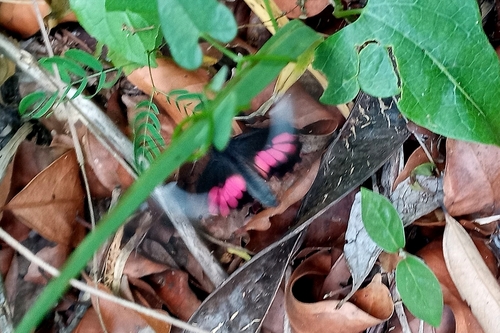
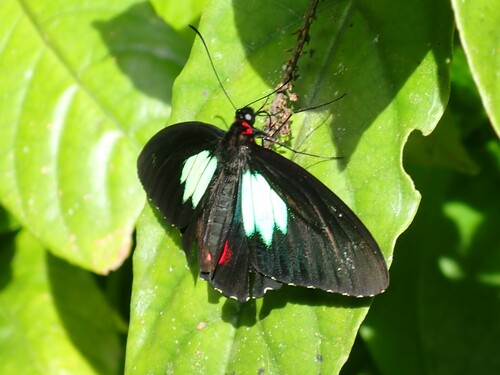
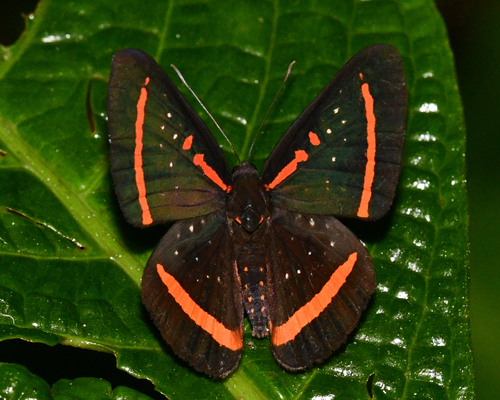
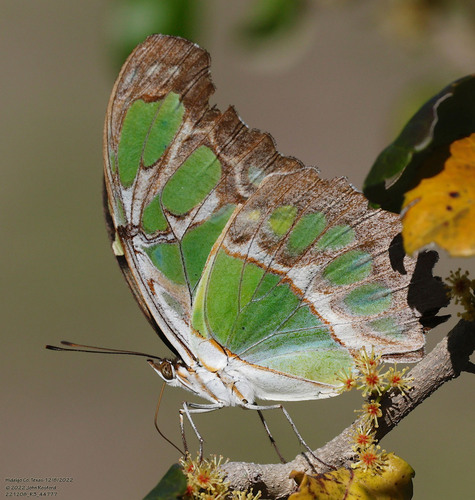
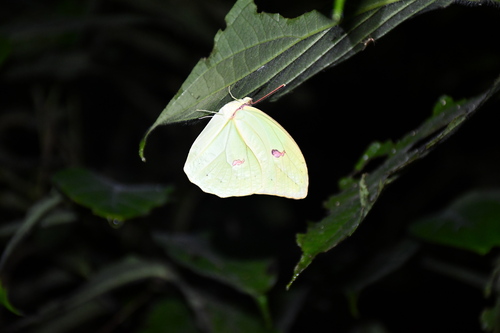
Thoas Swallowtail
Daily sighting probability ~20% · Possible
at Manu National Park

In 3 days ~40% in a week ~70%

27 Verified sightings at Manu National Park From 2019 to 2026
738 In all 28 parks
February Best month
☀️ Diurnal When it's spotted

About the Thoas Swallowtail

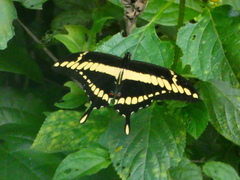
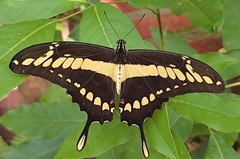
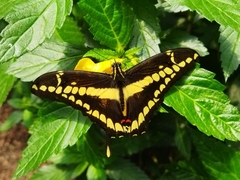
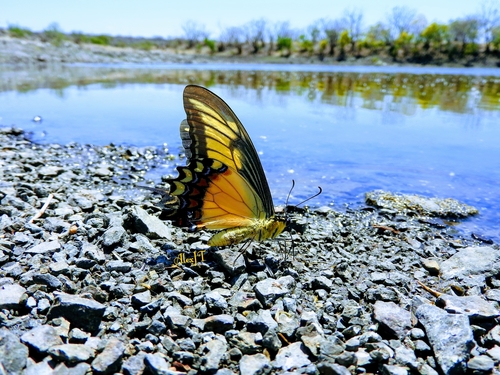
Papilio thoas, the king swallowtail or Thoas swallowtail, is a butterfly of the family Papilionidae. It is found in the southernmost United States, Mexico, Central America and South America (as far south as Argentina and Uruguay). The species is easily confused with the giant swallowtail, which it closely resembles in both larval and adult stages. The caterpillars feed on the leaves of citrus plants (Rutaceae). They have also been reported as feeding on a member of the genus Piper.

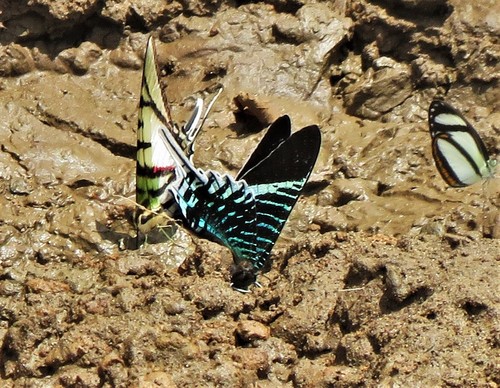
A large species (12 to 14 cm (4.7 to 5.5 in) wingspan. The wings are narrow. The forewings are mostly brown. A yellow band runs from the tip, becoming narrower towards the back. There is also a row of yellow arcuate spots on the underside of the wing edge. The hind wings are predominantly brown, toothed and have a long caudal process. This carries a yellow core. There is a row of yellow arcuate spots at the edge of the hind wings. A broad yellow band runs through the first half of the wing. Inside sits a black eyespot with blue-white dusting. The yellow regions are more pronounced on the undersides of the wings. Blue-white arcuate spots adjoin the yellow arcuate spots on the upper side... Wikipedia →

Global Distribution

Parks Where Found

# Park Country Daily sighting probability
1 Brownsberg Nature Park 🇸🇷 Suriname
~50%
2 Iguazú National Park 🇦🇷 Argentina
~40%
3 Iguaçu National Park 🇧🇷 Brazil
~30%
4 Bastimentos Island National Marine Park 🇵🇦 Panama
~30%
5 Soberanía National Park 🇵🇦 Panama
~20%
6 Pico Bonito National Park 🇭🇳 Honduras
~20%
7 Tortuguero National Park 🇨🇷 Costa Rica
~20%
8 Lago de Yojoa 🇭🇳 Honduras
~20%
9 Tambopata National Reserve 🇵🇪 Peru
~20%
10 Piedras Blancas National Park 🇨🇷 Costa Rica
~20%
11 Manuel Antonio National Park 🇨🇷 Costa Rica
~20%
12 Manu National Park 🇵🇪 Peru
~20%
13 Ostional Wildlife Refuge 🇨🇷 Costa Rica
~20%
14 Gandoca-Manzanillo Wildlife Refuge 🇨🇷 Costa Rica
~10%
15 Cerro Azul Meámbar National Park 🇭🇳 Honduras
~10%
16 Tenorio Volcano National Park 🇨🇷 Costa Rica
~10%
17 Braulio Carrillo National Park 🇨🇷 Costa Rica
~10%
18 La Amistad International Park (Panama) 🇵🇦 Panama
~10%
19 Parque Natural Metropolitano 🇵🇦 Panama
~10%
20 Corcovado National Park 🇨🇷 Costa Rica
~10%
21 Carara National Park 🇨🇷 Costa Rica
~10%
22 Monteverde Cloud Forest Reserve 🇨🇷 Costa Rica
~10%
23 Chirripó National Park 🇨🇷 Costa Rica
~10%
24 Yasuní National Park 🇪🇨 Ecuador
~10%
25 Cahuita National Park 🇨🇷 Costa Rica
~10%
26 Tijuca National Park 🇧🇷 Brazil
~10%
27 Arenal Volcano National Park 🇨🇷 Costa Rica
~10%
28 Tapantí-Macizo de la Muerte National Park 🇨🇷 Costa Rica
~10%

Cities Where Found

# City Country Daily sighting probability
1 São Luís 🇧🇷 Brazil
~50%
2 Santa Cruz de la Sierra 🇧🇴 Bolivia
~40%
3 Salvador 🇧🇷 Brazil
~30%
4 João Pessoa 🇧🇷 Brazil
~30%
5 Fortaleza 🇧🇷 Brazil
~30%
6 Mendoza 🇦🇷 Argentina
~30%
7 Recife 🇧🇷 Brazil
~20%
8 Valencia 🇻🇪 Venezuela
~20%
9 Manaus 🇧🇷 Brazil
~20%
10 Natal 🇧🇷 Brazil
~20%

Before you go

What are the chances of seeing a Thoas Swallowtail in Manu National Park?

Possible

About 20% of wildlife watchers report a Thoas Swallowtail sighting in Manu National Park on a given day, based on 27 verified sightings from GBIF citizen-science data from 2019 to 2026. It is the 35th most-seen of the 366 insects we can rate there. Over three days the chance rises to about 40%, and over a week to about 70%, if each day is a fresh chance.

When is the best time to see a Thoas Swallowtail in Manu National Park?

February

In that month about 30% of wildlife watchers report a Thoas Swallowtail in Manu National Park on a given day, against about 10% in January, April–July and October–November, the lowest months. That is one of Manu National Park's wettest months, with about 290 mm of rain against 60 mm in August.

What time of day is best to see a Thoas Swallowtail?

Between 10 am and 1 pm

Across all the parks we cover, that three-hour window holds the most Thoas Swallowtail sightings with a recorded time, and about 8 in 10 of them come between 6 am and 6 pm: it is a daytime animal.

Where does the Thoas Swallowtail sighting chance come from?

GBIF citizen-science records

It is estimated from how often the Thoas Swallowtail is recorded against all the insects logged in Manu National Park (27 verified sightings from 2019 to 2026), calibrated against known sighting rates. Figures are rounded to the nearest 10% because citizen-science data supports honest approximations, not decimals, and months with records from fewer than five people show "—". How it works.
← Back to Manu National Park