


Completed


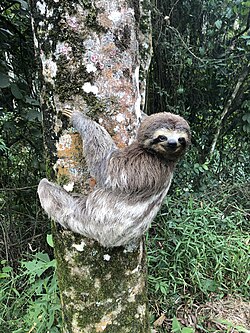

Brown-throated Sloth
Bradypus variegatus
Silhouette: Sarah Werning · PhyloPic
- KingdomAnimalia (Animals)
- PhylumChordata (Chordates)
- ClassMammalia (Mammals)
- OrderPilosa (Sloths and Anteaters)
- FamilyBradypodidae (Three-toed Sloths)
- GenusBradypus (Three-toed Sloths)
- SpeciesBradypus variegatus (Brown-throated Sloth)
In 3 days ~40% in a week ~70%
8 Verified sightings at Marino Ballena National Park From 2019 to 2026
3,603 In all 27 parks
February Best month
☀️ Diurnal When it's spotted


Completed
About the Brown-throated Sloth
The brown-throated sloth (Bradypus variegatus) is a species of three-toed sloth found in the Neotropical realm of Central and South America. It is the most common of the five species of three-toed sloth, and is found in the forests of South and Central America in countries such as Bolivia, Brazil, Colombia, Ecuador, Honduras, Nicaragua, Panama, Paraguay, Peru, and Venezuela. Although they once lived in Argentina, they are now believed to be extinct there.
The brown-throated sloth is of similar size and build to most other species of three-toed sloths, with both males and females being 42 to 80 cm (17 to 31 in) in total body length. The tail is relatively short, only 2.5 to 9 cm (1.0 to 3.5 in) long. Adults weigh from 2.25 to 6.3 kg (5.0 to 13.9 lb), with no significant size difference between males and females. Each foot has three fingers, ending in long, curved claws, which are 7 to 8 cm (2.8 to 3.1 in) long on the fore feet, and 5 to 5.5 cm (2.0 to 2.2 in) on the hind feet.
They have long forelimbs with three claws on each and about 10 cervical vertebrae, allowing their necks to rotate up to 270 degrees. Their cylindrical teeth lack enamel. Like many herbivorous... Wikipedia →
Sounds
Recording0:24
Ecuador · 2025
© Cathy Pasterczyk · iNaturalist · CC BY-NC 4.0
Recording0:51
Panama · 2020
© Cameron Eckert · iNaturalist · CC BY-NC 4.0
Recording0:23
Brazil · 2025
© Misael Domingos · iNaturalist · CC BY-NC 4.0
Recent sightings of Brown-throated Sloth in Marino Ballena National Park
LIVEiNaturalistGlobal Distribution
Parks Where Found
Cities Where Found
| # | City | Country | Daily sighting probability |
|---|---|---|---|
| 1 | João Pessoa | 🇧🇷 Brazil | |
| 2 | Belém | 🇧🇷 Brazil | |
| 3 | Santa Cruz de la Sierra | 🇧🇴 Bolivia | |
| 4 | Maceió | 🇧🇷 Brazil | |
| 5 | Recife | 🇧🇷 Brazil | |
| 6 | São Luís | 🇧🇷 Brazil | |
| 7 | Caracas | 🇻🇪 Venezuela | |
| 8 | San José | 🇨🇷 Costa Rica | |
| 9 | Panama City | 🇵🇦 Panama | |
| 10 | Manaus | 🇧🇷 Brazil |
Zoos & Centres Where Found
| # | Zoo / Centre | Country | |
|---|---|---|---|
| 1 | Parque Municipal Summit | 🇵🇦 Panama | |
| 2 | Vogelpark Marlow | 🇩🇪 Germany | |
| 3 | Bosque Rodrigues Alves | 🇧🇷 Brazil | |
| 4 | Alaska Zoo | 🇺🇸 United States | |
| 5 | Zoológico de Fauna Sudamericana | 🇧🇴 Bolivia | |
| 6 | El Nispero Zoo | 🇵🇦 Panama | |
| 7 | Dallas World Aquarium | 🇺🇸 United States | |
| 8 | The Green Planet | 🇦🇪 United Arab Emirates | |
| 9 | Amazon Rescue Center | 🇵🇪 Peru | |
| 10 | International Animal Rescue – Costa Rica | 🇨🇷 Costa Rica |
Closest Relatives at Marino Ballena National Park


Before you go
What are the chances of seeing a Brown-throated Sloth in Marino Ballena National Park?
Possible
About 20% of wildlife watchers report a Brown-throated Sloth sighting in Marino Ballena National Park on a given day, based on 8 verified sightings from GBIF citizen-science data from 2019 to 2026. It is the 7th most-seen of the 12 mammals we can rate there. Over three days the chance rises to about 40%, and over a week to about 70%, if each day is a fresh chance.
When is the best time to see a Brown-throated Sloth in Marino Ballena National Park?
February
In that month about 30% of wildlife watchers report a Brown-throated Sloth in Marino Ballena National Park on a given day, against under 5% in March, August and October–January, the lowest months. That is one of Marino Ballena National Park's driest months, with about 110 mm of rain against 920 mm in October.
What time of day is best to see a Brown-throated Sloth?
Between 9 am and noon
Across all the parks we cover, that three-hour window holds the most Brown-throated Sloth sightings with a recorded time, and about 9 in 10 of them come between 6 am and 6 pm: it is a daytime animal.
Is Marino Ballena National Park the best place to see a Brown-throated Sloth?
23rd of 27
Of the 27 parks where we can rate Brown-throated Sloth sightings, Marino Ballena National Park ranks 23rd at about 20%. The best odds are in Manuel Antonio National Park (Costa Rica, about 80%), Bastimentos Island National Marine Park (Panama, about 70%) and Tenorio Volcano National Park (Costa Rica, about 70%). All parks ranked.
Which relatives of the Brown-throated Sloth live in Marino Ballena National Park?
Same order: Pilosa
The closest relatives of the Brown-throated Sloth that you can see in Marino Ballena National Park (order Pilosa, Sloths and Anteaters) are Hoffmann's Two-toed Sloth (about 40%) and Northern Tamandua (about 10%), with each one's daily chance of a sighting.
Where does the Brown-throated Sloth sighting chance come from?
GBIF citizen-science records
It is estimated from how often the Brown-throated Sloth is recorded against all the mammals logged in Marino Ballena National Park (8 verified sightings from 2019 to 2026), calibrated against known sighting rates. Figures are rounded to the nearest 10% because citizen-science data supports honest approximations, not decimals, and months with records from fewer than five people show "—". How it works.
