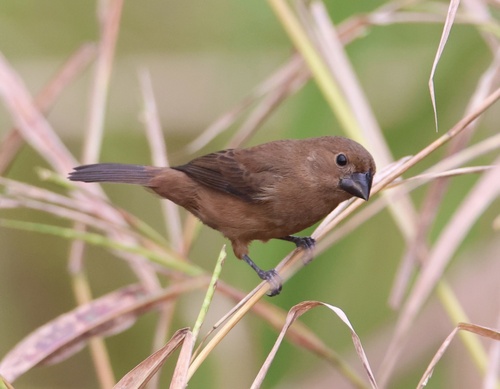
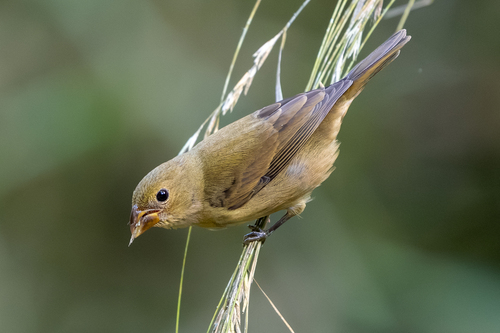
Yellow-bellied Seedeater

Yellow-bellied Seedeater

Sporophila nigricollis

Silhouette: Sheatherius · PhyloPic

LCLeast ConcernNTVUENCR
Daily sighting probability ~10% · With luck
at Soberanía National Park

In 3 days ~30% in a week ~50%

1,005 Verified sightings at Soberanía National Park From 2019 to 2026
3,473 In all 24 parks
June Best month
☀️ Diurnal When it's spotted

About the Yellow-bellied Seedeater

The yellow-bellied seedeater (Sporophila nigricollis) is a species of bird in the family Thraupidae, formerly placed with the New World sparrows in the Emberizidae. The "hooded seedeater" was a proposed bird species described by Austrian ornithologist August von Pelzeln as Spermophila melanops in 1870. The only known individual was heavily moulted and caught in October 1823 from a flock of other seedeater species at the edge of a lake 15 kilometres north of Registro do Araguaia, Brazil. It is now considered to be either an abnormal specimen of the yellow-bellied seedeater or a hybrid. The bird had a black crest and throat, the upperparts were olive, and the underparts showed a dingy buff. In contrast, a typical yellow-bellied seedeater has pale yellow underparts and the black colouring extends to the upper breast.

The yellow-bellied seedeater is found in Central and South America from Costa Rica to Bolivia. Its natural habitats are subtropical or tropical high-altitude shrubland, pastureland, and heavily degraded former forest. One study in Brazil estimated that 16,800 yellow-bellied... Wikipedia →

Sounds

Call0:26

Ecuador · 2026

© Marco Andrés Urvina Alejandro · XC1101769 · CC BY-NC-SA 4.0

Song0:42

Brazil · 2026

© JAYRSON ARAUJO DE OLIVEIRA · XC1080166 · CC BY-NC-SA 4.0

Chamado1:11

Brazil · 2018

© Caio Brito · XC556602 · CC BY-NC-SA 4.0

Global Distribution

Parks Where Found

# Park Country Daily sighting probability
1 Chapada Diamantina National Park 🇧🇷 Brazil
~30%
2 Serra da Canastra National Park 🇧🇷 Brazil
~20%
3 Farallones de Cali National Natural Park 🇨🇴 Colombia
~20%
4 Piedras Blancas National Park 🇨🇷 Costa Rica
~10%
5 Henri Pittier National Park 🇻🇪 Venezuela
~10%
6 Soberanía National Park 🇵🇦 Panama
~10%
7 Los Nevados National Natural Park 🇨🇴 Colombia
~10%
8 Chagres National Park 🇵🇦 Panama
<5%
9 Sierra de la Macarena National Park 🇨🇴 Colombia
<5%
10 Volcán Barú National Park 🇵🇦 Panama
<5%
11 Parque Natural Metropolitano 🇵🇦 Panama
<5%
12 Marino Ballena National Park 🇨🇷 Costa Rica
<5%
13 La Amistad International Park (Panama) 🇵🇦 Panama
<5%
14 Machalilla National Park 🇪🇨 Ecuador
<5%
15 Chingaza National Natural Park 🇨🇴 Colombia
<5%
16 Tayrona National Natural Park 🇨🇴 Colombia
<5%
17 Manu National Park 🇵🇪 Peru
<5%
18 Tijuca National Park 🇧🇷 Brazil
<5%
19 Chirripó National Park 🇨🇷 Costa Rica
<5%
20 Itatiaia National Park 🇧🇷 Brazil
<5%
21 Podocarpus National Park 🇪🇨 Ecuador
<5%
22 Manuel Antonio National Park 🇨🇷 Costa Rica
<5%
23 Tapantí-Macizo de la Muerte National Park 🇨🇷 Costa Rica
<5%
24 Corcovado National Park 🇨🇷 Costa Rica
<5%

Cities Where Found

# City Country Daily sighting probability
1 Goiânia 🇧🇷 Brazil
~30%
2 Cali 🇨🇴 Colombia
~20%
3 Brasilia 🇧🇷 Brazil
~20%
4 Medellín 🇨🇴 Colombia
~20%
5 Valencia 🇻🇪 Venezuela
~10%
6 Caracas 🇻🇪 Venezuela
~10%
7 Quito 🇪🇨 Ecuador
~10%
8 Panama City 🇵🇦 Panama
~10%
9 Belo Horizonte 🇧🇷 Brazil
<5%
10 Rio de Janeiro 🇧🇷 Brazil
<5%

Before you go

What are the chances of seeing a Yellow-bellied Seedeater in Soberanía National Park?

With luck

About 10% of wildlife watchers report a Yellow-bellied Seedeater sighting in Soberanía National Park on a given day, based on 1,005 verified sightings from GBIF citizen-science data from 2019 to 2026. It is the 177th most-seen of the 449 birds we can rate there. Over three days the chance rises to about 30%, and over a week to about 50%, if each day is a fresh chance.

When is the best time to see a Yellow-bellied Seedeater in Soberanía National Park?

February and June

In those months about 20% of wildlife watchers report a Yellow-bellied Seedeater in Soberanía National Park on a given day, against under 5% in September to December, the lowest months.

What time of day is best to see a Yellow-bellied Seedeater?

Between 7 and 10 am

Across all the parks we cover, that three-hour window holds the most Yellow-bellied Seedeater sightings with a recorded time, and about 9 in 10 of them come between 6 am and 6 pm: it is a daytime animal.

Which relatives of the Yellow-bellied Seedeater live in Soberanía National Park?

Same genus: Sporophila

The closest relatives of the Yellow-bellied Seedeater that you can see in Soberanía National Park (genus Sporophila, Typical Seedeaters and Seed-Finches) are Variable Seedeater (about 40%) and Thick-billed Seed-Finch (about 10%), with each one's daily chance of a sighting.

Where does the Yellow-bellied Seedeater sighting chance come from?

GBIF citizen-science records

It is estimated from how often the Yellow-bellied Seedeater is recorded against all the birds logged in Soberanía National Park (1,005 verified sightings from 2019 to 2026), calibrated against known sighting rates. Figures are rounded to the nearest 10% because citizen-science data supports honest approximations, not decimals, and months with records from fewer than five people show "—". How it works.

← Back to Soberanía National Park