
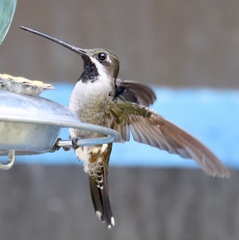
Long-billed Starthroat

Long-billed Starthroat

Heliomaster longirostris

Silhouette: Cristian Gutierrez-Ibanez · PhyloPic

LCLeast ConcernNTVUENCR
Daily sighting probability <5% · Rare
at Tapantí-Macizo de la Muerte National Park

In 3 days <5%

7 Verified sightings at Tapantí-Macizo de la Muerte National Park From 2019 to 2026
2,733 In all 34 parks
June Best month
☀️ Diurnal When it's spotted

About the Long-billed Starthroat

The long-billed starthroat (Heliomaster longirostris) is a species of hummingbird in the "mountain gems", tribe Lampornithini in subfamily Trochilinae. It is found in Mexico, Central America, Trinidad, and all but the four southernmost countries of South America.

At one time the long-billed starthroat was placed in genus Anthoscenus but since the mid-1900s has had its current placement in Heliomaster. The long-billed starthroat is 11 to 12 cm (4.3 to 4.7 in) long. Males weigh 5.5 to 7.1 g (0.19 to 0.25 oz) and females about 6.5 g (0.23 oz). Both sexes of all subspecies have a long, almost straight, black bill and a small white spot behind the eye.

Males of the nominate subspecies have a glittering blue to greenish blue crown; the rest of its upperparts are dark bronzy green with the exception of a white stripe down the center of the rump. The face is black below the crown and has a white malar stripe below the black. Its tail is rather short and square-tipped. The feathers are bronzy green near the body and black away from it, and the outer... Wikipedia →

Sounds

Call0:29

Ecuador · 2024

© Manuel Sánchez-Nivicela · XC1152580 · CC BY-NC-ND 4.0

Flight call0:06

Ecuador · 2017

© Leonardo Ordóñez-Delgado · XC513948 · CC BY-NC-SA 4.0

Song0:27

Brazil · 2019

© JAYRSON ARAUJO DE OLIVEIRA · XC493184 · CC BY-NC-SA 4.0

Global Distribution

Parks Where Found

# Park Country Daily sighting probability
1 Manu National Park 🇵🇪 Peru
~10%
2 Machalilla National Park 🇪🇨 Ecuador
~10%
3 El Triunfo 🇲🇽 Mexico
~10%
4 Chirripó National Park 🇨🇷 Costa Rica
~10%
5 Yasuní National Park 🇪🇨 Ecuador
~10%
6 Tenorio Volcano National Park 🇨🇷 Costa Rica
<5%
7 La Amistad International Park (Panama) 🇵🇦 Panama
<5%
8 Farallones de Cali National Natural Park 🇨🇴 Colombia
<5%
9 Tambopata National Reserve 🇵🇪 Peru
<5%
10 Corcovado National Park 🇨🇷 Costa Rica
<5%
11 Piedras Blancas National Park 🇨🇷 Costa Rica
<5%
12 Lago de Yojoa 🇭🇳 Honduras
<5%
13 Arenal Volcano National Park 🇨🇷 Costa Rica
<5%
14 Chagres National Park 🇵🇦 Panama
<5%
15 Cañón del Sumidero National Park 🇲🇽 Mexico
<5%
16 Pico Bonito National Park 🇭🇳 Honduras
<5%
17 Sierra de la Macarena National Park 🇨🇴 Colombia
<5%
18 Cusuco National Park 🇭🇳 Honduras
<5%
19 Chapada dos Guimarães National Park 🇧🇷 Brazil
<5%
20 Tayrona National Natural Park 🇨🇴 Colombia
<5%
21 Carara National Park 🇨🇷 Costa Rica
<5%
22 Cerro Azul Meámbar National Park 🇭🇳 Honduras
<5%
23 Cuyabeno Wildlife Reserve 🇪🇨 Ecuador
<5%
24 Rincón de la Vieja National Park 🇨🇷 Costa Rica
<5%
25 Marino Ballena National Park 🇨🇷 Costa Rica
<5%
26 Braulio Carrillo National Park 🇨🇷 Costa Rica
<5%
27 Cahuita National Park 🇨🇷 Costa Rica
<5%
28 Manuel Antonio National Park 🇨🇷 Costa Rica
<5%
29 Volcán Barú National Park 🇵🇦 Panama
<5%
30 Soberanía National Park 🇵🇦 Panama
<5%
31 Gandoca-Manzanillo Wildlife Refuge 🇨🇷 Costa Rica
<5%
32 Podocarpus National Park 🇪🇨 Ecuador
<5%
33 Monteverde Cloud Forest Reserve 🇨🇷 Costa Rica
<5%
34 Tapantí-Macizo de la Muerte National Park 🇨🇷 Costa Rica
<5%

Cities Where Found

# City Country Daily sighting probability
1 Guayaquil 🇪🇨 Ecuador
<5%
2 San Salvador 🇸🇻 El Salvador
<5%
3 San José 🇨🇷 Costa Rica
<5%
4 Cali 🇨🇴 Colombia
<5%

Before you go

What are the chances of seeing a Long-billed Starthroat in Tapantí-Macizo de la Muerte National Park?

Rare

Under 5% of wildlife watchers report a Long-billed Starthroat sighting in Tapantí-Macizo de la Muerte National Park on a given day, based on 7 verified sightings from GBIF citizen-science data from 2019 to 2026. It is the 452nd most-seen of the 467 birds we can rate there. Over three days the chance rises to under 5%, if each day is a fresh chance.

When is the best time to see a Long-billed Starthroat in Tapantí-Macizo de la Muerte National Park?

Any time of year

In every month with enough records, under 5% of wildlife watchers report a Long-billed Starthroat in Tapantí-Macizo de la Muerte National Park on a given day, so our monthly data shows no clear season.

What time of day is best to see a Long-billed Starthroat?

Between 7 and 10 am

Across all the parks we cover, that three-hour window holds the most Long-billed Starthroat sightings with a recorded time, and about 9 in 10 of them come between 6 am and 6 pm: it is a daytime animal.

Is Tapantí-Macizo de la Muerte National Park the best place to see a Long-billed Starthroat?

34th of 34

Of the 34 parks where we can rate Long-billed Starthroat sightings, Tapantí-Macizo de la Muerte National Park ranks 34th at under 5%. The best odds are in Manu National Park (Peru, about 10%), Machalilla National Park (Ecuador, about 10%) and El Triunfo (Mexico, about 10%).

Which relatives of the Long-billed Starthroat live in Tapantí-Macizo de la Muerte National Park?

Same family: Trochilidae

The closest relatives of the Long-billed Starthroat that you can see in Tapantí-Macizo de la Muerte National Park (family Trochilidae, Hummingbirds) are Volcano Hummingbird (about 60%), Talamanca Hummingbird (about 50%) and Lesser Violetear (about 50%), with each one's daily chance of a sighting.

Where does the Long-billed Starthroat sighting chance come from?

GBIF citizen-science records

It is estimated from how often the Long-billed Starthroat is recorded against all the birds logged in Tapantí-Macizo de la Muerte National Park (7 verified sightings from 2019 to 2026), calibrated against known sighting rates. Figures are rounded to the nearest 10% because citizen-science data supports honest approximations, not decimals, and months with records from fewer than five people show "—". How it works.

← Back to Tapantí-Macizo de la Muerte National Park