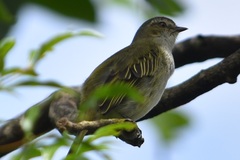
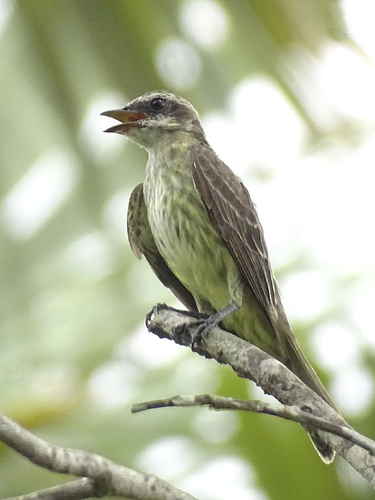
Guatemalan Paltry Tyrannulet

Guatemalan Paltry Tyrannulet

Zimmerius vilissimus

Silhouette: Emily Willoughby · PhyloPic

LCLeast ConcernNTVUENCR
Daily sighting probability <5% · Rare
at Carara National Park

In 3 days ~10% in a week ~20%

252 Verified sightings at Carara National Park From 2019 to 2026
20,490 In all 32 parks
September Best month
☀️ Diurnal When it's spotted

About the Guatemalan Paltry Tyrannulet

The Guatemalan tyrannulet, or paltry tyrannulet, (Zimmerius vilissimus) is a very small passerine bird in the family Tyrannidae, the tyrant flycatchers. It is found in Belize, El Salvador, Guatemala, and Mexico. The Guatemalan tyrannulet was originally described as Elainia vilissima. During much of the twentieth century it and several other tyrannulets were placed in genus Tyranniscus but a study published in 1977 erected the present genus Zimmerius for them.

Zimmerius vilissimus was previously called the paltry tyrannulet and included as subspecies what are now the mistletoe tyrannulet (Z. parvus), spectacled tyrannulet (Z. improbus), and Venezuelan tyrannulet (Z. petersi). Taxonomic systems began separating them in 2004 but it took until 2020 for all to complete the change. Most systems adopted the common name Guatemalan tyrannulet for Z. vilissimus sensu stricto to avoid confusion with the previous multi-subspecies paltry tyrannulet but as of late 2024 BirdLife International's Handbook of the Birds of the World retained the old "paltry" name.

The Guatemalan tyrannulet is monotypic. The Guatemalan tyrannulet is 10 to 12 cm (3.9 to 4... Wikipedia →

Sounds

Call0:23

Guatemala · 2024

© Peter Boesman · XC880387 · CC BY-NC-ND 4.0

Song0:13

Costa Rica · 2024

© Alain Verneau · XC875499 · CC BY-NC-SA 4.0

Call0:05

Mexico · 2015

© Richard E. Webster · XC335104 · CC BY-NC-SA 4.0

Global Distribution

Parks Where Found

# Park Country Daily sighting probability
1 Chagres National Park 🇵🇦 Panama
~50%
2 Chirripó National Park 🇨🇷 Costa Rica
~40%
3 El Triunfo 🇲🇽 Mexico
~30%
4 Tapantí-Macizo de la Muerte National Park 🇨🇷 Costa Rica
~30%
5 Monteverde Cloud Forest Reserve 🇨🇷 Costa Rica
~20%
6 Braulio Carrillo National Park 🇨🇷 Costa Rica
~20%
7 Tenorio Volcano National Park 🇨🇷 Costa Rica
~20%
8 Volcán Barú National Park 🇵🇦 Panama
~20%
9 San Lorenzo Protected Forest 🇵🇦 Panama
~20%
10 Los Quetzales National Park 🇨🇷 Costa Rica
~20%
11 Piedras Blancas National Park 🇨🇷 Costa Rica
~20%
12 La Amistad International Park (Panama) 🇵🇦 Panama
~20%
13 Pico Bonito National Park 🇭🇳 Honduras
~20%
14 Soberanía National Park 🇵🇦 Panama
~20%
15 Arenal Volcano National Park 🇨🇷 Costa Rica
~10%
16 Darién National Park 🇵🇦 Panama
~10%
17 Tortuguero National Park 🇨🇷 Costa Rica
~10%
18 Gandoca-Manzanillo Wildlife Refuge 🇨🇷 Costa Rica
~10%
19 Henri Pittier National Park 🇻🇪 Venezuela
~10%
20 Cahuita National Park 🇨🇷 Costa Rica
~10%
21 Poás Volcano National Park 🇨🇷 Costa Rica
~10%
22 Corcovado National Park 🇨🇷 Costa Rica
~10%
23 Parque Natural Metropolitano 🇵🇦 Panama
~10%
24 Cerro Azul Meámbar National Park 🇭🇳 Honduras
~10%
25 Rincón de la Vieja National Park 🇨🇷 Costa Rica
<5%
26 Carara National Park 🇨🇷 Costa Rica
<5%
27 Marino Ballena National Park 🇨🇷 Costa Rica
<5%
28 Cusuco National Park 🇭🇳 Honduras
<5%
29 Lago de Yojoa 🇭🇳 Honduras
<5%
30 Irazú Volcano National Park 🇨🇷 Costa Rica
<5%
31 Manuel Antonio National Park 🇨🇷 Costa Rica
<5%
32 Bastimentos Island National Marine Park 🇵🇦 Panama
<5%

Cities Where Found

# City Country Daily sighting probability
1 Caracas 🇻🇪 Venezuela
<5%
2 San José 🇨🇷 Costa Rica
<5%
3 Panama City 🇵🇦 Panama
<5%
4 Guatemala City 🇬🇹 Guatemala
<5%

Before you go

What are the chances of seeing a Guatemalan Paltry Tyrannulet in Carara National Park?

Rare

Under 5% of wildlife watchers report a Guatemalan Paltry Tyrannulet sighting in Carara National Park on a given day, based on 252 verified sightings from GBIF citizen-science data from 2019 to 2026. It is the 258th most-seen of the 414 birds we can rate there. Over three days the chance rises to about 10%, and over a week to about 20%, if each day is a fresh chance.

When is the best time to see a Guatemalan Paltry Tyrannulet in Carara National Park?

June and September

In those months about 10% of wildlife watchers report a Guatemalan Paltry Tyrannulet in Carara National Park on a given day, against under 5% in July–August and October–May, the lowest months. Those are among Carara National Park's wettest months, with about 590 mm of rain a month against 35 mm in February.

What time of day is best to see a Guatemalan Paltry Tyrannulet?

Between 8 and 11 am

Across all the parks we cover, that three-hour window holds the most Guatemalan Paltry Tyrannulet sightings with a recorded time, and nearly all of them come between 6 am and 6 pm: it is a daytime animal.

Is Carara National Park the best place to see a Guatemalan Paltry Tyrannulet?

26th of 32

Of the 32 parks where we can rate Guatemalan Paltry Tyrannulet sightings, Carara National Park ranks 26th at under 5%. The best odds are in Chagres National Park (Panama, about 50%), Chirripó National Park (Costa Rica, about 40%) and El Triunfo (Mexico, about 30%). All parks ranked.

Which relatives of the Guatemalan Paltry Tyrannulet live in Carara National Park?

Same family: Tyrannidae

The closest relatives of the Guatemalan Paltry Tyrannulet that you can see in Carara National Park (family Tyrannidae, Tyrant Flycatchers) are Great Kiskadee (about 60%), Tropical Kingbird (about 50%) and Social Flycatcher (about 40%), with each one's daily chance of a sighting.

Where does the Guatemalan Paltry Tyrannulet sighting chance come from?

GBIF citizen-science records

It is estimated from how often the Guatemalan Paltry Tyrannulet is recorded against all the birds logged in Carara National Park (252 verified sightings from 2019 to 2026), calibrated against known sighting rates. Figures are rounded to the nearest 10% because citizen-science data supports honest approximations, not decimals, and months with records from fewer than five people show "—". How it works.

← Back to Carara National Park