Lesser Yellow-headed Vulture

Lesser Yellow-headed Vulture

Cathartes burrovianus

Silhouette: Jan Sevcik (photo), John E. McCormack, Michael G. Harvey, Brant C. Faircloth, Nicholas G. Crawford, Travis C. Glenn, Robb T. Brumfield & T. Michael Keesey · PhyloPic

LCLeast ConcernNTVUENCR
Daily sighting probability ~40% · Likely
at Celestún Biosphere Reserve

In 3 days ~80% in a week >90%

719 Verified sightings at Celestún Biosphere Reserve From 2019 to 2026
5,168 In all 28 parks
June Best month
☀️ Diurnal When it's spotted

About the Lesser Yellow-headed Vulture

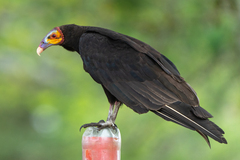
The lesser yellow-headed vulture (Cathartes burrovianus), also known as the savannah vulture, is a species of bird in the New World vulture family Cathartidae. It was considered to be the same species as the greater yellow-headed vulture until they were split in 1964. It is found in Mexico, Central America, and South America in seasonally wet or flooded lowland grassland, swamps, and heavily degraded former forest. It is a large bird, with a wingspan of 150–165 cm (59–65 in). The body plumage is black, and the head and neck, which are featherless, are pale orange with red or blue areas. It lacks a syrinx, so therefore its vocalizations are limited to grunts or low hisses.

The lesser yellow-headed vulture feeds on carrion and locates carcasses by sight and by smell, an ability which is rare in birds. It is dependent on larger vultures, such as the king vulture, to open the hides of larger animal carcasses as its bill is not strong enough to do this. Like other New World vultures, the lesser yellow-headed vulture utilizes thermals to stay aloft with minimal effort. It lays its eggs on flat surfaces, such as the floors of caves, or in the hollows of stumps. It feeds its young by regurgitation... Wikipedia →

Sounds

Alarm call0:06

Brazil · 2022

© Luiz C. Silva · XC717346 · CC BY-NC-SA 4.0

Global Distribution

Parks Where Found

# Park Country Daily sighting probability
1 Parque Estadual Encontro das Águas 🇧🇷 Brazil
~60%
2 Emas National Park 🇧🇷 Brazil
~40%
3 Iberá National Park 🇦🇷 Argentina
~40%
4 Celestún Biosphere Reserve 🇲🇽 Mexico
~40%
5 Ría Lagartos Biosphere Reserve 🇲🇽 Mexico
~40%
6 El Impenetrable National Park 🇦🇷 Argentina
~30%
7 Lago de Yojoa 🇭🇳 Honduras
~20%
8 Chapada Diamantina National Park 🇧🇷 Brazil
~20%
9 Sian Ka'an Biosphere Reserve 🇲🇽 Mexico
~20%
10 Cerro Azul Meámbar National Park 🇭🇳 Honduras
~10%
11 Amacayacu National Natural Park 🇨🇴 Colombia
~10%
12 Anavilhanas National Park 🇧🇷 Brazil
~10%
13 Sierra de la Macarena National Park 🇨🇴 Colombia
~10%
14 Serra dos Órgãos National Park 🇧🇷 Brazil
<5%
15 Soberanía National Park 🇵🇦 Panama
<5%
16 Manuel Antonio National Park 🇨🇷 Costa Rica
<5%
17 Arrecifes de Cozumel National Park 🇲🇽 Mexico
<5%
18 Itatiaia National Park 🇧🇷 Brazil
<5%
19 Chapada dos Guimarães National Park 🇧🇷 Brazil
<5%
20 Tayrona National Natural Park 🇨🇴 Colombia
<5%
21 Calakmul Biosphere Reserve 🇲🇽 Mexico
<5%
22 Yasuní National Park 🇪🇨 Ecuador
<5%
23 Iguaçu National Park 🇧🇷 Brazil
<5%
24 Tijuca National Park 🇧🇷 Brazil
<5%
25 Iguazú National Park 🇦🇷 Argentina
<5%
26 Tikal National Park 🇬🇹 Guatemala
<5%
27 Farallones de Cali National Natural Park 🇨🇴 Colombia
<5%
28 Parque Natural Metropolitano 🇵🇦 Panama
<5%

Cities Where Found

# City Country Daily sighting probability
1 Barranquilla 🇨🇴 Colombia
~30%
2 São Luís 🇧🇷 Brazil
~20%
3 Recife 🇧🇷 Brazil
~10%
4 Asuncion 🇵🇾 Paraguay
~10%
5 Santa Cruz de la Sierra 🇧🇴 Bolivia
~10%
6 Maceió 🇧🇷 Brazil
~10%
7 Vitória 🇧🇷 Brazil
~10%
8 João Pessoa 🇧🇷 Brazil
<5%
9 Fortaleza 🇧🇷 Brazil
<5%
10 Rio de Janeiro 🇧🇷 Brazil
<5%

Zoos & Centres Where Found

# Zoo / Centre Country
1 Pairi Daiza 🇧🇪 Belgium In captivity
2 Prague Zoo 🇨🇿 Czechia In captivity
3 Zlín-Lešná Zoo 🇨🇿 Czechia In captivity
4 Zoo Pilsen 🇨🇿 Czechia In captivity
5 African Lion Safari 🇨🇦 Canada In captivity
6 Catoctin Wildlife Preserve and Zoo 🇺🇸 United States In captivity
7 Reptile Gardens 🇺🇸 United States In captivity
8 Bioparc Fuengirola 🇪🇸 Spain In captivity
9 Rákosův pavilon 🇨🇿 Czechia In captivity
10 Velemlokárium 🇨🇿 Czechia In captivity
11 Snakeroom Serpentarium 🇪🇸 Spain In captivity

Before you go

What are the chances of seeing a Lesser Yellow-headed Vulture in Celestún Biosphere Reserve?

Likely

About 40% of wildlife watchers report a Lesser Yellow-headed Vulture sighting in Celestún Biosphere Reserve on a given day, based on 719 verified sightings from GBIF citizen-science data from 2019 to 2026. It is the 36th most-seen of the 297 birds we can rate there. Over three days the chance rises to about 80%, and over a week to over 90%, if each day is a fresh chance.

When is the best time to see a Lesser Yellow-headed Vulture in Celestún Biosphere Reserve?

June

In that month about 60% of wildlife watchers report a Lesser Yellow-headed Vulture in Celestún Biosphere Reserve on a given day, against about 20% in March and December, the lowest months. That is one of Celestún Biosphere Reserve's wettest months, with about 160 mm of rain against 10 mm in February.

What time of day is best to see a Lesser Yellow-headed Vulture?

Between 9 am and noon

Across all the parks we cover, that three-hour window holds the most Lesser Yellow-headed Vulture sightings with a recorded time, and nearly all of them come between 6 am and 6 pm: it is a daytime animal.

Where does the Lesser Yellow-headed Vulture sighting chance come from?

GBIF citizen-science records

It is estimated from how often the Lesser Yellow-headed Vulture is recorded against all the birds logged in Celestún Biosphere Reserve (719 verified sightings from 2019 to 2026), calibrated against known sighting rates. Figures are rounded to the nearest 10% because citizen-science data supports honest approximations, not decimals, and months with records from fewer than five people show "—". How it works.

← Back to Celestún Biosphere Reserve
