


Completed


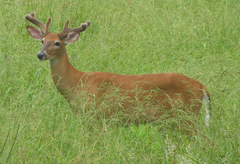


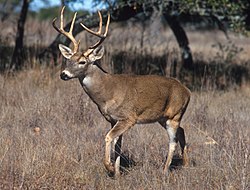
White-tailed Deer
Odocoileus virginianus
Silhouette: Tracy A. Heath · PhyloPic
- KingdomAnimalia (Animals)
- PhylumChordata (Chordates)
- ClassMammalia (Mammals)
- OrderArtiodactyla (Even-toed Ungulates and Cetaceans)
- FamilyCervidae (Deer)
- GenusOdocoileus (White-tailed and Mule Deer)
- SpeciesOdocoileus virginianus (White-tailed Deer)
In 3 days ~80% in a week >90%
159 Verified sightings at Detroit
4,956 In all 38 parks From 2019 to 2026
February Best month
☀️ Diurnal When it's spotted


Completed
About the White-tailed Deer
The white-tailed deer (Odocoileus virginianus), also known commonly as the whitetail and the Virginia deer, is a medium-sized species of deer native to North and South America. It is the most widely distributed mainland ungulate herbivore in the Americas; coupled with its natural predator, the mountain lion (Puma concolor), it is one of the most widely distributed terrestrial mammal species in the Americas and the world. Highly adaptable, the various subspecies of white-tailed deer inhabit many different ecosystems, from arid grasslands to the Amazon and Orinoco basins; from the Llanos to the high-elevation terrain of the Andes.
In North America, the white-tailed deer is very common (even considered a nuisance in some areas) in states to the east and south of the Rocky Mountains, including southwestern Arizona, with the exception of the American West Coast and Baja California Peninsula, where its ecological niche is filled by the black-tailed deer (in the Pacific Northwest) or the mule deer (Odocoileus hemionus) from that point west except for mixed deciduous riparian corridors, river valley bottomlands, and lower foothills of the northern Rocky Mountain region from... Wikipedia →
Sounds
Call0:38
United States · 2011
© Paul Driver · XC961843 · CC BY-NC-SA 4.0
Recording0:01
United States · 2021
© hb2000 · iNaturalist · CC BY-NC 4.0
Recording1:09
United States · 2025
© Susan Fawcett · iNaturalist · CC BY-NC 4.0
Recent sightings of White-tailed Deer in Detroit
LIVEiNaturalistGlobal Distribution
Parks Where Found
Cities Where Found
| # | City | Country | Daily sighting probability |
|---|---|---|---|
| 1 | San Antonio | 🇺🇸 United States | |
| 2 | Baltimore | 🇺🇸 United States | |
| 3 | Washington | 🇺🇸 United States | |
| 4 | Detroit | 🇺🇸 United States | |
| 5 | Austin | 🇺🇸 United States | |
| 6 | Chicago | 🇺🇸 United States | |
| 7 | Calgary | 🇨🇦 Canada | |
| 8 | Philadelphia | 🇺🇸 United States | |
| 9 | Boston | 🇺🇸 United States | |
| 10 | Minneapolis [Saint Paul] | 🇺🇸 United States |
Zoos & Centres Where Found
Closest Relatives at Detroit
No species of the same family or order lives in Detroit, so these are its closest relatives here: other mammals.







Before you go
What are the chances of seeing a White-tailed Deer in Detroit?
Likely
About 40% of wildlife watchers report a White-tailed Deer sighting in Detroit on a given day, based on 159 verified sightings from GBIF citizen-science data. It is the 2nd most-seen of the 15 mammals we can rate there. Over three days the chance rises to about 80%, and over a week to over 90%, if each day is a fresh chance.
When is the best time to see a White-tailed Deer in Detroit?
February and December
In those months about 50% of wildlife watchers report a White-tailed Deer in Detroit on a given day, against about 40% in January and March–November, the lowest months.
What time of day is best to see a White-tailed Deer?
Between 3 and 6 pm
Across all the parks we cover, that three-hour window holds the most White-tailed Deer sightings with a recorded time, and about 8 in 10 of them come between 6 am and 6 pm: it is a daytime animal.
Is Detroit the best place to see a White-tailed Deer?
4th of 24
Of the 24 cities where we can rate White-tailed Deer sightings, Detroit ranks 4th at about 40%. The best odds are in San Antonio (United States, about 50%), Baltimore (United States, about 50%) and Washington (United States, about 50%).
Where does the White-tailed Deer sighting chance come from?
GBIF citizen-science records
It is estimated from how often the White-tailed Deer is recorded against all the mammals logged in Detroit (159 verified sightings), calibrated against known sighting rates. Figures are rounded to the nearest 10% because citizen-science data supports honest approximations, not decimals, and months with records from fewer than five people show "—". How it works.
