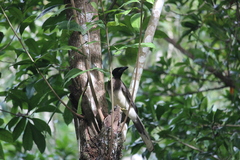
Brown Jay

Brown Jay

Psilorhinus morio

Silhouette: Peileppe · PhyloPic

Daily sighting probability <5% · Rare
at Monterrey

In 3 days <5%

5 Verified sightings at Monterrey
28,781 In all 35 parks From 2019 to 2026
May Best month
☀️ Diurnal When it's spotted

About the Brown Jay

The brown jay (Cyanocorax morio) is a large jay native to Central America and southern Texas. The brown jay was formerly placed in its own genus Psilorhinus. When molecular phylogenetic studies found that the genus Cyanocorax was paraphyletic relative to Psilorhinus, Psilorhinus was subsumed into Cyanocorax to resolve the paraphyly.

Brown jays vary in plumage geographically: there are two main groups. Northern birds are almost completely dark brown, with lighter brown on the underparts. Southern birds are white-bellied and have bright white tips to the outer tail feathers. The intergrade zone is in Veracruz, Mexico. Adults in both populations have black bills, legs, and feet. Immatures have yellow bare parts, including yellow eye-rings.

The voice is a loud but low-pitched pee-ah call and is often modified to suit its situation or mood. The northernmost extent... Wikipedia →

Sounds

Call1:27

Mexico · 2026

© Richard E. Webster · XC1183199 · CC BY-NC-SA 4.0

Alarm call0:16

Costa Rica · 2026

© Nick Talbot · XC1178478 · CC BY-NC-SA 4.0

Uncertain0:36

Belize · 2022

© Cheng-En, HSIEH · XC727055 · CC BY-NC-SA 4.0

Global Distribution

Parks Where Found

# Park Country Daily sighting probability
1 Tikal National Park 🇬🇹 Guatemala
~90%
2 Pico Bonito National Park 🇭🇳 Honduras
~70%
3 Calakmul Biosphere Reserve 🇲🇽 Mexico
~70%
4 Lago de Yojoa 🇭🇳 Honduras
~70%
5 Cerro Azul Meámbar National Park 🇭🇳 Honduras
~70%
6 Cusuco National Park 🇭🇳 Honduras
~70%
7 Monteverde Cloud Forest Reserve 🇨🇷 Costa Rica
~70%
8 Montes Azules Biosphere Reserve 🇲🇽 Mexico
~60%
9 Sian Ka'an Biosphere Reserve 🇲🇽 Mexico
~50%
10 Cockscomb Basin Wildlife Sanctuary 🇧🇿 Belize
~40%
11 Chirripó National Park 🇨🇷 Costa Rica
~40%
12 Biotopo Cerro Cahuí 🇬🇹 Guatemala
~30%
13 Arenal Volcano National Park 🇨🇷 Costa Rica
~20%
14 Rincón de la Vieja National Park 🇨🇷 Costa Rica
~20%
15 Tenorio Volcano National Park 🇨🇷 Costa Rica
~20%
16 Tapantí-Macizo de la Muerte National Park 🇨🇷 Costa Rica
~10%
17 Cañón del Sumidero National Park 🇲🇽 Mexico
~10%
18 Marino Ballena National Park 🇨🇷 Costa Rica
~10%
19 Braulio Carrillo National Park 🇨🇷 Costa Rica
~10%
20 Carara National Park 🇨🇷 Costa Rica
~10%
21 Poás Volcano National Park 🇨🇷 Costa Rica
~10%
22 Cumbres de Monterrey National Park 🇲🇽 Mexico
~10%
23 La Amistad International Park (Panama) 🇵🇦 Panama
~10%
24 Irazú Volcano National Park 🇨🇷 Costa Rica
<5%
25 Gandoca-Manzanillo Wildlife Refuge 🇨🇷 Costa Rica
<5%
26 Cahuita National Park 🇨🇷 Costa Rica
<5%
27 Celaque National Park 🇭🇳 Honduras
<5%
28 Bastimentos Island National Marine Park 🇵🇦 Panama
<5%
29 Piedras Blancas National Park 🇨🇷 Costa Rica
<5%
30 Manuel Antonio National Park 🇨🇷 Costa Rica
<5%
31 Corcovado National Park 🇨🇷 Costa Rica
<5%
32 Ría Lagartos Biosphere Reserve 🇲🇽 Mexico
<5%
33 Tortuguero National Park 🇨🇷 Costa Rica
<5%
34 Los Quetzales National Park 🇨🇷 Costa Rica
<5%
35 Palo Verde National Park 🇨🇷 Costa Rica
<5%

Cities Where Found

# City Country Daily sighting probability
1 San José 🇨🇷 Costa Rica
~30%
2 San Pedro Sula 🇭🇳 Honduras
~30%
3 Monterrey 🇲🇽 México
<5%

Before you go

What are the chances of seeing a Brown Jay in Monterrey?

Rare

Under 5% of wildlife watchers report a Brown Jay sighting in Monterrey on a given day, based on 5 verified sightings from GBIF citizen-science data. It is the 198th most-seen of the 207 birds we can rate there. Over three days the chance rises to under 5%, if each day is a fresh chance.

When is the best time to see a Brown Jay in Monterrey?

Any time of year

In every month with enough records, under 5% of wildlife watchers report a Brown Jay in Monterrey on a given day, so our monthly data shows no clear season.

What time of day is best to see a Brown Jay?

Between noon and 3 pm

Across all the parks we cover, that three-hour window holds the most Brown Jay sightings with a recorded time, and about 9 in 10 of them come between 6 am and 6 pm: it is a daytime animal.

Is Monterrey the best place to see a Brown Jay?

3rd of 3

Of the 3 cities where we can rate Brown Jay sightings, Monterrey ranks 3rd at under 5%. The best odds are in San José (Costa Rica, about 30%) and San Pedro Sula (Honduras, about 30%).

Where does the Brown Jay sighting chance come from?

GBIF citizen-science records

It is estimated from how often the Brown Jay is recorded against all the birds logged in Monterrey (5 verified sightings), calibrated against known sighting rates. Figures are rounded to the nearest 10% because citizen-science data supports honest approximations, not decimals, and months with records from fewer than five people show "—". How it works.

← Back to Monterrey