



Completed



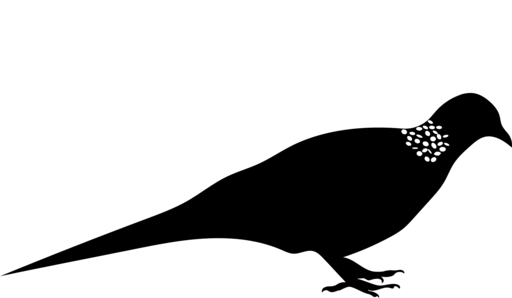
Laughing Dove
Spilopelia senegalensis
Silhouette: Jun Mencius · PhyloPic
- KingdomAnimalia (Animals)
- PhylumChordata (Chordates)
- ClassAves (Birds)
- OrderColumbiformes (Pigeons and Doves)
- FamilyColumbidae (Pigeons and Doves)
- GenusSpilopelia (Laughing and Spotted Doves)
- SpeciesSpilopelia senegalensis (Laughing Dove)
In 3 days ~80% in a week >90%
7,456 Verified sightings at Pune
25,522 In all 62 parks From 2019 to 2026
October Best month
☀️ Diurnal When it's spotted
About the Laughing Dove
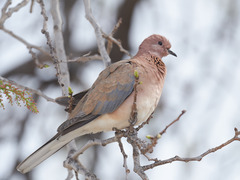
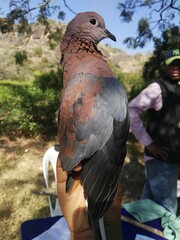
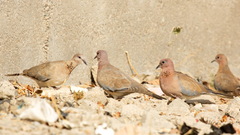
The laughing dove (Spilopelia senegalensis) is a small pigeon that is a resident breeder in Africa, the Middle East, South Asia, and Western Australia where it has established itself in the wild after being released from Perth Zoo in 1898. This small long-tailed dove is found in dry scrub and semi-desert habitats where pairs can often be seen feeding on the ground. It is closely related to the spotted dove (Spilopelia chinensis) which is distinguished by a white and black chequered necklace. Other names include laughing turtle dove, palm dove and Senegal dove while in Asia the name little brown dove is often used.
In 1760 the French zoologist Mathurin Jacques Brisson included a description of the laughing dove in his six volume Ornithologie based on a specimen collected in Senegal. He used the French name La tourterelle à gorge tachetée du Sénégal and the Latin Tutur gutture maculato senegalensis. Although Brisson coined Latin names, these do not conform to the binomial system and are not recognised by the International Commission on Zoological Nomenclature. When in 1766 the Swedish naturalist Carl Linnaeus updated his Systema Naturae for the twelfth edition, he added... Wikipedia →
Recent sightings of Laughing Dove in Pune
LIVEiNaturalistGlobal Distribution
Parks Where Found
Zoos & Centres Where Found
| # | Zoo / Centre | Country | |
|---|---|---|---|
| 1 | San Diego Zoo | 🇺🇸 United States | |
| 2 | Zoo Pilsen | 🇨🇿 Czechia | |
| 3 | San Diego Zoo Safari Park | 🇺🇸 United States | |
| 4 | Al Ain Zoo | 🇦🇪 United Arab Emirates | |
| 5 | Berlin Zoological Garden | 🇩🇪 Germany | |
| 6 | Wildlands | 🇳🇱 Netherlands | |
| 7 | Zoológico Benito Juárez | 🇲🇽 Mexico | |
| 8 | Wilhelma | 🇩🇪 Germany | |
| 9 | Hanover Zoo | 🇩🇪 Germany | |
| 10 | Budapest Zoo & Botanical Garden | 🇭🇺 Hungary | |
| 11 | Bird Paradise | 🇸🇬 Singapore | |
| 12 | Rainforest Wild Asia | 🇸🇬 Singapore | |
| 13 | Vogelpark Avifauna | 🇳🇱 Netherlands | |
| 14 | African Dawn Bird and Wildlife Sanctuary | 🇿🇦 South Africa | |
| 15 | Santillana Zoo | 🇪🇸 Spain | |
| 16 | World of Birds Wildlife Sanctuary and Monkey Park | 🇿🇦 South Africa | |
| 17 | Zoopark Nehvizdy | 🇨🇿 Czechia | |
| 18 | Aquarium Berlin | 🇩🇪 Germany |
Closest Relatives at Pune





Before you go
What are the chances of seeing a Laughing Dove in Pune?
Likely
About 50% of wildlife watchers report a Laughing Dove sighting in Pune on a given day, based on 7,456 verified sightings from GBIF citizen-science data. It is the 18th most-seen of the 236 birds we can rate there. Over three days the chance rises to about 80%, and over a week to over 90%, if each day is a fresh chance.
When is the best time to see a Laughing Dove in Pune?
October
In that month about 60% of wildlife watchers report a Laughing Dove in Pune on a given day, against about 30% in May, the lowest month.
What time of day is best to see a Laughing Dove?
Between 7 and 10 am
Across all the parks we cover, that three-hour window holds the most Laughing Dove sightings with a recorded time, and about 9 in 10 of them come between 6 am and 6 pm: it is a daytime animal.
Is Pune the best place to see a Laughing Dove?
71st of 116
Of the 116 cities where we can rate Laughing Dove sightings, Pune ranks 71st at about 50%. The best odds are in Raipur (India, over 90%), Ouagadougou (Burkina Faso, over 90%) and Doha (Qatar, over 90%).
Where does the Laughing Dove sighting chance come from?
GBIF citizen-science records
It is estimated from how often the Laughing Dove is recorded against all the birds logged in Pune (7,456 verified sightings), calibrated against known sighting rates. Figures are rounded to the nearest 10% because citizen-science data supports honest approximations, not decimals, and months with records from fewer than five people show "—". How it works.
