Giant Red-Winged Grasshopper

Giant Red-Winged Grasshopper

Tropidacris cristata

Daily sighting probability ~20% · Possible
at San Salvador

In 3 days ~50% in a week ~80%

58 Verified sightings at San Salvador
770 In all 28 parks From 2019 to 2026
September Best month
☀️🌙 Day & Night When it's spotted

About the Giant Red-Winged Grasshopper

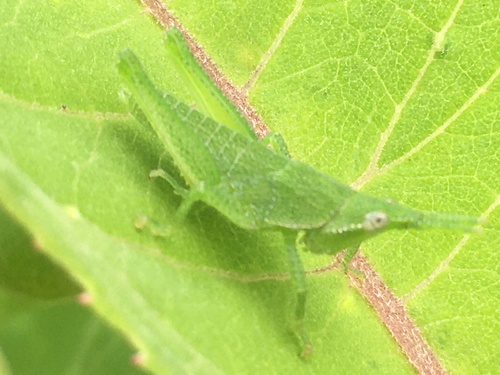
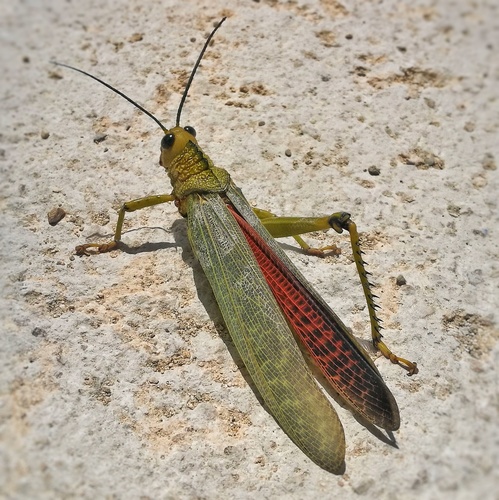
Tropidacris cristata, the giant red-winged grasshopper, is a widespread species of lubber grasshopper in the family Romaleidae from tropical South and Central America, and Mexico. It is among the largest grasshoppers in the world by length and wingspan, reaching up to 14.5 cm (5.7 in) and 24 cm (9.4 in) respectively. More typical adult lengths are 5.5–7 cm (2.2–2.8 in), average 6.5 cm (2.6 in), in males and 7–12 cm (2.8–4.7 in), average 11 cm (4.3 in), in females. As suggested by the common name, adult T. cristata have conspicuously red wings in flight, although the exact red hue varies. The flightless and gregarious nymphs have aposematic dark-and-yellow stripes and are presumed to be toxic.

T. cristata occurs in a wide range of habitats, both in lowlands and highlands. In the southern part of its distribution, it is largely restricted to humid and semi-humid forested regions, avoiding places that are open and dry, but in the northern part it also occurs in somewhat drier habitats. It is generally quite common, although the blue-winged T. collaris often is more common where their ranges overlap in South America (only T. cristata is found in some parts of northwestern South America and in Central America).

T. cristata feeds on many types of plants and occasionally it is regarded as a pest. The lifecycle is annual with overlapping generations, but in some regions there is a level of seasonality in the occurrence of adults and nymphs. The female lays an egg sac that contains up to 100 eggs in the soil. Wikipedia →
Global Distribution

Parks Where Found

# Park Country Daily sighting probability
1 Las Baulas Marine National Park 🇨🇷 Costa Rica
~50%
2 Manuel Antonio National Park 🇨🇷 Costa Rica
~40%
3 Marino Ballena National Park 🇨🇷 Costa Rica
~40%
4 Santa Rosa National Park 🇨🇷 Costa Rica
~40%
5 Ostional Wildlife Refuge 🇨🇷 Costa Rica
~40%
6 Tayrona National Natural Park 🇨🇴 Colombia
~30%
7 Cabo Blanco Absolute Nature Reserve 🇨🇷 Costa Rica
~30%
8 Masaya Volcano National Park 🇳🇮 Nicaragua
~30%
9 Bastimentos Island National Marine Park 🇵🇦 Panama
~30%
10 Corcovado National Park 🇨🇷 Costa Rica
~30%
11 Coiba National Park 🇵🇦 Panama
~20%
12 Palo Verde National Park 🇨🇷 Costa Rica
~20%
13 Tikal National Park 🇬🇹 Guatemala
~20%
14 Machalilla National Park 🇪🇨 Ecuador
~20%
15 Ría Lagartos Biosphere Reserve 🇲🇽 Mexico
~20%
16 Rincón de la Vieja National Park 🇨🇷 Costa Rica
~20%
17 Lago de Yojoa 🇭🇳 Honduras
~20%
18 Sian Ka'an Biosphere Reserve 🇲🇽 Mexico
~10%
19 Main Ridge Forest Reserve 🇹🇹 Trinidad and Tobago
~10%
20 Cerro Azul Meámbar National Park 🇭🇳 Honduras
~10%
21 Carara National Park 🇨🇷 Costa Rica
~10%
22 Soberanía National Park 🇵🇦 Panama
~10%
23 La Amistad International Park (Panama) 🇵🇦 Panama
~10%
24 Calakmul Biosphere Reserve 🇲🇽 Mexico
~10%
25 Iguazú National Park 🇦🇷 Argentina
~10%
26 Cumbres de Monterrey National Park 🇲🇽 Mexico
~10%
27 Iguaçu National Park 🇧🇷 Brazil
~10%
28 Monteverde Cloud Forest Reserve 🇨🇷 Costa Rica
<5%

Cities Where Found

# City Country Daily sighting probability
1 San Pedro Sula 🇭🇳 Honduras
~30%
2 Tegucigalpa 🇭🇳 Honduras
~30%
3 San Salvador 🇸🇻 El Salvador
~20%
4 Managua 🇳🇮 Nicaragua
~20%
5 Guayaquil 🇪🇨 Ecuador
~10%
6 Guatemala City 🇬🇹 Guatemala
~10%
7 São Paulo 🇧🇷 Brazil
<5%

Before you go

What are the chances of seeing a Giant Red-Winged Grasshopper in San Salvador?

Possible

About 20% of wildlife watchers report a Giant Red-Winged Grasshopper sighting in San Salvador on a given day, based on 58 verified sightings from GBIF citizen-science data. It is the 2nd most-seen of the 72 insects we can rate there. Over three days the chance rises to about 50%, and over a week to about 80%, if each day is a fresh chance.

When is the best time to see a Giant Red-Winged Grasshopper in San Salvador?

September

In that month about 40% of wildlife watchers report a Giant Red-Winged Grasshopper in San Salvador on a given day, against under 5% in December and January, the lowest months. That is one of San Salvador's wettest months, with about 280 mm of rain against almost none in January.

What time of day is best to see a Giant Red-Winged Grasshopper?

Between 8 and 11 am

Across all the parks we cover, that three-hour window holds the most Giant Red-Winged Grasshopper sightings with a recorded time, and about 7 in 10 of them come between 6 am and 6 pm: it is seen both by day and at night.

Is San Salvador the best place to see a Giant Red-Winged Grasshopper?

3rd of 7

Of the 7 cities where we can rate Giant Red-Winged Grasshopper sightings, San Salvador ranks 3rd at about 20%. The best odds are in San Pedro Sula (Honduras, about 30%) and Tegucigalpa (Honduras, about 30%).

Where does the Giant Red-Winged Grasshopper sighting chance come from?

GBIF citizen-science records

It is estimated from how often the Giant Red-Winged Grasshopper is recorded against all the insects logged in San Salvador (58 verified sightings), calibrated against known sighting rates. Figures are rounded to the nearest 10% because citizen-science data supports honest approximations, not decimals, and months with records from fewer than five people show "—". How it works.

← Back to San Salvador