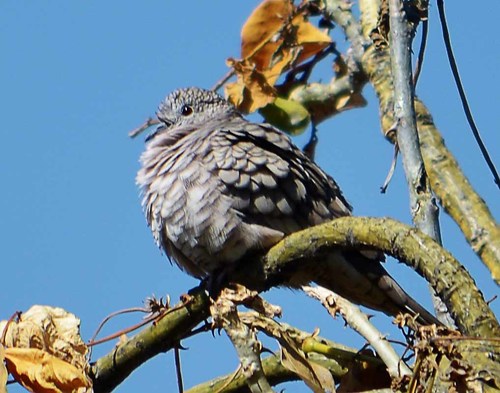
Red-billed Pigeon

Red-billed Pigeon

Patagioenas flavirostris

Silhouette: Ferran Sayol · PhyloPic

LCLeast ConcernNTVUENCR
Daily sighting probability ~40% · Likely
at San Salvador

In 3 days ~80% in a week >90%

1,426 Verified sightings at San Salvador
17,685 In all 39 parks From 2019 to 2026
April Best month
☀️ Diurnal When it's spotted

About the Red-billed Pigeon

The red-billed pigeon (Patagioenas flavirostris) is a relatively large, robust species of pigeon. Its breeding range extends from southern Texas, United States, to Costa Rica. It is primarily found throughout coastal and lowland areas of Mexico and Central America. It belongs to a clade of Patagioenas which generally lack iridescent display plumage, except some vestiges in the pale-vented pigeon.

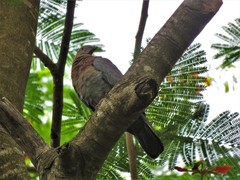
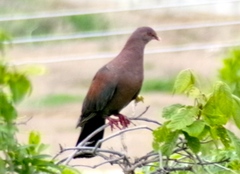
Red-billed pigeons have largely dark, slate-gray plumage with a more maroon, though sometimes described as purple, head, neck, and wing coverts. They have pale red eyes with an orange orbital ring, along with a red bill with a yellow tip. Noticeably, they don't have iridescent collar plumage. A blue-gray belly and tail coverts, as well as a less brown back, distinguish it from most other species., such as the Ruddy Pigeon and Short-billed Pigeon. The only noticeable difference between males and females is that the females have a duller colored head and neck. Juveniles are often even more dull in color and have dark and dusky shoulders, as well as a more brown mantle and wings.

Compared to other birds, they are a more mid-to-large sized bird, growing to be between 30 and 37... Wikipedia →

Sounds

Song0:07

Costa Rica · 2018

© Alain Malengreau · XC538453 · CC BY-NC-SA 4.0

Song1:11

Mexico · 2018

© Richard E. Webster · XC447723 · CC BY-NC-SA 4.0

Song0:09

Mexico · 2015

© Frank Lambert · XC352718 · CC BY-NC-ND 4.0

Global Distribution

Parks Where Found

# Park Country Daily sighting probability
1 Masaya Volcano National Park 🇳🇮 Nicaragua
~60%
2 Calakmul Biosphere Reserve 🇲🇽 Mexico
~30%
3 Arenal Volcano National Park 🇨🇷 Costa Rica
~30%
4 Tenorio Volcano National Park 🇨🇷 Costa Rica
~30%
5 El Triunfo 🇲🇽 Mexico
~30%
6 Monteverde Cloud Forest Reserve 🇨🇷 Costa Rica
~30%
7 Rincón de la Vieja National Park 🇨🇷 Costa Rica
~30%
8 Braulio Carrillo National Park 🇨🇷 Costa Rica
~20%
9 Pico Bonito National Park 🇭🇳 Honduras
~20%
10 Cabo Blanco Absolute Nature Reserve 🇨🇷 Costa Rica
~20%
11 Cusuco National Park 🇭🇳 Honduras
~20%
12 Irazú Volcano National Park 🇨🇷 Costa Rica
~20%
13 Santa Rosa National Park 🇨🇷 Costa Rica
~20%
14 Cañón del Sumidero National Park 🇲🇽 Mexico
~20%
15 La Tigra National Park 🇭🇳 Honduras
~20%
16 Poás Volcano National Park 🇨🇷 Costa Rica
~10%
17 Lago de Yojoa 🇭🇳 Honduras
~10%
18 Sian Ka'an Biosphere Reserve 🇲🇽 Mexico
~10%
19 Ostional Wildlife Refuge 🇨🇷 Costa Rica
~10%
20 Las Baulas Marine National Park 🇨🇷 Costa Rica
~10%
21 Palo Verde National Park 🇨🇷 Costa Rica
~10%
22 Cerro Azul Meámbar National Park 🇭🇳 Honduras
~10%
23 Carara National Park 🇨🇷 Costa Rica
~10%
24 Celaque National Park 🇭🇳 Honduras
~10%
25 Tapantí-Macizo de la Muerte National Park 🇨🇷 Costa Rica
~10%
26 Montes Azules Biosphere Reserve 🇲🇽 Mexico
~10%
27 Biotopo Cerro Cahuí 🇬🇹 Guatemala
~10%
28 Cockscomb Basin Wildlife Sanctuary 🇧🇿 Belize
~10%
29 Tortuguero National Park 🇨🇷 Costa Rica
<5%
30 Cumbres de Monterrey National Park 🇲🇽 Mexico
<5%
31 Cahuita National Park 🇨🇷 Costa Rica
<5%
32 Chirripó National Park 🇨🇷 Costa Rica
<5%
33 Gandoca-Manzanillo Wildlife Refuge 🇨🇷 Costa Rica
<5%
34 Tikal National Park 🇬🇹 Guatemala
<5%
35 Manuel Antonio National Park 🇨🇷 Costa Rica
<5%
36 Marino Ballena National Park 🇨🇷 Costa Rica
<5%
37 La Amistad International Park (Panama) 🇵🇦 Panama
<5%
38 Celestún Biosphere Reserve 🇲🇽 Mexico
<5%
39 Los Quetzales National Park 🇨🇷 Costa Rica
<5%

Cities Where Found

# City Country Daily sighting probability
1 San José 🇨🇷 Costa Rica
~60%
2 San Salvador 🇸🇻 El Salvador
~40%
3 Managua 🇳🇮 Nicaragua
~40%
4 Tegucigalpa 🇭🇳 Honduras
~10%
5 San Pedro Sula 🇭🇳 Honduras
~10%
6 Guatemala City 🇬🇹 Guatemala
~10%
7 Monterrey 🇲🇽 México
<5%

Zoos & Centres Where Found

# Zoo / Centre Country
1 Singapore Zoo 🇸🇬 Singapore In captivity
2 Bird Paradise 🇸🇬 Singapore In captivity
3 Rainforest Wild Asia 🇸🇬 Singapore In captivity
4 UMA "El Palapo" 🇲🇽 Mexico In captivity
5 Zoológico Miguél Álvarez del Toro 🇲🇽 Mexico In captivity

Before you go

What are the chances of seeing a Red-billed Pigeon in San Salvador?

Likely

About 40% of wildlife watchers report a Red-billed Pigeon sighting in San Salvador on a given day, based on 1,426 verified sightings from GBIF citizen-science data. It is the 13th most-seen of the 153 birds we can rate there. Over three days the chance rises to about 80%, and over a week to over 90%, if each day is a fresh chance.

When is the best time to see a Red-billed Pigeon in San Salvador?

March to May

In those months about 60% of wildlife watchers report a Red-billed Pigeon in San Salvador on a given day, against about 20% in September, the lowest month.

What time of day is best to see a Red-billed Pigeon?

Between 6 and 9 am

Across all the parks we cover, that three-hour window holds the most Red-billed Pigeon sightings with a recorded time, and about 9 in 10 of them come between 6 am and 6 pm: it is a daytime animal.

Is San Salvador the best place to see a Red-billed Pigeon?

2nd of 7

Of the 7 cities where we can rate Red-billed Pigeon sightings, San Salvador ranks 2nd at about 40%. The best odds are in San José (Costa Rica, about 60%).

Which relatives of the Red-billed Pigeon live in San Salvador?

Same family: Columbidae

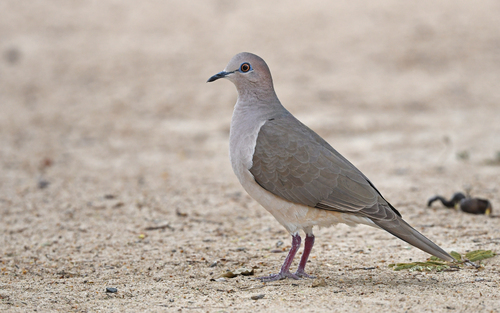
The closest relatives of the Red-billed Pigeon that you can see in San Salvador (family Columbidae, Pigeons and Doves) are White-winged Dove (about 90%), Ruddy Ground-Dove (about 60%) and Rock Pigeon (about 40%), with each one's daily chance of a sighting.

Where does the Red-billed Pigeon sighting chance come from?

GBIF citizen-science records

It is estimated from how often the Red-billed Pigeon is recorded against all the birds logged in San Salvador (1,426 verified sightings), calibrated against known sighting rates. Figures are rounded to the nearest 10% because citizen-science data supports honest approximations, not decimals, and months with records from fewer than five people show "—". How it works.

← Back to San Salvador