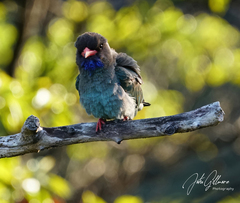
Dollarbird

Dollarbird

Eurystomus orientalis

Silhouette: Ferran Sayol · PhyloPic

LCLeast ConcernNTVUENCR
Daily sighting probability ~10% · With luck
at Seoul

In 3 days ~30% in a week ~60%

1,051 Verified sightings at Seoul
7,370 In all 35 parks From 2019 to 2026
July Best month
☀️ Diurnal When it's spotted

About the Dollarbird

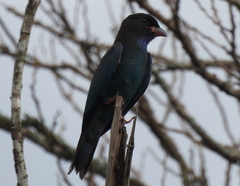
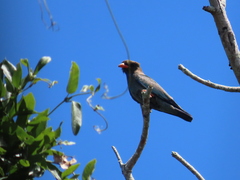
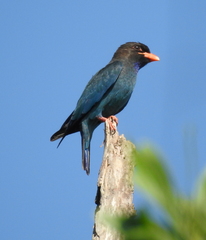
The Oriental dollarbird (Eurystomus orientalis) is a bird of the roller family, so named because of the distinctive pale blue or white, coin-shaped spots on its wings. It can be found from Australia to Korea, Japan and India.

The Oriental dollarbird was formally described by the Swedish naturalist Carl Linnaeus in 1766 in the twelfth edition of his Systema Naturae under the binomial name Coracias orientalis. Linnaeus based his description on "Le Rollier des Indes" that had been described and illustrated by the French zoologist Mathurin Jacques Brisson in 1760. The type locality is the island of Java in Indonesia. The Oriental dollarbird is now placed in the genus Eurystomus that was introduced in 1816 by the French ornithologist Louis Pierre Vieillot.

A molecular phylogenetic study published in 2018 found that the azure dollarbird (Eurystomus azureus) was nested in a clade containing subspecies of the Oriental dollarbird. Formerly, some authorities have also considered the broad-billed roller and the azure dollarbird to have been subspecies of the oriental dollarbird. The generic name derives from Ancient Greek eurustomos 'wide-mouthed' and the specific epithet is Latin... Wikipedia →

Sounds

Call0:19

Philippines · 2026

© Kelle Moreau · XC1162432 · CC BY-NC-SA 4.0

Alarm call0:36

Singapore · 2025

© Ding Li Yong · XC1060792 · CC BY-NC-ND 4.0

Song0:30

Australia · 2021

© nick talbot · XC694518 · CC BY-NC-SA 4.0

Global Distribution

Parks Where Found

# Park Country Daily sighting probability
1 Kinabatangan Wildlife Sanctuary 🇲🇾 Malaysia
~70%
2 Cat Tien National Park 🇻🇳 Vietnam
~60%
3 Raja Ampat 🇮🇩 Indonesia
~40%
4 Khao Yai National Park 🇹🇭 Thailand
~20%
5 Kaeng Krachan National Park 🇹🇭 Thailand
~20%
6 Way Kambas National Park 🇮🇩 Indonesia
~20%
7 Sepilok 🇲🇾 Malaysia
~20%
8 Bali Barat National Park 🇮🇩 Indonesia
~10%
9 Chitwan National Park 🇳🇵 Nepal
~10%
10 Daintree National Park 🇦🇺 Australia
~10%
11 Kakadu National Park 🇦🇺 Australia
~10%
12 Manas National Park 🇮🇳 India
~10%
13 Nitmiluk National Park 🇦🇺 Australia
~10%
14 Taman Negara National Park 🇲🇾 Malaysia
~10%
15 Royal National Park 🇦🇺 Australia
~10%
16 Litchfield National Park 🇦🇺 Australia
~10%
17 Khao Luang National Park 🇹🇭 Thailand
~10%
18 Cuc Phuong National Park 🇻🇳 Vietnam
~10%
19 Royal Bardia National Park 🇳🇵 Nepal
~10%
20 Jim Corbett National Park 🇮🇳 India
~10%
21 Danum Valley Conservation Area 🇲🇾 Malaysia
~10%
22 Gunung Leuser National Park 🇮🇩 Indonesia
<5%
23 Blue Mountains National Park 🇦🇺 Australia
<5%
24 Khao Sok National Park 🇹🇭 Thailand
<5%
25 Springbrook National Park 🇦🇺 Australia
<5%
26 Kaziranga National Park 🇮🇳 India
<5%
27 Booderee National Park 🇦🇺 Australia
<5%
28 Royal Manas National Park 🇧🇹 Bhutan
<5%
29 Namdapha National Park 🇮🇳 India
<5%
30 Noosa National Park 🇦🇺 Australia
<5%
31 Lamington National Park 🇦🇺 Australia
<5%
32 Tangkoko Nature Reserve 🇮🇩 Indonesia
<5%
33 Periyar National Park 🇮🇳 India
<5%
34 Nagarhole National Park 🇮🇳 India
<5%
35 Sinharaja Forest Reserve 🇱🇰 Sri Lanka
<5%

Cities Where Found

# City Country Daily sighting probability
1 Singapore 🇸🇬 Singapore
~20%
2 Daejeon 🇰🇷 South Korea
~20%
3 Johor Bahru 🇲🇾 Malaysia
~20%
4 Seoul 🇰🇷 South Korea
~10%
5 Kuala Lumpur 🇲🇾 Malaysia
~10%
6 Hangzhou 🇨🇳 China
~10%
7 Brisbane 🇦🇺 Australia
~10%
8 Gwangju 🇰🇷 South Korea
<5%
9 Nanjing 🇨🇳 China
<5%
10 Sydney 🇦🇺 Australia
<5%

Zoos & Centres Where Found

# Zoo / Centre Country
1 San Diego Zoo 🇺🇸 United States In captivity
2 Zoo Miami 🇺🇸 United States In captivity
3 Taronga Zoo 🇦🇺 Australia In captivity
4 Sydney Zoo 🇦🇺 Australia In captivity
5 Adelaide Zoo 🇦🇺 Australia In captivity

Before you go

What are the chances of seeing a Dollarbird in Seoul?

With luck

About 10% of wildlife watchers report a Dollarbird sighting in Seoul on a given day, based on 1,051 verified sightings from GBIF citizen-science data. It is the 44th most-seen of the 231 birds we can rate there. Over three days the chance rises to about 30%, and over a week to about 60%, if each day is a fresh chance.

When is the best time to see a Dollarbird in Seoul?

June to August

In those months about 50% of wildlife watchers report a Dollarbird in Seoul on a given day, against under 5% in October to April, the lowest months. Those are among Seoul's wettest months, with about 250 mm of rain a month against 20 mm in January.

What time of day is best to see a Dollarbird?

Between 9 am and noon

Across all the parks we cover, that three-hour window holds the most Dollarbird sightings with a recorded time, and about 9 in 10 of them come between 6 am and 6 pm: it is a daytime animal.

Is Seoul the best place to see a Dollarbird?

4th of 20

Of the 20 cities where we can rate Dollarbird sightings, Seoul ranks 4th at about 10%. The best odds are in Singapore (Singapore, about 20%), Daejeon (South Korea, about 20%) and Johor Bahru (Malaysia, about 20%).

Where does the Dollarbird sighting chance come from?

GBIF citizen-science records

It is estimated from how often the Dollarbird is recorded against all the birds logged in Seoul (1,051 verified sightings), calibrated against known sighting rates. Figures are rounded to the nearest 10% because citizen-science data supports honest approximations, not decimals, and months with records from fewer than five people show "—". How it works.

← Back to Seoul