Hooded Warbler

Hooded Warbler

Setophaga citrina

Silhouette: Dylan GE Gomes · PhyloPic

LCLeast ConcernNTVUENCR
Daily sighting probability ~30% · Possible
at Cockscomb Basin Wildlife Sanctuary

In 3 days ~70% in a week ~90%

417 Verified sightings at Cockscomb Basin Wildlife Sanctuary From 2019 to 2026
8,930 In all 41 parks
November Best month
☀️ Diurnal When it's spotted

About the Hooded Warbler

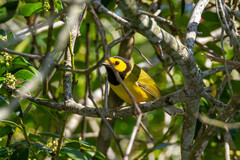
The hooded warbler (Setophaga citrina) is a New World warbler. It breeds in eastern North America across the eastern United States and into southernmost Canada (Ontario). It is migratory, wintering in Central America and the West Indies. Hooded warblers are very rare vagrants to western Europe.

Recent genetic research has suggested that the type species of Wilsonia (hooded warbler W. citrina) and of Setophaga (American redstart S. ruticilla) are closely related and should be merged into the same genus. As the name Setophaga (published in 1827) takes priority over Wilsonia (published in 1838), hooded warbler would then be transferred as Setophaga citrina. This change has been accepted by the North American Classification Committee of the American Ornithologists' Union, and the IOC World Bird List. The South American Classification Committee continues to list the bird in the genus Wilsonia.

The French polymath Georges-Louis Leclerc, Comte de Buffon described the hooded warbler in 1779 in his Histoire Naturelle des Oiseaux from a specimen collected in Louisiana. The bird was also illustrated in a hand-coloured plate engraved by François-Nicolas Martinet in the Planches Enluminées... Wikipedia →

Sounds

Song0:17

United States · 2025

© Molly Jacobson · XC996861 · CC BY-NC-SA 4.0

Call1:13

United States · 2022

© Richard E. Webster · XC780541 · CC BY-NC-SA 4.0

Begging call0:17

United States · 2018

© Matt Wistrand · XC425081 · CC BY-NC-SA 4.0

Global Distribution

Parks Where Found

# Park Country Daily sighting probability
1 Tikal National Park 🇬🇹 Guatemala
~40%
2 Sian Ka'an Biosphere Reserve 🇲🇽 Mexico
~30%
3 Cockscomb Basin Wildlife Sanctuary 🇧🇿 Belize
~30%
4 Calakmul Biosphere Reserve 🇲🇽 Mexico
~30%
5 Great Smoky Mountains National Park 🇺🇸 United States
~30%
6 Pico Bonito National Park 🇭🇳 Honduras
~30%
7 Biotopo Cerro Cahuí 🇬🇹 Guatemala
~30%
8 Congaree National Park 🇺🇸 United States
~30%
9 Cerro Azul Meámbar National Park 🇭🇳 Honduras
~20%
10 Cusuco National Park 🇭🇳 Honduras
~20%
11 Shenandoah National Park 🇺🇸 United States
~20%
12 Lago de Yojoa 🇭🇳 Honduras
~20%
13 Montes Azules Biosphere Reserve 🇲🇽 Mexico
~20%
14 Arrecifes de Cozumel National Park 🇲🇽 Mexico
~20%
15 Cañón del Sumidero National Park 🇲🇽 Mexico
~10%
16 Point Pelee National Park 🇨🇦 Canada
~10%
17 Celestún Biosphere Reserve 🇲🇽 Mexico
~10%
18 Ría Lagartos Biosphere Reserve 🇲🇽 Mexico
<5%
19 La Tigra National Park 🇭🇳 Honduras
<5%
20 Arenal Volcano National Park 🇨🇷 Costa Rica
<5%
21 Tenorio Volcano National Park 🇨🇷 Costa Rica
<5%
22 Padre Island National Seashore 🇺🇸 United States
<5%
23 Braulio Carrillo National Park 🇨🇷 Costa Rica
<5%
24 Cumbres de Monterrey National Park 🇲🇽 Mexico
<5%
25 Rincón de la Vieja National Park 🇨🇷 Costa Rica
<5%
26 Ciénaga de Zapata 🇨🇺 Cuba
<5%
27 Blue and John Crow Mountains National Park 🇯🇲 Jamaica
<5%
28 Cahuita National Park 🇨🇷 Costa Rica
<5%
29 Sequoia and Kings Canyon National Parks 🇺🇸 United States
<5%
30 Everglades National Park 🇺🇸 United States
<5%
31 Merritt Island National Wildlife Refuge 🇺🇸 United States
<5%
32 Big Bend National Park 🇺🇸 United States
<5%
33 Tortuguero National Park 🇨🇷 Costa Rica
<5%
34 Bastimentos Island National Marine Park 🇵🇦 Panama
<5%
35 Monteverde Cloud Forest Reserve 🇨🇷 Costa Rica
<5%
36 Carara National Park 🇨🇷 Costa Rica
<5%
37 Los Quetzales National Park 🇨🇷 Costa Rica
<5%
38 Channel Islands National Park 🇺🇸 United States
<5%
39 La Amistad International Park (Panama) 🇵🇦 Panama
<5%
40 Tapantí-Macizo de la Muerte National Park 🇨🇷 Costa Rica
<5%
41 Soberanía National Park 🇵🇦 Panama
<5%

Cities Where Found

# City Country Daily sighting probability
1 San Pedro Sula 🇭🇳 Honduras
~10%
2 Havana 🇨🇺 Cuba
~10%
3 Houston 🇺🇸 United States
<5%
4 Tegucigalpa 🇭🇳 Honduras
<5%
5 Montreal 🇨🇦 Canada
<5%
6 New York City 🇺🇸 United States
<5%
7 Guatemala City 🇬🇹 Guatemala
<5%
8 Orlando 🇺🇸 United States
<5%
9 Guadalajara 🇲🇽 México
<5%
10 Baltimore 🇺🇸 United States
<5%

Zoos & Centres Where Found

# Zoo / Centre Country
1 Disney's Animal Kingdom 🇺🇸 United States In captivity
2 Woodland Park Zoo 🇺🇸 United States In captivity

Before you go

What are the chances of seeing a Hooded Warbler in Cockscomb Basin Wildlife Sanctuary?

Possible

About 30% of wildlife watchers report a Hooded Warbler sighting in Cockscomb Basin Wildlife Sanctuary on a given day, based on 417 verified sightings from GBIF citizen-science data from 2019 to 2026. It is the 51st most-seen of the 277 birds we can rate there. Over three days the chance rises to about 70%, and over a week to about 90%, if each day is a fresh chance.

When is the best time to see a Hooded Warbler in Cockscomb Basin Wildlife Sanctuary?

October to December

In those months about 50% of wildlife watchers report a Hooded Warbler in Cockscomb Basin Wildlife Sanctuary on a given day, against about 10% in May to August, the lowest months.

What time of day is best to see a Hooded Warbler?

Between 9 am and noon

Across all the parks we cover, that three-hour window holds the most Hooded Warbler sightings with a recorded time, and about 9 in 10 of them come between 6 am and 6 pm: it is a daytime animal.

Is Cockscomb Basin Wildlife Sanctuary the best place to see a Hooded Warbler?

3rd of 41

Of the 41 parks where we can rate Hooded Warbler sightings, Cockscomb Basin Wildlife Sanctuary ranks 3rd at about 30%. The best odds are in Tikal National Park (Guatemala, about 40%) and Sian Ka'an Biosphere Reserve (Mexico, about 30%).

Which relatives of the Hooded Warbler live in Cockscomb Basin Wildlife Sanctuary?

Same genus: Setophaga

The closest relatives of the Hooded Warbler that you can see in Cockscomb Basin Wildlife Sanctuary (genus Setophaga, Setophaga Warblers) are American Redstart (about 40%), Magnolia Warbler (about 40%) and Chestnut-sided Warbler (about 30%), with each one's daily chance of a sighting.

Where does the Hooded Warbler sighting chance come from?

GBIF citizen-science records

It is estimated from how often the Hooded Warbler is recorded against all the birds logged in Cockscomb Basin Wildlife Sanctuary (417 verified sightings from 2019 to 2026), calibrated against known sighting rates. Figures are rounded to the nearest 10% because citizen-science data supports honest approximations, not decimals, and months with records from fewer than five people show "—". How it works.

← Back to Cockscomb Basin Wildlife Sanctuary