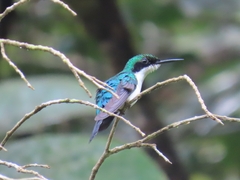
Purple-crowned Fairy

Purple-crowned Fairy

Heliothryx barroti

Silhouette: Ferran Sayol · PhyloPic

LCLeast ConcernNTVUENCR
Daily sighting probability ~10% · With luck
at Gandoca-Manzanillo Wildlife Refuge

In 3 days ~20% in a week ~40%

87 Verified sightings at Gandoca-Manzanillo Wildlife Refuge From 2019 to 2026
9,239 In all 32 parks
December Best month
☀️ Diurnal When it's spotted

About the Purple-crowned Fairy

The purple-crowned fairy (Heliothryx barroti) is a species of hummingbird in the subfamily Polytminae, the mangoes. It is found from southeastern Mexico south into northern Peru. The purple-crowned fairy was originally described as Trochilus Barroti. It and the black-eared fairy (Heliothryx auritus) were treated as conspecific by some authors but are now considered to be a superspecies; they are the only members of the genus. Its scientific name commemorates Adolphe Barrot (1801–1870), a French diplomat who served in Colombia from 1831 to 1835.

The purple-crowned fairy is monotypic. The purple-crowned fairy is 9 to 13 cm (3.5 to 5.1 in) long and weighs about 5.5 g (0.19 oz). It is slender and has bright emerald green upperparts, pure white underparts, and a long pointed tail which has blue-black central and white outer feathers. It has a black patch through the eye and the bill is short, straight, and black. The male has a metallic violet forecrown; the eye patch has a metallic violet spot behind it and bright emerald green below it. The female has a green crown and the face has less black, no violet spot, and no green below the black... Wikipedia →

Sounds

Call0:09

Ecuador · 2023

© rudy gelis · XC833596 · CC BY-NC-SA 4.0

Song0:39

Ecuador · 1997

© Olaf Jahn · XC261778 · CC BY-NC-SA 4.0

Begging call0:21

Ecuador · 2003

© Niels Krabbe · XC238372 · CC BY-NC-SA 3.0

Global Distribution

Parks Where Found

# Park Country Daily sighting probability
1 Pico Bonito National Park 🇭🇳 Honduras
~20%
2 Tikal National Park 🇬🇹 Guatemala
~20%
3 Darién National Park 🇵🇦 Panama
~20%
4 Arenal Volcano National Park 🇨🇷 Costa Rica
~20%
5 Bastimentos Island National Marine Park 🇵🇦 Panama
~10%
6 Piedras Blancas National Park 🇨🇷 Costa Rica
~10%
7 Corcovado National Park 🇨🇷 Costa Rica
~10%
8 Braulio Carrillo National Park 🇨🇷 Costa Rica
~10%
9 Soberanía National Park 🇵🇦 Panama
~10%
10 Utría National Natural Park 🇨🇴 Colombia
~10%
11 Carara National Park 🇨🇷 Costa Rica
~10%
12 Chagres National Park 🇵🇦 Panama
~10%
13 Tenorio Volcano National Park 🇨🇷 Costa Rica
~10%
14 Chirripó National Park 🇨🇷 Costa Rica
~10%
15 Farallones de Cali National Natural Park 🇨🇴 Colombia
~10%
16 Tapantí-Macizo de la Muerte National Park 🇨🇷 Costa Rica
~10%
17 Marino Ballena National Park 🇨🇷 Costa Rica
~10%
18 Manuel Antonio National Park 🇨🇷 Costa Rica
~10%
19 La Amistad International Park (Panama) 🇵🇦 Panama
~10%
20 San Lorenzo Protected Forest 🇵🇦 Panama
~10%
21 Gandoca-Manzanillo Wildlife Refuge 🇨🇷 Costa Rica
~10%
22 Montes Azules Biosphere Reserve 🇲🇽 Mexico
<5%
23 Machalilla National Park 🇪🇨 Ecuador
<5%
24 Calakmul Biosphere Reserve 🇲🇽 Mexico
<5%
25 Cockscomb Basin Wildlife Sanctuary 🇧🇿 Belize
<5%
26 Cahuita National Park 🇨🇷 Costa Rica
<5%
27 Rincón de la Vieja National Park 🇨🇷 Costa Rica
<5%
28 Tortuguero National Park 🇨🇷 Costa Rica
<5%
29 Parque Natural Metropolitano 🇵🇦 Panama
<5%
30 Poás Volcano National Park 🇨🇷 Costa Rica
<5%
31 Monteverde Cloud Forest Reserve 🇨🇷 Costa Rica
<5%
32 Los Quetzales National Park 🇨🇷 Costa Rica
<5%

Before you go

What are the chances of seeing a Purple-crowned Fairy in Gandoca-Manzanillo Wildlife Refuge?

With luck

About 10% of wildlife watchers report a Purple-crowned Fairy sighting in Gandoca-Manzanillo Wildlife Refuge on a given day, based on 87 verified sightings from GBIF citizen-science data from 2019 to 2026. It is the 152nd most-seen of the 329 birds we can rate there. Over three days the chance rises to about 20%, and over a week to about 40%, if each day is a fresh chance.

When is the best time to see a Purple-crowned Fairy in Gandoca-Manzanillo Wildlife Refuge?

December

In that month about 20% of wildlife watchers report a Purple-crowned Fairy in Gandoca-Manzanillo Wildlife Refuge on a given day, against under 5% in January–March, September and November, the lowest months.

What time of day is best to see a Purple-crowned Fairy?

Between 8 and 11 am

Across all the parks we cover, that three-hour window holds the most Purple-crowned Fairy sightings with a recorded time, and about 9 in 10 of them come between 6 am and 6 pm: it is a daytime animal.

Is Gandoca-Manzanillo Wildlife Refuge the best place to see a Purple-crowned Fairy?

21st of 32

Of the 32 parks where we can rate Purple-crowned Fairy sightings, Gandoca-Manzanillo Wildlife Refuge ranks 21st at about 10%. The best odds are in Pico Bonito National Park (Honduras, about 20%), Tikal National Park (Guatemala, about 20%) and Darién National Park (Panama, about 20%).

Which relatives of the Purple-crowned Fairy live in Gandoca-Manzanillo Wildlife Refuge?

Same family: Trochilidae

The closest relatives of the Purple-crowned Fairy that you can see in Gandoca-Manzanillo Wildlife Refuge (family Trochilidae, Hummingbirds) are Rufous-tailed Hummingbird (about 50%), Long-billed Hermit (about 40%) and Stripe-throated Hermit (about 30%), with each one's daily chance of a sighting.

Where does the Purple-crowned Fairy sighting chance come from?

GBIF citizen-science records

It is estimated from how often the Purple-crowned Fairy is recorded against all the birds logged in Gandoca-Manzanillo Wildlife Refuge (87 verified sightings from 2019 to 2026), calibrated against known sighting rates. Figures are rounded to the nearest 10% because citizen-science data supports honest approximations, not decimals, and months with records from fewer than five people show "—". How it works.

← Back to Gandoca-Manzanillo Wildlife Refuge