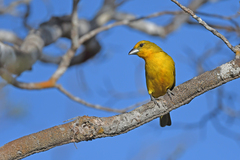
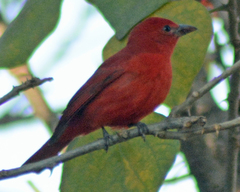
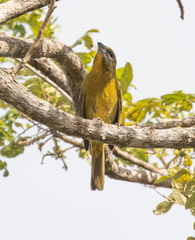

Red Tanager

Red Tanager

Piranga flava

Silhouette: Sheatherius · PhyloPic

LCLeast ConcernNTVUENCR
Daily sighting probability <5% · Rare
at Poás Volcano National Park

In 3 days ~10% in a week ~20%

88 Verified sightings at Poás Volcano National Park From 2019 to 2026
7,417 In all 30 parks
January Best month
☀️ Diurnal When it's spotted

About the Red Tanager

The red tanager (Piranga flava) is a medium-sized American songbird in the family Cardinalidae. There four subspecies of Piranga flava: Piranga flava macconnelli C. Chubb, 1921 (southern Guyana, southern Suriname and northern Brazil)

Piranga flava rosacea Todd, 1922 (eastern Bolivia) Piranga flava saira (von Spix, 1825) (eastern and southern Brazil) Piranga flava flava (Vieillot, 1822) (southeastern Bolivia, Paraguay, northern Argentina and Uruguay)

The red tanager is sometimes treated as part of a more broadly circumscribed hepatic tanager species, where it makes up the flava subspecies group (lowland hepatic tanager). However, the IOC World Bird List splits these birds into three species, also recognising Piranga hepatica (the hepatic tanager) and Piranga lutea (the tooth-billed tanager). Wikipedia →

Sounds

Call0:13

Ecuador · 2026

© Paul Molina Abril · XC1175818 · CC BY-NC-SA 4.0

Song0:16

Argentina · 2024

© Guillermo Treboux · XC898677 · CC BY-NC-SA 4.0

Call0:22

Argentina · 2013

© Peter Boesman · XC272879 · CC BY-NC-ND 4.0

Global Distribution

Parks Where Found

# Park Country Daily sighting probability
1 Chagres National Park 🇵🇦 Panama
~60%
2 El Palmar National Park 🇦🇷 Argentina
~40%
3 Arenal Volcano National Park 🇨🇷 Costa Rica
~30%
4 El Impenetrable National Park 🇦🇷 Argentina
~20%
5 Chapada Diamantina National Park 🇧🇷 Brazil
~10%
6 Tenorio Volcano National Park 🇨🇷 Costa Rica
~10%
7 Amboró National Park 🇧🇴 Bolivia
<5%
8 Brownsberg Nature Park 🇸🇷 Suriname
<5%
9 Tapantí-Macizo de la Muerte National Park 🇨🇷 Costa Rica
<5%
10 Farallones de Cali National Natural Park 🇨🇴 Colombia
<5%
11 Poás Volcano National Park 🇨🇷 Costa Rica
<5%
12 La Amistad International Park (Panama) 🇵🇦 Panama
<5%
13 Iberá National Park 🇦🇷 Argentina
<5%
14 Monteverde Cloud Forest Reserve 🇨🇷 Costa Rica
<5%
15 Henri Pittier National Park 🇻🇪 Venezuela
<5%
16 Volcán Barú National Park 🇵🇦 Panama
<5%
17 Darién National Park 🇵🇦 Panama
<5%
18 Serra da Canastra National Park 🇧🇷 Brazil
<5%
19 Serra dos Órgãos National Park 🇧🇷 Brazil
<5%
20 Rincón de la Vieja National Park 🇨🇷 Costa Rica
<5%
21 Los Nevados National Natural Park 🇨🇴 Colombia
<5%
22 Podocarpus National Park 🇪🇨 Ecuador
<5%
23 Braulio Carrillo National Park 🇨🇷 Costa Rica
<5%
24 Chapada dos Guimarães National Park 🇧🇷 Brazil
<5%
25 Chirripó National Park 🇨🇷 Costa Rica
<5%
26 Piedras Blancas National Park 🇨🇷 Costa Rica
<5%
27 Tayrona National Natural Park 🇨🇴 Colombia
<5%
28 Iguaçu National Park 🇧🇷 Brazil
<5%
29 Iguazú National Park 🇦🇷 Argentina
<5%
30 Los Quetzales National Park 🇨🇷 Costa Rica
<5%

Cities Where Found

# City Country Daily sighting probability
1 Buenos Aires 🇦🇷 Argentina
~10%
2 Cochabamba 🇧🇴 Bolivia
<5%
3 Cordoba 🇦🇷 Argentina
<5%
4 Caracas 🇻🇪 Venezuela
<5%
5 Montevideo 🇺🇾 Uruguay
<5%
6 Medellín 🇨🇴 Colombia
<5%
7 Panama City 🇵🇦 Panama
<5%
8 San José 🇨🇷 Costa Rica
<5%

Before you go

What are the chances of seeing a Red Tanager in Poás Volcano National Park?

Rare

Under 5% of wildlife watchers report a Red Tanager sighting in Poás Volcano National Park on a given day, based on 88 verified sightings from GBIF citizen-science data from 2019 to 2026. It is the 137th most-seen of the 356 birds we can rate there. Over three days the chance rises to about 10%, and over a week to about 20%, if each day is a fresh chance.

When is the best time to see a Red Tanager in Poás Volcano National Park?

January and September

In those months about 10% of wildlife watchers report a Red Tanager in Poás Volcano National Park on a given day, against under 5% in February–August and October–December, the lowest months.

What time of day is best to see a Red Tanager?

Between 9 am and noon

Across all the parks we cover, that three-hour window holds the most Red Tanager sightings with a recorded time, and about 9 in 10 of them come between 6 am and 6 pm: it is a daytime animal.

Which relatives of the Red Tanager live in Poás Volcano National Park?

Same genus: Piranga

The closest relatives of the Red Tanager that you can see in Poás Volcano National Park (genus Piranga, Piranga Tanagers) are Summer Tanager (about 20%) and Flame-colored Tanager (about 10%), with each one's daily chance of a sighting.

Where does the Red Tanager sighting chance come from?

GBIF citizen-science records

It is estimated from how often the Red Tanager is recorded against all the birds logged in Poás Volcano National Park (88 verified sightings from 2019 to 2026), calibrated against known sighting rates. Figures are rounded to the nearest 10% because citizen-science data supports honest approximations, not decimals, and months with records from fewer than five people show "—". How it works.

← Back to Poás Volcano National Park