


Completed



Common Raccoon
Procyon lotor
Silhouette: Steven Traver · PhyloPic
- KingdomAnimalia (Animals)
- PhylumChordata (Chordates)
- ClassMammalia (Mammals)
- OrderCarnivora (Carnivorans)
- FamilyProcyonidae (Raccoons, Coatis, and Allies)
- GenusProcyon (Raccoons)
- SpeciesProcyon lotor (Common Raccoon)
In 3 days ~20% in a week ~50%
6 Verified sightings at Riding Mountain National Park From 2019 to 2026
1,793 In all 47 parks
April Best month
☀️🌙 Day & Night When it's spotted


Completed
About the Common Raccoon
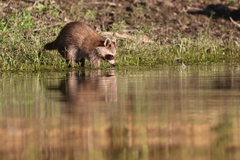
The raccoon ( or US:, Procyon lotor), sometimes called the North American, northern or common raccoon (also spelled racoon) to distinguish it from other species of raccoon, is a mammal native to North America. It is the largest of the procyonid family, having a body length of 40 to 70 cm (16 to 28 in), and a body weight of 5 to 26 kg (11 to 57 lb). Its grayish coat mostly consists of dense underfur, which insulates it against cold weather. The animal's most distinctive features include its extremely dexterous front paws, its facial mask, and its ringed tail, which are common themes in the mythologies of the Indigenous peoples of the Americas surrounding the species. The raccoon is noted for its intelligence, and studies show that it can remember the solution to tasks for at least three years. It is usually nocturnal and omnivorous, eating about 40% invertebrates, 33% plants, and 27% vertebrates.
The original habitats of the raccoon are deciduous and mixed forests. Still, due to their adaptability, they have extended their range to mountainous areas, coastal marshes, and urban areas, where some homeowners consider them to be pests. As a result of escapes and deliberate introductions in the mid-20th century, raccoons are now also distributed across central Europe, the Caucasus, and Japan. In Europe, the raccoon has been included on the list of Invasive Alien Species of Union Concern since 2016. This implies that this species cannot be imported, bred, transported, commercialized, or intentionally released into the environment in the whole of the European Union.
Though raccoons were previously thought to be generally solitary, there is now evidence that they engage in sex-specific social behavior. Related females often share a common area, while unrelated males live together in groups of up to four raccoons to maintain their positions against foreign males during the mating season and against other potential invaders. Home range sizes vary anywhere from 3 ha (7.4 acres) for females in cities, to 5,000 ha (50 km2; 19 sq mi) for males in prairies. After a gestation of about 65 days, two to five young known as "kits" are born in spring. The kits are subsequently raised by their mother until dispersal in late fall. Although captive raccoons have been known to live over 20 years, their life expectancy in the wild is only 1.8 to 3.1 years. In many areas, hunting and vehicular injury are the two most common causes of death. Wikipedia →
Sounds
Call0:07
France · 2022
© Stanislas Wroza · XC697007 · CC BY-NC-SA 4.0
Recording0:15
United States · 2021
© Andrew George · iNaturalist · CC BY-NC 4.0
Recording1:27
United States · 2025
© woody276 · iNaturalist · CC BY-NC 4.0
Recent sightings of Common Raccoon in Riding Mountain National Park
LIVEiNaturalistGlobal Distribution
Parks Where Found
Cities Where Found
| # | City | Country | Daily sighting probability |
|---|---|---|---|
| 1 | Miami | 🇺🇸 United States | |
| 2 | Austin | 🇺🇸 United States | |
| 3 | Boston | 🇺🇸 United States | |
| 4 | Montreal | 🇨🇦 Canada | |
| 5 | Toronto | 🇨🇦 Canada | |
| 6 | San Antonio | 🇺🇸 United States | |
| 7 | Panama City | 🇵🇦 Panama | |
| 8 | Guatemala City | 🇬🇹 Guatemala | |
| 9 | Vancouver | 🇨🇦 Canada | |
| 10 | Detroit | 🇺🇸 United States |
Zoos & Centres Where Found
Closest Relatives at Riding Mountain National Park





Before you go
What are the chances of seeing a Common Raccoon in Riding Mountain National Park?
With luck
About 10% of wildlife watchers report a Common Raccoon sighting in Riding Mountain National Park on a given day, based on 6 verified sightings from GBIF citizen-science data from 2019 to 2026. It is the 21st most-seen of the 24 mammals we can rate there. Over three days the chance rises to about 20%, and over a week to about 50%, if each day is a fresh chance.
When is the best time to see a Common Raccoon in Riding Mountain National Park?
April
In that month about 20% of wildlife watchers report a Common Raccoon in Riding Mountain National Park on a given day, against under 5% in June–August and November–March, the lowest months.
What time of day is best to see a Common Raccoon?
Between 6 and 9 pm
Across all the parks we cover, that three-hour window holds the most Common Raccoon sightings with a recorded time, and about half of them come between 6 am and 6 pm: it is seen both by day and at night.
Is Riding Mountain National Park the best place to see a Common Raccoon?
36th of 47
Of the 47 parks where we can rate Common Raccoon sightings, Riding Mountain National Park ranks 36th at about 10%. The best odds are in Celestún Biosphere Reserve (Mexico, about 80%), Cahuita National Park (Costa Rica, about 70%) and Ría Lagartos Biosphere Reserve (Mexico, about 50%). All parks ranked.
Which relatives of the Common Raccoon live in Riding Mountain National Park?
Same order: Carnivora
The closest relatives of the Common Raccoon that you can see in Riding Mountain National Park (order Carnivora, Carnivorans) are American Black Bear (about 60%), Red Fox (about 20%) and Coyote (about 20%), with each one's daily chance of a sighting.
Where does the Common Raccoon sighting chance come from?
GBIF citizen-science records
It is estimated from how often the Common Raccoon is recorded against all the mammals logged in Riding Mountain National Park (6 verified sightings from 2019 to 2026), calibrated against known sighting rates. Figures are rounded to the nearest 10% because citizen-science data supports honest approximations, not decimals, and months with records from fewer than five people show "—". How it works.
