Bare-throated Tiger Heron

Bare-throated Tiger Heron

Tigrisoma mexicanum

Silhouette: Mannheim Reinhard Jahn (photograph) · PhyloPic

LCLeast ConcernNTVUENCR
Daily sighting probability ~10% · With luck
at Santa Rosa National Park

In 3 days ~30% in a week ~60%

84 Verified sightings at Santa Rosa National Park From 2019 to 2026
14,492 In all 35 parks
December Best month
☀️ Diurnal When it's spotted

About the Bare-throated Tiger Heron

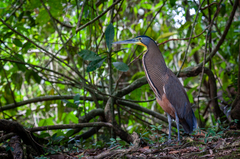
The bare-throated tiger heron (Tigrisoma mexicanum) is a wading bird of the heron family, Ardeidae, found from Mexico to northwestern Colombia, with one recorded sighting from the United States in Hidalgo County, Texas. It is 80 cm (31 in) in length and weighs 1,200 g (42 oz).

This large species is found in more open habitats than other Tigrisoma herons, such as river and lake banks. It waits often motionless for suitable prey such as fish, frogs or crabs to come within reach of its long bill.

This is a solitary breeder, not normally found in heron colonies. The nest is a small flattish stick platform in a tree into which 2–3 green-tinged white eggs are laid. The throat is bare and is greenish-yellow to orange in all plumages. The adult has black crown and light grey sides of the head, the sides of the neck and the upperparts otherwise blackish narrowly barred buff. The median stripe down the fore-neck is white-bordered with black; the remaining underparts are dull cinnamon brown. The juvenile is buff coarsely barred with black, more mottled and vermiculated on wings; the throat, median underparts, and belly are whitish.

The flight is heavy, and the call is a hoarse... Wikipedia →

Sounds

Call0:24

Mexico · 2021

© Manuel Grosselet · XC617745 · CC BY-NC-SA 4.0

Song0:48

Costa Rica · 2016

© Jacob R. Saucier · XC404553 · CC BY-NC-SA 4.0

Flight call0:09

Guatemala · 2009

© Pablo Bolaños · XC34056 · CC BY-NC-ND 2.5

Global Distribution

Parks Where Found

# Park Country Daily sighting probability
1 Palo Verde National Park 🇨🇷 Costa Rica
~70%
2 Tortuguero National Park 🇨🇷 Costa Rica
~60%
3 Carara National Park 🇨🇷 Costa Rica
~40%
4 Coiba National Park 🇵🇦 Panama
~40%
5 Cabo Blanco Absolute Nature Reserve 🇨🇷 Costa Rica
~40%
6 Lago de Yojoa 🇭🇳 Honduras
~40%
7 Corcovado National Park 🇨🇷 Costa Rica
~30%
8 Celestún Biosphere Reserve 🇲🇽 Mexico
~30%
9 Cerro Azul Meámbar National Park 🇭🇳 Honduras
~20%
10 Ría Lagartos Biosphere Reserve 🇲🇽 Mexico
~20%
11 Ostional Wildlife Refuge 🇨🇷 Costa Rica
~20%
12 Manuel Antonio National Park 🇨🇷 Costa Rica
~20%
13 Tikal National Park 🇬🇹 Guatemala
~20%
14 Montes Azules Biosphere Reserve 🇲🇽 Mexico
~10%
15 Santa Rosa National Park 🇨🇷 Costa Rica
~10%
16 Sian Ka'an Biosphere Reserve 🇲🇽 Mexico
~10%
17 Piedras Blancas National Park 🇨🇷 Costa Rica
~10%
18 Braulio Carrillo National Park 🇨🇷 Costa Rica
~10%
19 Marino Ballena National Park 🇨🇷 Costa Rica
~10%
20 Soberanía National Park 🇵🇦 Panama
~10%
21 Rincón de la Vieja National Park 🇨🇷 Costa Rica
<5%
22 Los Quetzales National Park 🇨🇷 Costa Rica
<5%
23 Gandoca-Manzanillo Wildlife Refuge 🇨🇷 Costa Rica
<5%
24 Las Baulas Marine National Park 🇨🇷 Costa Rica
<5%
25 Calakmul Biosphere Reserve 🇲🇽 Mexico
<5%
26 Bastimentos Island National Marine Park 🇵🇦 Panama
<5%
27 Cockscomb Basin Wildlife Sanctuary 🇧🇿 Belize
<5%
28 Arenal Volcano National Park 🇨🇷 Costa Rica
<5%
29 Tenorio Volcano National Park 🇨🇷 Costa Rica
<5%
30 La Amistad International Park (Panama) 🇵🇦 Panama
<5%
31 Cahuita National Park 🇨🇷 Costa Rica
<5%
32 Pico Bonito National Park 🇭🇳 Honduras
<5%
33 Cumbres de Monterrey National Park 🇲🇽 Mexico
<5%
34 Tapantí-Macizo de la Muerte National Park 🇨🇷 Costa Rica
<5%
35 Monteverde Cloud Forest Reserve 🇨🇷 Costa Rica
<5%

Cities Where Found

# City Country Daily sighting probability
1 San Pedro Sula 🇭🇳 Honduras
~10%
2 Barranquilla 🇨🇴 Colombia
<5%
3 Panama City 🇵🇦 Panama
<5%
4 San José 🇨🇷 Costa Rica
<5%

Zoos & Centres Where Found

# Zoo / Centre Country
1 Aviario Nacional de Colombia 🇨🇴 Colombia In captivity
2 Hong Kong Zoological and Botanical Gardens 🇨🇳 China In captivity
3 Zoológico Thomas Belt 🇳🇮 Nicaragua In captivity
4 Tracy Aviary 🇺🇸 United States In captivity
5 Edward Youde Aviary 🇭🇰 Hong Kong SAR China In captivity
6 International Animal Rescue – Costa Rica 🇨🇷 Costa Rica In captivity

Before you go

What are the chances of seeing a Bare-throated Tiger Heron in Santa Rosa National Park?

With luck

About 10% of wildlife watchers report a Bare-throated Tiger Heron sighting in Santa Rosa National Park on a given day, based on 84 verified sightings from GBIF citizen-science data from 2019 to 2026. It is the 80th most-seen of the 233 birds we can rate there. Over three days the chance rises to about 30%, and over a week to about 60%, if each day is a fresh chance.

When is the best time to see a Bare-throated Tiger Heron in Santa Rosa National Park?

May and December

In those months about 20% of wildlife watchers report a Bare-throated Tiger Heron in Santa Rosa National Park on a given day, against under 5% in February, the lowest month.

What time of day is best to see a Bare-throated Tiger Heron?

Between 6 and 9 am

Across all the parks we cover, that three-hour window holds the most Bare-throated Tiger Heron sightings with a recorded time, and about 9 in 10 of them come between 6 am and 6 pm: it is a daytime animal.

Which relatives of the Bare-throated Tiger Heron live in Santa Rosa National Park?

Same family: Ardeidae

The closest relatives of the Bare-throated Tiger Heron that you can see in Santa Rosa National Park (family Ardeidae, Herons, Egrets, and Bitterns) are Snowy Egret (about 10%), Great Egret (about 10%) and Green Heron (about 10%), with each one's daily chance of a sighting.

Where does the Bare-throated Tiger Heron sighting chance come from?

GBIF citizen-science records

It is estimated from how often the Bare-throated Tiger Heron is recorded against all the birds logged in Santa Rosa National Park (84 verified sightings from 2019 to 2026), calibrated against known sighting rates. Figures are rounded to the nearest 10% because citizen-science data supports honest approximations, not decimals, and months with records from fewer than five people show "—". How it works.

← Back to Santa Rosa National Park