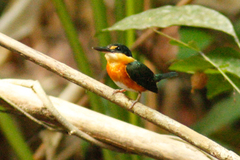
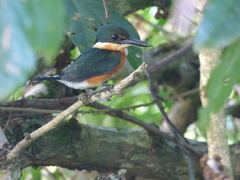
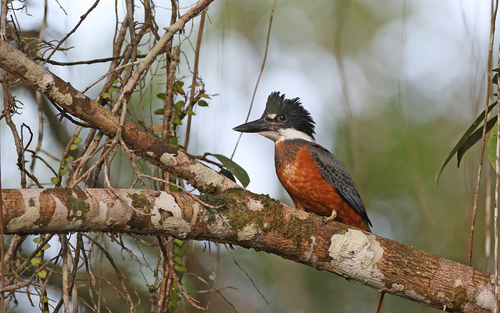
American Pygmy Kingfisher

American Pygmy Kingfisher

Chloroceryle aenea

Silhouette: Steven Traver · PhyloPic

LCLeast ConcernNTVUENCR
Daily sighting probability <5% · Rare
at Tenorio Volcano National Park

In 3 days <5% in a week ~10%

40 Verified sightings at Tenorio Volcano National Park From 2019 to 2026
5,788 In all 33 parks
April Best month
☀️ Diurnal When it's spotted

About the American Pygmy Kingfisher

The American pygmy kingfisher (Chloroceryle aenea) is a species of "water kingfisher" in subfamily Cerylinae of family Alcedinidae. It is found in the American tropics from southern Mexico south through Central America into every mainland South American country except Chile and Uruguay. It also occurs on Trinidad.

The first formal description of the American pygmy kingfisher was by the German zoologist Peter Simon Pallas in 1764 under the binomial name Alcedo aenea. The specific epithet aenea is from the Latin aeneus meaning "of a bronze colour". The current genus Chloroceryle was erected by Johann Jakob Kaup in 1848.

A molecular phylogenetic study published in 2006 found that the American pygmy kingfisher was a sister species to a clade containing the green-and-rufous kingfisher (C. inda) and the green kingfisher (C. americana). The American pygmy kingfisher is about 13 cm (5.1 in) long. Males weigh 10 to 16 g (0.35 to 0.56 oz) and females 12 to 16 g (0.42 to 0.56 oz). It has the typical kingfisher shape, with a shaggy... Wikipedia →

Sounds

Flight call0:04

French Guiana · 2024

© Tristan Guillebot de Nerville · XC1139137 · CC BY-NC-SA 4.0

Call0:04

Brazil · 2019

© Fernando Igor de Godoy · XC770306 · CC BY-NC-SA 4.0

Song0:11

Ecuador · 2019

© Jerome Fischer · XC484396 · CC BY-NC-SA 4.0

Global Distribution

Parks Where Found

# Park Country Daily sighting probability
1 Caroni Swamp 🇹🇹 Trinidad and Tobago
~30%
2 Celestún Biosphere Reserve 🇲🇽 Mexico
~20%
3 Yasuní National Park 🇪🇨 Ecuador
~20%
4 Cuyabeno Wildlife Reserve 🇪🇨 Ecuador
~20%
5 Parque Estadual Encontro das Águas 🇧🇷 Brazil
~10%
6 Anavilhanas National Park 🇧🇷 Brazil
~10%
7 Bastimentos Island National Marine Park 🇵🇦 Panama
~10%
8 Montes Azules Biosphere Reserve 🇲🇽 Mexico
~10%
9 Carara National Park 🇨🇷 Costa Rica
~10%
10 Soberanía National Park 🇵🇦 Panama
~10%
11 Sian Ka'an Biosphere Reserve 🇲🇽 Mexico
~10%
12 Tortuguero National Park 🇨🇷 Costa Rica
~10%
13 Gandoca-Manzanillo Wildlife Refuge 🇨🇷 Costa Rica
~10%
14 Tambopata National Reserve 🇵🇪 Peru
~10%
15 Utría National Natural Park 🇨🇴 Colombia
~10%
16 Piedras Blancas National Park 🇨🇷 Costa Rica
<5%
17 La Amistad International Park (Panama) 🇵🇦 Panama
<5%
18 Amacayacu National Natural Park 🇨🇴 Colombia
<5%
19 Manuel Antonio National Park 🇨🇷 Costa Rica
<5%
20 Marino Ballena National Park 🇨🇷 Costa Rica
<5%
21 Cockscomb Basin Wildlife Sanctuary 🇧🇿 Belize
<5%
22 Ría Lagartos Biosphere Reserve 🇲🇽 Mexico
<5%
23 Tikal National Park 🇬🇹 Guatemala
<5%
24 Cahuita National Park 🇨🇷 Costa Rica
<5%
25 Palo Verde National Park 🇨🇷 Costa Rica
<5%
26 Manu National Park 🇵🇪 Peru
<5%
27 Ostional Wildlife Refuge 🇨🇷 Costa Rica
<5%
28 Parque Natural Metropolitano 🇵🇦 Panama
<5%
29 Corcovado National Park 🇨🇷 Costa Rica
<5%
30 Tenorio Volcano National Park 🇨🇷 Costa Rica
<5%
31 Arenal Volcano National Park 🇨🇷 Costa Rica
<5%
32 Braulio Carrillo National Park 🇨🇷 Costa Rica
<5%
33 Tijuca National Park 🇧🇷 Brazil
<5%

Cities Where Found

# City Country Daily sighting probability
1 Panama City 🇵🇦 Panama
<5%
2 São Paulo 🇧🇷 Brazil
<5%
3 Rio de Janeiro 🇧🇷 Brazil
<5%

Before you go

What are the chances of seeing an American Pygmy Kingfisher in Tenorio Volcano National Park?

Rare

Under 5% of wildlife watchers report an American Pygmy Kingfisher sighting in Tenorio Volcano National Park on a given day, based on 40 verified sightings from GBIF citizen-science data from 2019 to 2026. It is the 291st most-seen of the 444 birds we can rate there. Over three days the chance rises to under 5%, and over a week to about 10%, if each day is a fresh chance.

When is the best time to see an American Pygmy Kingfisher in Tenorio Volcano National Park?

Any time of year

In every month with enough records, under 5% of wildlife watchers report an American Pygmy Kingfisher in Tenorio Volcano National Park on a given day, so our monthly data shows no clear season.

What time of day is best to see an American Pygmy Kingfisher?

Between 8 and 11 am

Across all the parks we cover, that three-hour window holds the most American Pygmy Kingfisher sightings with a recorded time, and about 8 in 10 of them come between 6 am and 6 pm: it is a daytime animal.

Is Tenorio Volcano National Park the best place to see an American Pygmy Kingfisher?

30th of 33

Of the 33 parks where we can rate American Pygmy Kingfisher sightings, Tenorio Volcano National Park ranks 30th at under 5%. The best odds are in Caroni Swamp (Trinidad and Tobago, about 30%), Celestún Biosphere Reserve (Mexico, about 20%) and Yasuní National Park (Ecuador, about 20%).

Where does the American Pygmy Kingfisher sighting chance come from?

GBIF citizen-science records

It is estimated from how often the American Pygmy Kingfisher is recorded against all the birds logged in Tenorio Volcano National Park (40 verified sightings from 2019 to 2026), calibrated against known sighting rates. Figures are rounded to the nearest 10% because citizen-science data supports honest approximations, not decimals, and months with records from fewer than five people show "—". How it works.

← Back to Tenorio Volcano National Park