
Black Tern

Black Tern

Chlidonias niger

Silhouette: Andy Wilson · PhyloPic

LCLeast ConcernNTVUENCR
Daily sighting probability <5% · Rare
at Bavarian Forest National Park

In 3 days <5% in a week ~10%

6 Verified sightings at Bavarian Forest National Park From 2019 to 2026
6,457 In all 36 parks
May Best month
☀️ Diurnal When it's spotted

About the Black Tern

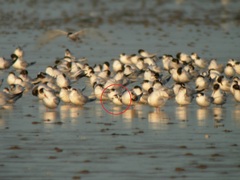
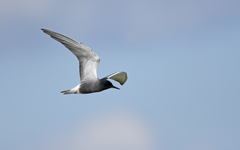
The black tern (Chlidonias niger) is a small tern generally found in or near inland water that breeds in Europe, Western Asia and North America. In winter the birds migrate to coastal areas of Africa and South America. The black tern was formally described in 1758 by the Swedish naturalist Carl Linnaeus in the tenth edition of his Systema Naturae under the binomial name Sterna nigra. Linnaeus specified the type location as Europe but it is now restricted to Uppsala in Sweden. The black tern is now one of four species placed in the genus Chlidonias that was introduced in 1822 by the French naturalist Constantine Rafinesque. The genus name is from Ancient Greek khelidonios, "swallow-like", from khelidon, "swallow": another old English name for the black tern is "carr (i.e. lake) swallow". The species name is from Latin niger "shining black". As its name suggests, it has predominantly dark plumage. In some lights it can appear blue in the breeding season, hence the old English name "blue darr".

Two subspecies are recognised. These are listed below with their breeding ranges. Adults are 25 cm (10 in) long, with a wingspan 61 cm (24 in), and weigh 62... Wikipedia →

Sounds

Alarm call0:05

France · 2025

© Lionel FREDERIC · XC1037312 · CC BY-NC-SA 4.0

Nocturnal flight call0:43

Spain · 2024

© Bosco Dies / BirdingAlbufera · XC928612 · CC BY-NC-SA 4.0

Flight call1:02

United States · 2023

© Sue Riffe · XC860959 · CC BY-NC-SA 4.0

Global Distribution

Parks Where Found

# Park Country Daily sighting probability
1 Padre Island National Seashore 🇺🇸 United States
~30%
2 Biebrza National Park 🇵🇱 Poland
~20%
3 Elk Island National Park 🇨🇦 Canada
~20%
4 Point Pelee National Park 🇨🇦 Canada
~20%
5 Hortobágy National Park 🇭🇺 Hungary
~20%
6 Fertő-Hanság National Park 🇭🇺 Hungary
~10%
7 Kiskunság National Park 🇭🇺 Hungary
~10%
8 Cabo Blanco Absolute Nature Reserve 🇨🇷 Costa Rica
~10%
9 Coiba National Park 🇵🇦 Panama
~10%
10 Bastimentos Island National Marine Park 🇵🇦 Panama
~10%
11 Białowieża National Park 🇵🇱 Poland
~10%
12 Ría Lagartos Biosphere Reserve 🇲🇽 Mexico
~10%
13 Riding Mountain National Park 🇨🇦 Canada
~10%
14 Camargue 🇫🇷 France
~10%
15 Jaragua National Park 🇩🇴 Dominican Republic
<5%
16 Wadden Sea National Park 🇩🇪 Germany
<5%
17 La Amistad International Park (Panama) 🇵🇦 Panama
<5%
18 Doñana National Park 🇪🇸 Spain
<5%
19 Celestún Biosphere Reserve 🇲🇽 Mexico
<5%
20 El Vizcaíno Biosphere Reserve 🇲🇽 Mexico
<5%
21 Marino Ballena National Park 🇨🇷 Costa Rica
<5%
22 Bavarian Forest National Park 🇩🇪 Germany
<5%
23 Las Baulas Marine National Park 🇨🇷 Costa Rica
<5%
24 Santa Rosa National Park 🇨🇷 Costa Rica
<5%
25 Merritt Island National Wildlife Refuge 🇺🇸 United States
<5%
26 Sierra de Guadarrama National Park 🇪🇸 Spain
<5%
27 Gandoca-Manzanillo Wildlife Refuge 🇨🇷 Costa Rica
<5%
28 Manuel Antonio National Park 🇨🇷 Costa Rica
<5%
29 Corcovado National Park 🇨🇷 Costa Rica
<5%
30 Sian Ka'an Biosphere Reserve 🇲🇽 Mexico
<5%
31 Tortuguero National Park 🇨🇷 Costa Rica
<5%
32 Everglades National Park 🇺🇸 United States
<5%
33 Piedras Blancas National Park 🇨🇷 Costa Rica
<5%
34 Carara National Park 🇨🇷 Costa Rica
<5%
35 Monfragüe National Park 🇪🇸 Spain
<5%
36 Soberanía National Park 🇵🇦 Panama
<5%

Cities Where Found

# City Country Daily sighting probability
1 Dakar 🇸🇳 Senegal
~30%
2 Accra 🇬🇭 Ghana
~10%
3 Bucharest 🇷🇴 Romania
<5%
4 Warsaw 🇵🇱 Poland
<5%
5 Calgary 🇨🇦 Canada
<5%
6 Kyiv 🇺🇦 Ukraine
<5%
7 Barranquilla 🇨🇴 Colombia
<5%
8 Istanbul 🇹🇷 Turkey
<5%
9 Saint Petersburg 🇷🇺 Russia
<5%
10 Mexico City 🇲🇽 México
<5%

Before you go

What are the chances of seeing a Black Tern in Bavarian Forest National Park?

Rare

Under 5% of wildlife watchers report a Black Tern sighting in Bavarian Forest National Park on a given day, based on 6 verified sightings from GBIF citizen-science data from 2019 to 2026. It is the 162nd most-seen of the 170 birds we can rate there. Over three days the chance rises to under 5%, and over a week to about 10%, if each day is a fresh chance.

When is the best time to see a Black Tern in Bavarian Forest National Park?

Any time of year

In every month with enough records, under 5% of wildlife watchers report a Black Tern in Bavarian Forest National Park on a given day, so our monthly data shows no clear season.

What time of day is best to see a Black Tern?

Between 11 am and 2 pm

Across all the parks we cover, that three-hour window holds the most Black Tern sightings with a recorded time, and about 9 in 10 of them come between 6 am and 6 pm: it is a daytime animal.

Which relatives of the Black Tern live in Bavarian Forest National Park?

Same family: Laridae

The closest relatives of the Black Tern that you can see in Bavarian Forest National Park (family Laridae, Gulls, Terns, and Skimmers) are Black-headed Gull (about 20%), Yellow-legged Gull (about 20%) and Common Tern (about 10%), with each one's daily chance of a sighting.

Where does the Black Tern sighting chance come from?

GBIF citizen-science records

It is estimated from how often the Black Tern is recorded against all the birds logged in Bavarian Forest National Park (6 verified sightings from 2019 to 2026), calibrated against known sighting rates. Figures are rounded to the nearest 10% because citizen-science data supports honest approximations, not decimals, and months with records from fewer than five people show "—". How it works.

← Back to Bavarian Forest National Park