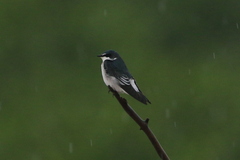
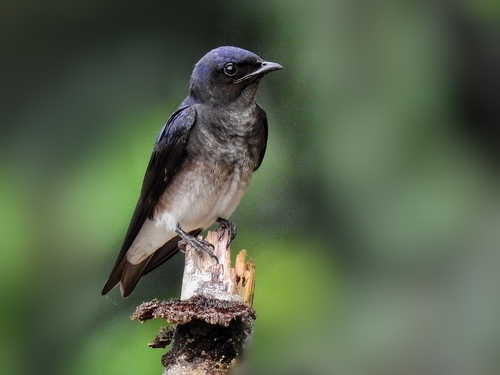
Mangrove Swallow

Mangrove Swallow

Tachycineta albilinea

Silhouette: Andy Wilson · PhyloPic

LCLeast ConcernNTVUENCR
Daily sighting probability <5% · Rare
at Calakmul Biosphere Reserve

In 3 days ~10%

21 Verified sightings at Calakmul Biosphere Reserve From 2019 to 2026
14,355 In all 35 parks
November Best month
☀️ Diurnal When it's spotted

About the Mangrove Swallow

The mangrove swallow (Tachycineta albilinea) is a passerine bird in the swallow family that breeds in coastal regions from Mexico through Central America to Panama. It has blue-green upperparts, blackish flight feathers, a white rump, a black tail, and white underparts. It can be identified by the supraloral white streak, the white line near its eye, which only occurs in two other species of Tachycineta: the violet-green swallow and the white-rumped swallow. The sexes, although similar in plumage, differ slightly in size. The juveniles have grey-brown upperparts and white-washed underparts. This swallow's song is generally described as a soft trilling, with a rolled jeerrt call, and a sharp alarm note.

The mangrove swallow is very territorial when breeding, much like the related tree swallow. Its nest is normally built in a hole or crevice near water and less than 2 metres (7 ft) above the ground. This species usually feeds alone when breeding, but will feed in groups when not. It normally forages closer to the nest when hunting for its chicks, but will go much further when foraging for itself. In between foraging attempts, it is frequently seen perching near water. It is an aerial insectivore and eats unusually large prey for its size.

With an estimated population of at least 500,000 individuals, the mangrove swallow is classified as a species of least concern by the International Union for Conservation of Nature (IUCN). Its numbers are decreasing, although not fast enough for it to be classified as vulnerable. Little is known about the predation of this species, although it is a host of Sternostoma hirundinis, a type of nasal mite. It has also been known to lose nests both to termites and black flies. Wikipedia →

Sounds

Call0:21

Mexico · 2020

© Isain Contreras Rodríguez · XC569588 · CC BY-NC-SA 4.0

Flight call0:06

Mexico · 2020

© Manuel Grosselet · XC531840 · CC BY-NC-SA 4.0

Call1:20

Mexico · 2018

© Richard E. Webster · XC449271 · CC BY-NC-SA 4.0

Global Distribution

Parks Where Found

# Park Country Daily sighting probability
1 Celestún Biosphere Reserve 🇲🇽 Mexico
~50%
2 Tortuguero National Park 🇨🇷 Costa Rica
~40%
3 Carara National Park 🇨🇷 Costa Rica
~40%
4 Soberanía National Park 🇵🇦 Panama
~30%
5 Montes Azules Biosphere Reserve 🇲🇽 Mexico
~30%
6 Ría Lagartos Biosphere Reserve 🇲🇽 Mexico
~30%
7 San Lorenzo Protected Forest 🇵🇦 Panama
~30%
8 Biotopo Cerro Cahuí 🇬🇹 Guatemala
~30%
9 Palo Verde National Park 🇨🇷 Costa Rica
~30%
10 Bastimentos Island National Marine Park 🇵🇦 Panama
~20%
11 Braulio Carrillo National Park 🇨🇷 Costa Rica
~10%
12 Las Baulas Marine National Park 🇨🇷 Costa Rica
~10%
13 Sian Ka'an Biosphere Reserve 🇲🇽 Mexico
~10%
14 Ostional Wildlife Refuge 🇨🇷 Costa Rica
~10%
15 Lago de Yojoa 🇭🇳 Honduras
~10%
16 La Amistad International Park (Panama) 🇵🇦 Panama
~10%
17 Cahuita National Park 🇨🇷 Costa Rica
~10%
18 Coiba National Park 🇵🇦 Panama
~10%
19 Marino Ballena National Park 🇨🇷 Costa Rica
~10%
20 Cañón del Sumidero National Park 🇲🇽 Mexico
<5%
21 Gandoca-Manzanillo Wildlife Refuge 🇨🇷 Costa Rica
<5%
22 Rincón de la Vieja National Park 🇨🇷 Costa Rica
<5%
23 Cerro Azul Meámbar National Park 🇭🇳 Honduras
<5%
24 Piedras Blancas National Park 🇨🇷 Costa Rica
<5%
25 Manuel Antonio National Park 🇨🇷 Costa Rica
<5%
26 Chagres National Park 🇵🇦 Panama
<5%
27 Corcovado National Park 🇨🇷 Costa Rica
<5%
28 Calakmul Biosphere Reserve 🇲🇽 Mexico
<5%
29 Cabo Blanco Absolute Nature Reserve 🇨🇷 Costa Rica
<5%
30 Arenal Volcano National Park 🇨🇷 Costa Rica
<5%
31 Tikal National Park 🇬🇹 Guatemala
<5%
32 Parque Natural Metropolitano 🇵🇦 Panama
<5%
33 Arrecifes de Cozumel National Park 🇲🇽 Mexico
<5%
34 Cockscomb Basin Wildlife Sanctuary 🇧🇿 Belize
<5%
35 Tenorio Volcano National Park 🇨🇷 Costa Rica
<5%

Cities Where Found

# City Country Daily sighting probability
1 San Pedro Sula 🇭🇳 Honduras
~10%
2 Panama City 🇵🇦 Panama
<5%
3 Managua 🇳🇮 Nicaragua
<5%
4 San José 🇨🇷 Costa Rica
<5%
5 Mexico City 🇲🇽 México
<5%

Before you go

What are the chances of seeing a Mangrove Swallow in Calakmul Biosphere Reserve?

Rare

Under 5% of wildlife watchers report a Mangrove Swallow sighting in Calakmul Biosphere Reserve on a given day, based on 21 verified sightings from GBIF citizen-science data from 2019 to 2026. It is the 230th most-seen of the 271 birds we can rate there. Over three days the chance rises to about 10%, if each day is a fresh chance.

When is the best time to see a Mangrove Swallow in Calakmul Biosphere Reserve?

August and November

In those months about 10% of wildlife watchers report a Mangrove Swallow in Calakmul Biosphere Reserve on a given day, against under 5% in September–October and December–July, the lowest months.

What time of day is best to see a Mangrove Swallow?

Between 7 and 10 am

Across all the parks we cover, that three-hour window holds the most Mangrove Swallow sightings with a recorded time, and about 9 in 10 of them come between 6 am and 6 pm: it is a daytime animal.

Which relatives of the Mangrove Swallow live in Calakmul Biosphere Reserve?

Same family: Hirundinidae

The closest relatives of the Mangrove Swallow that you can see in Calakmul Biosphere Reserve (family Hirundinidae, Swallows and Martins) are Gray-breasted Martin (about 10%) and Purple Martin (about 10%), with each one's daily chance of a sighting.

Where does the Mangrove Swallow sighting chance come from?

GBIF citizen-science records

It is estimated from how often the Mangrove Swallow is recorded against all the birds logged in Calakmul Biosphere Reserve (21 verified sightings from 2019 to 2026), calibrated against known sighting rates. Figures are rounded to the nearest 10% because citizen-science data supports honest approximations, not decimals, and months with records from fewer than five people show "—". How it works.

← Back to Calakmul Biosphere Reserve