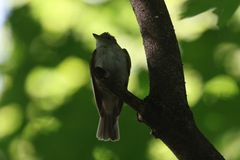
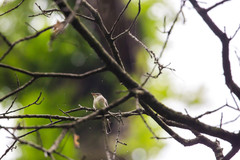
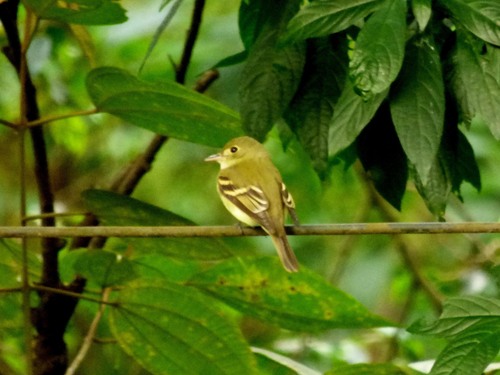
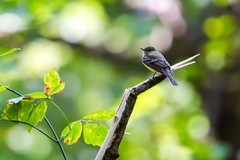
Acadian Flycatcher

Acadian Flycatcher

Empidonax virescens

Silhouette: Emily Willoughby · PhyloPic

LCLeast ConcernNTVUENCR
Daily sighting probability <5% · Rare
at Cerro Azul Meámbar National Park

In 3 days ~10%

17 Verified sightings at Cerro Azul Meámbar National Park From 2019 to 2026
5,926 In all 38 parks
April Best month
☀️ Diurnal When it's spotted

About the Acadian Flycatcher

The Acadian flycatcher (Empidonax virescens) is a small insect-eating bird of the tyrant flycatcher family. Adults have olive upperparts, darker on the wings and tail, with whitish underparts; they have a white eye ring, white wing bars and a wide bill. The breast is washed with olive. The upper part of the bill is dark; the lower part is yellowish. This bird's song is an explosive peet-sa. The call is a soft peet. They also have a call similar to that of the northern flicker. A unique two-note song described as "ka-zeep" helps to identify this species.

Measurements: Length: 5.5–5.9 inches (14–15 cm) Weight: 0.4–0.5 ounces (11–14 g) Wingspan: 8.7–9.1 inches (22–23 cm) Originally described in 1810 by ornithologist Alexander Wilson, its first scientific name was Muscicapa querula. The Acadian flycatcher is the only member of its clade within Empidonax, but is most closely related to willow and alder flycatchers.

Because of the similar appearance of the Empidonax flycatchers, the Acadian flycatcher owes its name to a misidentified type specimen for the species, taken in the historic Acadia region of Nova Scotia. Despite its common name, the Acadian flycatcher... Wikipedia →
Sounds

Recording0:16

Colombia · 2025

© Andrés Mauricio López · XC1064546 · CC BY-NC-SA 4.0

Song0:25

United States · 2025

© Bobby Wilcox · XC1036513 · CC BY-NC-SA 4.0

Call0:32

Ecuador · 2024

© Charlie Vogt · XC950022 · CC BY-NC-SA 4.0

Global Distribution

Parks Where Found

# Park Country Daily sighting probability
1 Congaree National Park 🇺🇸 United States
~30%
2 Darién National Park 🇵🇦 Panama
~20%
3 Shenandoah National Park 🇺🇸 United States
~20%
4 Soberanía National Park 🇵🇦 Panama
~10%
5 Great Smoky Mountains National Park 🇺🇸 United States
~10%
6 San Lorenzo Protected Forest 🇵🇦 Panama
~10%
7 Farallones de Cali National Natural Park 🇨🇴 Colombia
~10%
8 Parque Natural Metropolitano 🇵🇦 Panama
~10%
9 Pico Bonito National Park 🇭🇳 Honduras
~10%
10 Chagres National Park 🇵🇦 Panama
~10%
11 Gandoca-Manzanillo Wildlife Refuge 🇨🇷 Costa Rica
<5%
12 Cahuita National Park 🇨🇷 Costa Rica
<5%
13 Tikal National Park 🇬🇹 Guatemala
<5%
14 Bastimentos Island National Marine Park 🇵🇦 Panama
<5%
15 La Amistad International Park (Panama) 🇵🇦 Panama
<5%
16 Braulio Carrillo National Park 🇨🇷 Costa Rica
<5%
17 Santa Rosa National Park 🇨🇷 Costa Rica
<5%
18 Cerro Azul Meámbar National Park 🇭🇳 Honduras
<5%
19 Arenal Volcano National Park 🇨🇷 Costa Rica
<5%
20 Manuel Antonio National Park 🇨🇷 Costa Rica
<5%
21 Carara National Park 🇨🇷 Costa Rica
<5%
22 Los Nevados National Natural Park 🇨🇴 Colombia
<5%
23 Rincón de la Vieja National Park 🇨🇷 Costa Rica
<5%
24 Tortuguero National Park 🇨🇷 Costa Rica
<5%
25 Lago de Yojoa 🇭🇳 Honduras
<5%
26 Tenorio Volcano National Park 🇨🇷 Costa Rica
<5%
27 Chirripó National Park 🇨🇷 Costa Rica
<5%
28 Volcán Barú National Park 🇵🇦 Panama
<5%
29 Tapantí-Macizo de la Muerte National Park 🇨🇷 Costa Rica
<5%
30 Cockscomb Basin Wildlife Sanctuary 🇧🇿 Belize
<5%
31 Machalilla National Park 🇪🇨 Ecuador
<5%
32 Point Pelee National Park 🇨🇦 Canada
<5%
33 Palo Verde National Park 🇨🇷 Costa Rica
<5%
34 Big Cypress National Preserve 🇺🇸 United States
<5%
35 Piedras Blancas National Park 🇨🇷 Costa Rica
<5%
36 Merritt Island National Wildlife Refuge 🇺🇸 United States
<5%
37 Everglades National Park 🇺🇸 United States
<5%
38 Monteverde Cloud Forest Reserve 🇨🇷 Costa Rica
<5%

Cities Where Found

# City Country Daily sighting probability
1 Medellín 🇨🇴 Colombia
~10%
2 Washington 🇺🇸 United States
~10%
3 Cali 🇨🇴 Colombia
~10%
4 Baltimore 🇺🇸 United States
<5%
5 Orlando 🇺🇸 United States
<5%
6 Houston 🇺🇸 United States
<5%
7 Bogota 🇨🇴 Colombia
<5%
8 Philadelphia 🇺🇸 United States
<5%
9 San José 🇨🇷 Costa Rica
<5%
10 Panama City 🇵🇦 Panama
<5%

Before you go

What are the chances of seeing an Acadian Flycatcher in Cerro Azul Meámbar National Park?

Rare

Under 5% of wildlife watchers report an Acadian Flycatcher sighting in Cerro Azul Meámbar National Park on a given day, based on 17 verified sightings from GBIF citizen-science data from 2019 to 2026. It is the 240th most-seen of the 293 birds we can rate there. Over three days the chance rises to about 10%, if each day is a fresh chance.

When is the best time to see an Acadian Flycatcher in Cerro Azul Meámbar National Park?

April–May and October

In those months about 10% of wildlife watchers report an Acadian Flycatcher in Cerro Azul Meámbar National Park on a given day, against under 5% in June–September and November–March, the lowest months.

What time of day is best to see an Acadian Flycatcher?

Between 9 am and noon

Across all the parks we cover, that three-hour window holds the most Acadian Flycatcher sightings with a recorded time, and about 9 in 10 of them come between 6 am and 6 pm: it is a daytime animal.

Is Cerro Azul Meámbar National Park the best place to see an Acadian Flycatcher?

18th of 38

Of the 38 parks where we can rate Acadian Flycatcher sightings, Cerro Azul Meámbar National Park ranks 18th at under 5%. The best odds are in Congaree National Park (United States, about 30%), Darién National Park (Panama, about 20%) and Shenandoah National Park (United States, about 20%).

Which relatives of the Acadian Flycatcher live in Cerro Azul Meámbar National Park?

Same genus: Empidonax

The closest relatives of the Acadian Flycatcher that you can see in Cerro Azul Meámbar National Park (genus Empidonax, Empidonax Flycatchers) are Yellow-bellied Flycatcher (about 30%) and Least Flycatcher (about 10%), with each one's daily chance of a sighting.

Where does the Acadian Flycatcher sighting chance come from?

GBIF citizen-science records

It is estimated from how often the Acadian Flycatcher is recorded against all the birds logged in Cerro Azul Meámbar National Park (17 verified sightings from 2019 to 2026), calibrated against known sighting rates. Figures are rounded to the nearest 10% because citizen-science data supports honest approximations, not decimals, and months with records from fewer than five people show "—". How it works.

← Back to Cerro Azul Meámbar National Park