Short-billed Pigeon

Short-billed Pigeon

Patagioenas nigrirostris

Silhouette: Ferran Sayol · PhyloPic

LCLeast ConcernNTVUENCR
Daily sighting probability <5% · Rare
at Chirripó National Park

In 3 days ~10%

26 Verified sightings at Chirripó National Park From 2019 to 2026
19,834 In all 32 parks
March Best month
☀️ Diurnal When it's spotted

About the Short-billed Pigeon

The short-billed pigeon (Patagioenas nigrirostris) is a largish pigeon which breeds from southern Mexico south to northwestern Colombia. It is a member of a clade of Patagioenas that contains the smaller and rather plain species with characteristic calls that constitute the subgenus Oenoenas.

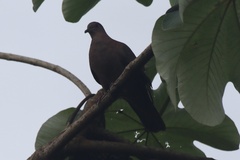
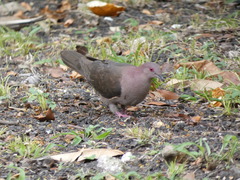
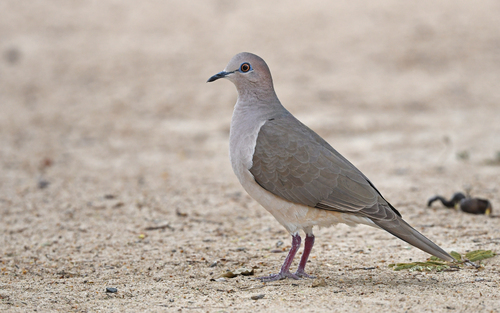
It is found in lowland forest canopy and semi-open woodland, and builds a rudimentary platform nest out of twigs 5–30 m (16–98 ft) high in a tree or amongst vines. It lays one white egg. The short-billed pigeon is 26.5 cm (10.4 in) long and weighs 150 g (5.3 oz). It is unpatterned and mainly wine-purple in colour, becoming browner on the belly and more olive-brown on the back. The tail and primary flight feathers are blackish, the bill is black, and the legs and eyes are purple-red. The female is slightly duller and browner than the male, and the juvenile bird has a greyish brown head, neck and breast, with cinnamon scaling on the head and upperparts.

The short-billed pigeon has a complex, loud and high-pitched call coo... cu-COO k’CO coohoo; this is usually uttered singly or at least with considerable pauses between calls. It is normally sighted in pairs as it forages in the tree tops for mistletoe, fruits and berries, but may also be seen on tracks and roadsides seeking grit or small invertebrates.

In southern Central America, this species is replaced at higher altitudes by its close relative, the very similar ruddy pigeon, Patagioenas subvinacea. They can be distinguished by the slower, more complex "song" of the short-billed pigeon. Wikipedia →

Sounds

Song0:15

Costa Rica · 2022

© Jerome Fischer · XC720632 · CC BY-NC-SA 4.0

Call0:16

Panama · 2021

radrat · XC695657 · CC0

Song0:23

Costa Rica · 2015

© Garry Bakker · XC576863 · CC BY-NC-SA 4.0

Global Distribution

Parks Where Found

# Park Country Daily sighting probability
1 Cockscomb Basin Wildlife Sanctuary 🇧🇿 Belize
~60%
2 Bastimentos Island National Marine Park 🇵🇦 Panama
~50%
3 Corcovado National Park 🇨🇷 Costa Rica
~50%
4 Piedras Blancas National Park 🇨🇷 Costa Rica
~40%
5 Montes Azules Biosphere Reserve 🇲🇽 Mexico
~40%
6 Tortuguero National Park 🇨🇷 Costa Rica
~30%
7 Cahuita National Park 🇨🇷 Costa Rica
~30%
8 Gandoca-Manzanillo Wildlife Refuge 🇨🇷 Costa Rica
~30%
9 Tikal National Park 🇬🇹 Guatemala
~30%
10 Carara National Park 🇨🇷 Costa Rica
~20%
11 Braulio Carrillo National Park 🇨🇷 Costa Rica
~20%
12 San Lorenzo Protected Forest 🇵🇦 Panama
~20%
13 Tenorio Volcano National Park 🇨🇷 Costa Rica
~20%
14 La Amistad International Park (Panama) 🇵🇦 Panama
~20%
15 Chagres National Park 🇵🇦 Panama
~20%
16 Cerro Azul Meámbar National Park 🇭🇳 Honduras
~20%
17 Arenal Volcano National Park 🇨🇷 Costa Rica
~10%
18 Marino Ballena National Park 🇨🇷 Costa Rica
~10%
19 Soberanía National Park 🇵🇦 Panama
~10%
20 Tapantí-Macizo de la Muerte National Park 🇨🇷 Costa Rica
~10%
21 Pico Bonito National Park 🇭🇳 Honduras
~10%
22 Darién National Park 🇵🇦 Panama
~10%
23 Rincón de la Vieja National Park 🇨🇷 Costa Rica
<5%
24 Manuel Antonio National Park 🇨🇷 Costa Rica
<5%
25 Calakmul Biosphere Reserve 🇲🇽 Mexico
<5%
26 Chirripó National Park 🇨🇷 Costa Rica
<5%
27 Cusuco National Park 🇭🇳 Honduras
<5%
28 Lago de Yojoa 🇭🇳 Honduras
<5%
29 Poás Volcano National Park 🇨🇷 Costa Rica
<5%
30 Volcán Barú National Park 🇵🇦 Panama
<5%
31 Parque Natural Metropolitano 🇵🇦 Panama
<5%
32 Monteverde Cloud Forest Reserve 🇨🇷 Costa Rica
<5%

Cities Where Found

# City Country Daily sighting probability
1 San José 🇨🇷 Costa Rica
<5%
2 Panama City 🇵🇦 Panama
<5%

Before you go

What are the chances of seeing a Short-billed Pigeon in Chirripó National Park?

Rare

Under 5% of wildlife watchers report a Short-billed Pigeon sighting in Chirripó National Park on a given day, based on 26 verified sightings from GBIF citizen-science data from 2019 to 2026. It is the 224th most-seen of the 332 birds we can rate there. Over three days the chance rises to about 10%, if each day is a fresh chance.

When is the best time to see a Short-billed Pigeon in Chirripó National Park?

Any time of year

In every month with enough records, under 5% of wildlife watchers report a Short-billed Pigeon in Chirripó National Park on a given day, so our monthly data shows no clear season.

What time of day is best to see a Short-billed Pigeon?

Between 6 and 9 am

Across all the parks we cover, that three-hour window holds the most Short-billed Pigeon sightings with a recorded time, and about 9 in 10 of them come between 6 am and 6 pm: it is a daytime animal.

Which relatives of the Short-billed Pigeon live in Chirripó National Park?

Same genus: Patagioenas

The closest relatives of the Short-billed Pigeon that you can see in Chirripó National Park (genus Patagioenas, New World Pigeons) are Ruddy Pigeon (about 20%), Scaled Pigeon (about 10%) and Band-tailed Pigeon (about 10%), with each one's daily chance of a sighting.

Where does the Short-billed Pigeon sighting chance come from?

GBIF citizen-science records

It is estimated from how often the Short-billed Pigeon is recorded against all the birds logged in Chirripó National Park (26 verified sightings from 2019 to 2026), calibrated against known sighting rates. Figures are rounded to the nearest 10% because citizen-science data supports honest approximations, not decimals, and months with records from fewer than five people show "—". How it works.

← Back to Chirripó National Park