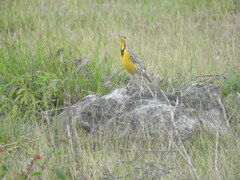
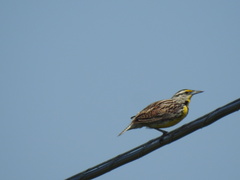
Eastern Meadowlark

Eastern Meadowlark

Sturnella magna

Silhouette: Sheatherius · PhyloPic

LCNTNear ThreatenedVUENCR
Daily sighting probability <5% · Rare
at Boston

In 3 days <5%

27 Verified sightings at Boston
7,677 In all 36 parks From 2019 to 2026
October Best month
☀️ Diurnal When it's spotted

About the Eastern Meadowlark

The eastern meadowlark (Sturnella magna) is a medium-sized icterid bird, very similar in appearance to its sister species, the western meadowlark. It occurs from eastern North America to northern South America, where it is also most widespread in the east. The Chihuahuan meadowlark was formerly considered to be conspecific with the eastern meadowlark.

The eastern meadowlark was formally described by the Swedish naturalist Carl Linnaeus in 1758 in the tenth edition of his Systema Naturae. He placed it with the larks and pipits in the genus Alauda and adopted the binomial name Alauda magna. Linnaeus based his description on the "large lark" that had been described and illustrated in 1729–1732 by the English naturalist Mark Catesby. Catesby also used the Latin Alauda magna but as his book predates the introduction of the binomial system, he is not acknowledged as the authority. Catesby reported that "they inhabit Carolina, Virginia and most of the Northern continent of America." Confusingly, Linnaeus specified the habitat as "America, Africa". The type location was restricted to South Carolina by the American Ornithologist's Union in 1931. The eastern meadowlark is now placed... Wikipedia →

Sounds

Call0:12

Mexico · 2026

© Manuel Grosselet · XC1084543 · CC BY-NC-SA 4.0

Song0:20

Mexico · 2026

© Manuel Grosselet-Edgar del valle-Rebeca Martinez · XC1070675 · CC BY-NC-SA 4.0

Alarm call0:27

Colombia · 2021

© Mauricio Cuellar Ramirez (@Birding.travel) · XC695089 · CC BY-NC-SA 4.0

Global Distribution

Parks Where Found

# Park Country Daily sighting probability
1 Padre Island National Seashore 🇺🇸 United States
~40%
2 Everglades National Park 🇺🇸 United States
~20%
3 Chingaza National Natural Park 🇨🇴 Colombia
~20%
4 Sierra de la Macarena National Park 🇨🇴 Colombia
~20%
5 Big Cypress National Preserve 🇺🇸 United States
~20%
6 Great Smoky Mountains National Park 🇺🇸 United States
~20%
7 Irazú Volcano National Park 🇨🇷 Costa Rica
~10%
8 Celaque National Park 🇭🇳 Honduras
~10%
9 Palo Verde National Park 🇨🇷 Costa Rica
~10%
10 Rincón de la Vieja National Park 🇨🇷 Costa Rica
~10%
11 Poás Volcano National Park 🇨🇷 Costa Rica
~10%
12 Montes Azules Biosphere Reserve 🇲🇽 Mexico
~10%
13 Los Nevados National Natural Park 🇨🇴 Colombia
<5%
14 Piedras Blancas National Park 🇨🇷 Costa Rica
<5%
15 La Amistad International Park (Panama) 🇵🇦 Panama
<5%
16 Braulio Carrillo National Park 🇨🇷 Costa Rica
<5%
17 Shenandoah National Park 🇺🇸 United States
<5%
18 Merritt Island National Wildlife Refuge 🇺🇸 United States
<5%
19 Congaree National Park 🇺🇸 United States
<5%
20 Santa Rosa National Park 🇨🇷 Costa Rica
<5%
21 Las Baulas Marine National Park 🇨🇷 Costa Rica
<5%
22 Bastimentos Island National Marine Park 🇵🇦 Panama
<5%
23 Point Pelee National Park 🇨🇦 Canada
<5%
24 Gandoca-Manzanillo Wildlife Refuge 🇨🇷 Costa Rica
<5%
25 Chagres National Park 🇵🇦 Panama
<5%
26 Ciénaga de Zapata 🇨🇺 Cuba
<5%
27 Volcán Barú National Park 🇵🇦 Panama
<5%
28 Tenorio Volcano National Park 🇨🇷 Costa Rica
<5%
29 Carara National Park 🇨🇷 Costa Rica
<5%
30 Chirripó National Park 🇨🇷 Costa Rica
<5%
31 Monteverde Cloud Forest Reserve 🇨🇷 Costa Rica
<5%
32 Tortuguero National Park 🇨🇷 Costa Rica
<5%
33 Arenal Volcano National Park 🇨🇷 Costa Rica
<5%
34 Parque Natural Metropolitano 🇵🇦 Panama
<5%
35 Tapantí-Macizo de la Muerte National Park 🇨🇷 Costa Rica
<5%
36 Los Quetzales National Park 🇨🇷 Costa Rica
<5%

Cities Where Found

# City Country Daily sighting probability
1 San Pedro Sula 🇭🇳 Honduras
~20%
2 Bogota 🇨🇴 Colombia
~20%
3 Havana 🇨🇺 Cuba
~10%
4 San José 🇨🇷 Costa Rica
<5%
5 Chicago 🇺🇸 United States
<5%
6 Dallas 🇺🇸 United States
<5%
7 Detroit 🇺🇸 United States
<5%
8 Washington 🇺🇸 United States
<5%
9 Baltimore 🇺🇸 United States
<5%
10 Houston 🇺🇸 United States
<5%

Before you go

What are the chances of seeing an Eastern Meadowlark in Boston?

Rare

Under 5% of wildlife watchers report an Eastern Meadowlark sighting in Boston on a given day, based on 27 verified sightings from GBIF citizen-science data. It is the 258th most-seen of the 283 birds we can rate there. Over three days the chance rises to under 5%, if each day is a fresh chance.

When is the best time to see an Eastern Meadowlark in Boston?

Any time of year

In every month with enough records, under 5% of wildlife watchers report an Eastern Meadowlark in Boston on a given day, so our monthly data shows no clear season.

What time of day is best to see an Eastern Meadowlark?

Between 8 and 11 am

Across all the parks we cover, that three-hour window holds the most Eastern Meadowlark sightings with a recorded time, and about 8 in 10 of them come between 6 am and 6 pm: it is a daytime animal.

Is Boston the best place to see an Eastern Meadowlark?

20th of 21

Of the 21 cities where we can rate Eastern Meadowlark sightings, Boston ranks 20th at under 5%. The best odds are in San Pedro Sula (Honduras, about 20%), Bogota (Colombia, about 20%) and Havana (Cuba, about 10%).

Which relatives of the Eastern Meadowlark live in Boston?

Same family: Icteridae

The closest relatives of the Eastern Meadowlark that you can see in Boston (family Icteridae, New World Blackbirds and Orioles) are Common Grackle (about 50%), Red-winged Blackbird (about 50%) and Baltimore Oriole (about 20%), with each one's daily chance of a sighting.

Where does the Eastern Meadowlark sighting chance come from?

GBIF citizen-science records

It is estimated from how often the Eastern Meadowlark is recorded against all the birds logged in Boston (27 verified sightings), calibrated against known sighting rates. Figures are rounded to the nearest 10% because citizen-science data supports honest approximations, not decimals, and months with records from fewer than five people show "—". How it works.

← Back to Boston