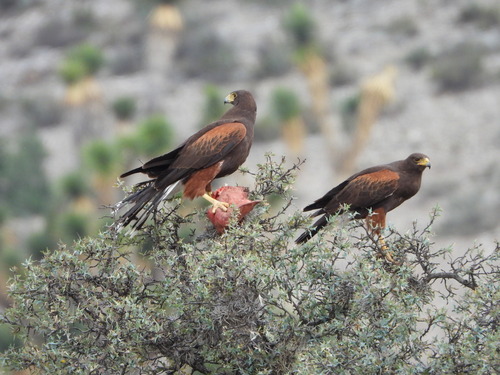
Common Black-Hawk

Common Black-Hawk

Buteogallus anthracinus

Silhouette: Sheatherius · PhyloPic

LCLeast ConcernNTVUENCR
Daily sighting probability ~10% · With luck
at Maracaibo

In 3 days ~10% in a week ~30%

17 Verified sightings at Maracaibo
16,914 In all 40 parks From 2019 to 2026
November Best month
☀️ Diurnal When it's spotted

About the Common Black-Hawk

The common black hawk (Buteogallus anthracinus) is a bird of prey in the family Accipitridae, which also includes the eagles, hawks, and vultures. The adult common black-hawk is 43–53 cm (17–21 in) long and weighs 930 g (33 oz) on average. It has very broad wings, and is mainly black or dark gray. The short tail is black with a single broad white band and a white tip. The bill is black and the legs and cere are yellow. The adults resemble zone-tailed hawks, but have fewer white bars on their tail and are larger in size.

Sexes are similar, but immature birds are dark brown above with spotting and streaks. Their underparts are buff to whitish with dark blotches, and the tail has a number of black and white bars. It formerly included the Cuban black-hawk (Buteogallus gundlachii) as a subspecies. The mangrove black hawk, traditionally considered a distinct species, is now generally considered a subspecies, B. a. subtilis, of the common black-hawk.

The common black-hawk is a breeding bird in the warmer parts of the Americas, from the Southwestern United States through Central America to Venezuela, Peru, Trinidad, and the Lesser... Wikipedia →

Sounds

Call0:09

Costa Rica · 2017

© Albert Lastukhin · XC1094583 · CC BY-NC-ND 4.0

Song0:17

Venezuela · 2023

© Francisco contreras · XC858937 · CC BY-NC-SA 4.0

Flight call0:39

Colombia · 2023

© Laura Franco · XC802323 · CC BY-NC-SA 4.0

Global Distribution

Parks Where Found

# Park Country Daily sighting probability
1 Ría Lagartos Biosphere Reserve 🇲🇽 Mexico
~50%
2 Coiba National Park 🇵🇦 Panama
~50%
3 Bastimentos Island National Marine Park 🇵🇦 Panama
~40%
4 Gandoca-Manzanillo Wildlife Refuge 🇨🇷 Costa Rica
~40%
5 Corcovado National Park 🇨🇷 Costa Rica
~40%
6 Ostional Wildlife Refuge 🇨🇷 Costa Rica
~40%
7 Las Baulas Marine National Park 🇨🇷 Costa Rica
~40%
8 Tortuguero National Park 🇨🇷 Costa Rica
~40%
9 Carara National Park 🇨🇷 Costa Rica
~40%
10 Utría National Natural Park 🇨🇴 Colombia
~30%
11 Celestún Biosphere Reserve 🇲🇽 Mexico
~30%
12 Cabo Blanco Absolute Nature Reserve 🇨🇷 Costa Rica
~30%
13 Cahuita National Park 🇨🇷 Costa Rica
~30%
14 Tayrona National Natural Park 🇨🇴 Colombia
~30%
15 Marino Ballena National Park 🇨🇷 Costa Rica
~30%
16 Caroni Swamp 🇹🇹 Trinidad and Tobago
~20%
17 La Amistad International Park (Panama) 🇵🇦 Panama
~20%
18 Santa Rosa National Park 🇨🇷 Costa Rica
~20%
19 Manuel Antonio National Park 🇨🇷 Costa Rica
~20%
20 Darién National Park 🇵🇦 Panama
~10%
21 San Lorenzo Protected Forest 🇵🇦 Panama
~10%
22 Palo Verde National Park 🇨🇷 Costa Rica
~10%
23 Big Bend National Park 🇺🇸 United States
~10%
24 Celaque National Park 🇭🇳 Honduras
~10%
25 Sian Ka'an Biosphere Reserve 🇲🇽 Mexico
~10%
26 Cumbres de Monterrey National Park 🇲🇽 Mexico
~10%
27 Henri Pittier National Park 🇻🇪 Venezuela
~10%
28 Tapantí-Macizo de la Muerte National Park 🇨🇷 Costa Rica
~10%
29 Zion National Park 🇺🇸 United States
<5%
30 La Tigra National Park 🇭🇳 Honduras
<5%
31 Piedras Blancas National Park 🇨🇷 Costa Rica
<5%
32 Soberanía National Park 🇵🇦 Panama
<5%
33 Lago de Yojoa 🇭🇳 Honduras
<5%
34 Parque Natural Metropolitano 🇵🇦 Panama
<5%
35 Chagres National Park 🇵🇦 Panama
<5%
36 Cerro Azul Meámbar National Park 🇭🇳 Honduras
<5%
37 Pico Bonito National Park 🇭🇳 Honduras
<5%
38 Tikal National Park 🇬🇹 Guatemala
<5%
39 Saguaro National Park 🇺🇸 United States
<5%
40 Braulio Carrillo National Park 🇨🇷 Costa Rica
<5%

Cities Where Found

# City Country Daily sighting probability
1 Panama City 🇵🇦 Panama
~10%
2 Maracaibo 🇻🇪 Venezuela
~10%
3 Monterrey 🇲🇽 México
~10%
4 Guadalajara 🇲🇽 México
<5%
5 Tegucigalpa 🇭🇳 Honduras
<5%
6 Mexico City 🇲🇽 México
<5%
7 Caracas 🇻🇪 Venezuela
<5%
8 San Salvador 🇸🇻 El Salvador
<5%
9 San José 🇨🇷 Costa Rica
<5%
10 Phoenix 🇺🇸 United States
<5%

Zoos & Centres Where Found

# Zoo / Centre Country
1 Knowsley Safari Park 🇬🇧 United Kingdom In captivity
2 São Paulo Zoo 🇧🇷 Brazil In captivity
3 Xcaret 🇲🇽 Mexico In captivity
4 Aviario Nacional de Colombia 🇨🇴 Colombia In captivity
5 Zoológico Thomas Belt 🇳🇮 Nicaragua In captivity
6 El Nispero Zoo 🇵🇦 Panama In captivity
7 Seaside Seabird Sanctuary 🇺🇸 United States In captivity
8 Zoológico Miguél Álvarez del Toro 🇲🇽 Mexico In captivity

Before you go

What are the chances of seeing a Common Black-Hawk in Maracaibo?

With luck

About 10% of wildlife watchers report a Common Black-Hawk sighting in Maracaibo on a given day, based on 17 verified sightings from GBIF citizen-science data. It is the 55th most-seen of the 89 birds we can rate there. Over three days the chance rises to about 10%, and over a week to about 30%, if each day is a fresh chance.

When is the best time to see a Common Black-Hawk in Maracaibo?

May and October–November

In those months about 10% of wildlife watchers report a Common Black-Hawk in Maracaibo on a given day, against under 5% in June–September and December–April, the lowest months. Those are among Maracaibo's wettest months, with about 110 mm of rain a month against 5 mm in February.

What time of day is best to see a Common Black-Hawk?

Between 9 am and noon

Across all the parks we cover, that three-hour window holds the most Common Black-Hawk sightings with a recorded time, and about 9 in 10 of them come between 6 am and 6 pm: it is a daytime animal.

Is Maracaibo the best place to see a Common Black-Hawk?

Among the best

Of the 10 cities where we can rate Common Black-Hawk sightings, Maracaibo ranks 2nd at about 10%, level with the leaders once rounded. The best odds are in Panama City (Panama, about 10%).

Which relatives of the Common Black-Hawk live in Maracaibo?

Same family: Accipitridae

The closest relatives of the Common Black-Hawk that you can see in Maracaibo (family Accipitridae, Hawks, Eagles, and Kites) are Pearl Kite (about 10%) and Harris' Hawk (about 10%), with each one's daily chance of a sighting.

Where does the Common Black-Hawk sighting chance come from?

GBIF citizen-science records

It is estimated from how often the Common Black-Hawk is recorded against all the birds logged in Maracaibo (17 verified sightings), calibrated against known sighting rates. Figures are rounded to the nearest 10% because citizen-science data supports honest approximations, not decimals, and months with records from fewer than five people show "—". How it works.

← Back to Maracaibo