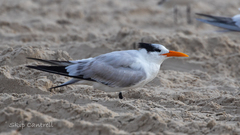

Royal Tern

Royal Tern

Thalasseus maximus

Silhouette: Andy Wilson · PhyloPic

LCLeast ConcernNTVUENCR
Daily sighting probability ~20% · Possible
at San Diego

In 3 days ~50% in a week ~80%

10,508 Verified sightings at San Diego
23,424 In all 42 parks From 2019 to 2026
July Best month
☀️ Diurnal When it's spotted

About the Royal Tern

The royal tern (Thalasseus maximus) is a tern in the family Laridae. The species is endemic to the Americas, though vagrants have been identified in Europe. The royal tern was described by the French polymath Georges-Louis Leclerc, Comte de Buffon in 1781 in his Histoire Naturelle des Oiseaux from a specimen collected in Cayenne, French Guiana. The bird was also illustrated in a hand-colored plate engraved by François-Nicolas Martinet in the Planches Enluminées D'Histoire Naturelle which was produced under the supervision of Edme-Louis Daubenton to accompany Buffon's text. Neither the plate caption nor Buffon's description included a scientific name but in 1783 the Dutch naturalist Pieter Boddaert coined the binomial name Sterna maxima in his catalogue of the Planches Enluminées. The royal tern is now placed in the genus Thalasseus that was erected by the German zoologist Friedrich Boie in 1822.

The generic name is derived from the Ancient Greek θάλασσα (thálassa) meaning "sea". The specific epithet maximus is Latin for "greatest". The royal tern belongs to the class Aves and the order Charadriiformes. Charadriiformes includes seabirds and shorebirds of small to medium... Wikipedia →

Sounds

Call0:28

United States · 2024

© Nancy Salem · XC927228 · CC BY-NC-SA 4.0

Song0:31

United States · 2022

© William Whitehead · XC741616 · CC BY-NC-ND 4.0

Flight call0:22

Mexico · 2020

© Manuel Grosselet · XC574454 · CC BY-NC-SA 4.0

Global Distribution

Parks Where Found

# Park Country Daily sighting probability
1 Padre Island National Seashore 🇺🇸 United States
~80%
2 Ría Lagartos Biosphere Reserve 🇲🇽 Mexico
~80%
3 Jaragua National Park 🇩🇴 Dominican Republic
~50%
4 Merritt Island National Wildlife Refuge 🇺🇸 United States
~40%
5 Celestún Biosphere Reserve 🇲🇽 Mexico
~40%
6 Ciénaga de Zapata 🇨🇺 Cuba
~40%
7 Península Valdés 🇦🇷 Argentina
~40%
8 Ostional Wildlife Refuge 🇨🇷 Costa Rica
~30%
9 Cabo Blanco Absolute Nature Reserve 🇨🇷 Costa Rica
~30%
10 Los Haitises National Park 🇩🇴 Dominican Republic
~30%
11 Bastimentos Island National Marine Park 🇵🇦 Panama
~30%
12 Bahía de Loreto National Park 🇲🇽 Mexico
~30%
13 El Vizcaíno Biosphere Reserve 🇲🇽 Mexico
~30%
14 Las Baulas Marine National Park 🇨🇷 Costa Rica
~30%
15 Biotopo Cerro Cahuí 🇬🇹 Guatemala
~30%
16 Arrecifes de Cozumel National Park 🇲🇽 Mexico
~30%
17 Carara National Park 🇨🇷 Costa Rica
~20%
18 Sian Ka'an Biosphere Reserve 🇲🇽 Mexico
~20%
19 Utría National Natural Park 🇨🇴 Colombia
~20%
20 Coiba National Park 🇵🇦 Panama
~20%
21 Everglades National Park 🇺🇸 United States
~20%
22 Cahuita National Park 🇨🇷 Costa Rica
~20%
23 La Amistad International Park (Panama) 🇵🇦 Panama
~20%
24 Tortuguero National Park 🇨🇷 Costa Rica
~10%
25 Channel Islands National Park 🇺🇸 United States
~10%
26 San Lorenzo Protected Forest 🇵🇦 Panama
~10%
27 Tayrona National Natural Park 🇨🇴 Colombia
~10%
28 Main Ridge Forest Reserve 🇹🇹 Trinidad and Tobago
~10%
29 Marino Ballena National Park 🇨🇷 Costa Rica
~10%
30 Palo Verde National Park 🇨🇷 Costa Rica
~10%
31 Big Cypress National Preserve 🇺🇸 United States
~10%
32 Machalilla National Park 🇪🇨 Ecuador
~10%
33 Gandoca-Manzanillo Wildlife Refuge 🇨🇷 Costa Rica
~10%
34 Santa Rosa National Park 🇨🇷 Costa Rica
~10%
35 Corcovado National Park 🇨🇷 Costa Rica
~10%
36 Piedras Blancas National Park 🇨🇷 Costa Rica
<5%
37 Soberanía National Park 🇵🇦 Panama
<5%
38 Henri Pittier National Park 🇻🇪 Venezuela
<5%
39 Galápagos Islands 🇪🇨 Ecuador
<5%
40 Manuel Antonio National Park 🇨🇷 Costa Rica
<5%
41 Chagres National Park 🇵🇦 Panama
<5%
42 Parque Natural Metropolitano 🇵🇦 Panama
<5%

Cities Where Found

# City Country Daily sighting probability
1 Havana 🇨🇺 Cuba
~30%
2 San Diego 🇺🇸 United States
~20%
3 Montevideo 🇺🇾 Uruguay
~20%
4 Miami 🇺🇸 United States
~10%
5 Panama City 🇵🇦 Panama
~10%
6 Tijuana 🇲🇽 México
~10%
7 Santo Domingo 🇩🇴 Dominican Republic
~10%
8 Los Angeles 🇺🇸 United States
<5%
9 Vitória 🇧🇷 Brazil
<5%
10 Barranquilla 🇨🇴 Colombia
<5%

Zoos & Centres Where Found

# Zoo / Centre Country
1 Downtown Aquarium, Denver 🇺🇸 United States In captivity

Before you go

What are the chances of seeing a Royal Tern in San Diego?

Possible

About 20% of wildlife watchers report a Royal Tern sighting in San Diego on a given day, based on 10,508 verified sightings from GBIF citizen-science data. It is the 34th most-seen of the 386 birds we can rate there. Over three days the chance rises to about 50%, and over a week to about 80%, if each day is a fresh chance.

When is the best time to see a Royal Tern in San Diego?

January–February and July–August

In those months about 30% of wildlife watchers report a Royal Tern in San Diego on a given day, against about 10% in May, the lowest month.

What time of day is best to see a Royal Tern?

Between 7 and 10 am

Across all the parks we cover, that three-hour window holds the most Royal Tern sightings with a recorded time, and about 9 in 10 of them come between 6 am and 6 pm: it is a daytime animal.

Is San Diego the best place to see a Royal Tern?

2nd of 20

Of the 20 cities where we can rate Royal Tern sightings, San Diego ranks 2nd at about 20%. The best odds are in Havana (Cuba, about 30%).

Where does the Royal Tern sighting chance come from?

GBIF citizen-science records

It is estimated from how often the Royal Tern is recorded against all the birds logged in San Diego (10,508 verified sightings), calibrated against known sighting rates. Figures are rounded to the nearest 10% because citizen-science data supports honest approximations, not decimals, and months with records from fewer than five people show "—". How it works.

← Back to San Diego